
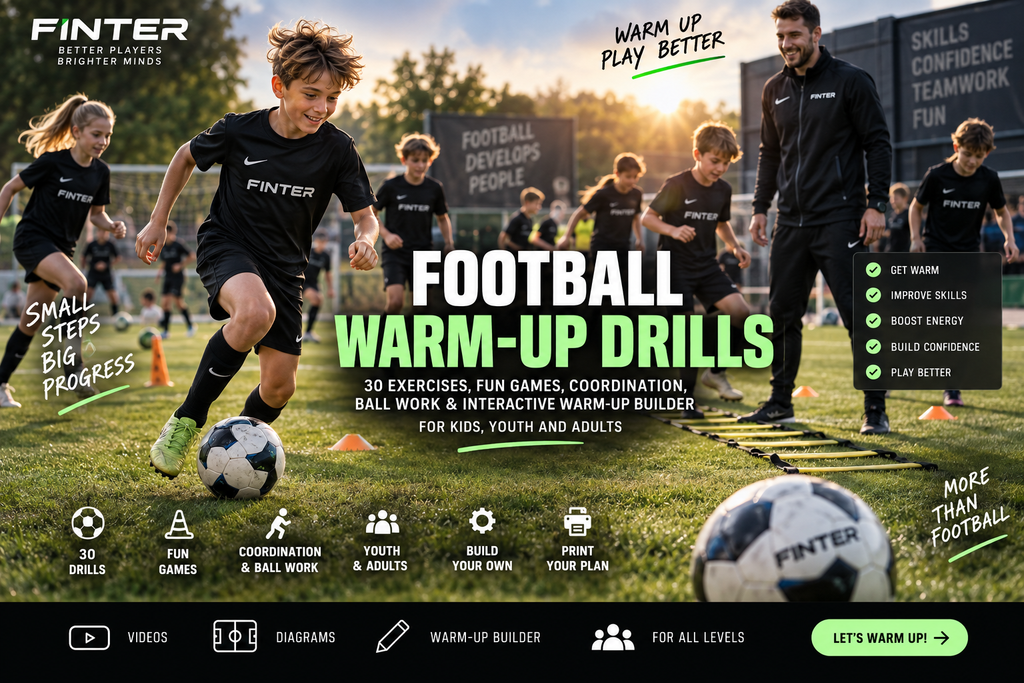
Football Warm-Up Drills – 30 Exercises, Games, Coordination & Your Own Warm-Up Builder
Build your own football warm-up by combining drills, or let FINTER create one for you.
Fun games, ball work, coordination, scanning, passing, dribbling, 1v1s, rondos, small-sided games and match-ready progression are all collected in one place.
The FINTER model: ACTIVATE → MOVE → BALL → COORDINATION → REACT → BUILD INTENSITY → BECOME MATCH-READY.
🧩 FINTER Warm-Up Builder – Create Your Own Football Warm-Up
This is the main tool: choose drills from the library, put them in the order you want, adjust the minutes and print your finished warm-up plan.
Free Dribbling
How it works: Every player has a ball and dribbles freely. Use small touches and the whole area.
Focus: Lots of touches, both feet, eyes up.
Make it harder: On the coach’s signal: turn, change speed or switch foot.
Coaching: Can you keep the ball close while still seeing the other players?
Traffic Lights
How it works: Green = dribble, yellow = slow down, red = stop. Add blue = turn.
Focus: Reaction, ball control, stopping and starting.
Make it harder: Let a player control the traffic lights or add more colour commands.
Coaching: React quickly without losing control of the ball.
Tail Tag
How it works: Each player tucks a bib into the back of their shorts as a tail. Collect tails without losing your own.
Focus: Reaction, acceleration, changes of direction, awareness.
Make it harder: Add safe zones or work in short 30–45 second rounds.
Coaching: Look up and change direction before the opponent reaches you.
Tail Tag with a Ball
How it works: Every player has a ball and a tail. Protect both at the same time.
Focus: Coordination, scanning, dribbling, body control.
Make it harder: Use only the weaker foot or award a bonus for winning a tail after a feint.
Coaching: Keep the ball close enough that you can still scan around you.
Ball Tag
How it works: Everyone except one player has a ball. The tagger tries to touch a dribbling player; the tagged player becomes a tagger too.
Focus: Dribbling, awareness, acceleration, fun.
Make it harder: Start with two taggers or reduce the area.
Coaching: Use changes of direction and speed, not just straight-line pace.
Freeze Tag with a Ball
How it works: When a player is tagged, they freeze. A teammate releases them by passing the ball through their legs.
Focus: Teamwork, passing, awareness, movement.
Make it harder: Release with the weaker foot or require eye contact before the pass.
Coaching: See who needs help, not only your own ball.
Ball Mastery
How it works: Work for 30 seconds per move: inside-inside, outside touches, sole taps, sole rolls and V-pulls.
Focus: Footwork, rhythm, feel for the ball.
Make it harder: Increase tempo, use the weaker foot, look up or combine two movements.
Coaching: Quality and rhythm before maximum speed.
Mirror Without a Ball
How it works: Work in pairs. Player A leads with side, forward and backward movements; Player B mirrors.
Focus: Reaction, coordination, body control.
Make it harder: Reduce the distance, increase the speed or use 20-second duels.
Coaching: Stay low and make controlled changes of direction.
Mirror with a Ball
How it works: Both players have a ball. Player A chooses the movements and direction; Player B copies.
Focus: Coordination, ball control and scanning.
Make it harder: Add feints or change leader on the coach’s signal.
Coaching: Use quick glances between your partner and the ball instead of staring down.
Passing in Pairs
How it works: Pass back and forth using both feet. Take the first touch away from the feet before the next pass.
Focus: Passing quality, first touch, rhythm.
Make it harder: Scan before receiving or receive with one foot and pass with the other.
Coaching: Open your body and make the next action easier.
Pass + Move
How it works: Use 3–4 players in a triangle. Pass and move immediately to a new position.
Focus: Passing, movement, angles, scanning.
Make it harder: Use two balls, one-touch play or receive on the back foot.
Coaching: PASS → MOVE. Create a new angle after every pass.
Colour Scan
How it works: The player scans before receiving and calls out the colour shown by the coach or partner.
Focus: Scanning, first touch, attention.
Make it harder: Make the colour also determine the direction of the first touch.
Coaching: Scan early, not only when the ball is already arriving.
3v1 Rondo
How it works: Three players keep the ball against one defender. Change defender after a regain or after a set time.
Focus: Passing, scanning, support angles, pressing.
Make it harder: Reduce the area, use a two-touch maximum or award a bonus for a split pass.
Coaching: Create a triangle and become available before the player on the ball runs out of options.
4v2 Rondo
How it works: Four players keep the ball against two defenders. Work in short, intense intervals.
Focus: Decision-making, scanning, positioning, pressing.
Make it harder: Two-touch, smaller area or a point for eight consecutive passes.
Coaching: Move before the pass, not after it.
1v1 Through Two Gates
How it works: The attacker scores by dribbling through either of two gates while the defender protects both.
Focus: 1v1, feints, changes of speed, defensive reactions.
Make it harder: Use smaller gates, add a time limit or start with a pass from the defender.
Coaching: Attacker: move the defender before you accelerate.
2v2 Lightning Game
How it works: Play 30–60 second games and rotate new teams in immediately.
Focus: Lots of actions, accelerations, duels and decisions.
Make it harder: Award a bonus for a goal after a 1v1 or cap each game at 60 seconds.
Coaching: React quickly after losing or winning the ball.
3v3 Lightning Game
How it works: Play short 3v3 games to mini-goals with high activity and minimal breaks.
Focus: Match tempo, decisions, communication.
Make it harder: Use four goals or award a bonus for a turn or successful 1v1.
Coaching: Let the players solve the game rather than stopping it constantly.
Acceleration on Signal
How it works: Jog or move actively. On the signal, accelerate for 5–10 metres.
Focus: Gradual acceleration, reaction.
Make it harder: Use different starting positions or a direction cue before the sprint.
Coaching: Build intensity gradually; the first repetitions are not maximal.
Change of Direction on Signal
How it works: Move forward. A signal determines left, right or a turn.
Focus: Deceleration, reaction, change of direction.
Make it harder: Add a ball after 1–2 rounds.
Coaching: Brake under control before accelerating again.
Finish After Movement
How it works: Short movement → pass → first touch → finish.
Focus: Match-ready technique, timing, finishing.
Make it harder: Finish with both feet or after a change of direction.
Coaching: Control the first touch and the finish becomes easier.
Single-Leg Balance + Ball
How it works: Stand on one leg for 5–10 seconds, receive and return a gentle pass, then switch legs.
Focus: Balance, stability, body control.
Make it harder: Add a small hop before landing or rotate slightly before receiving.
Coaching: Land and stabilise first; do not chase difficulty for its own sake.
Cross-Coordination
How it works: Jog forward: right knee to left hand, then left knee to right hand.
Focus: Rhythm, motor control, whole-body coordination.
Make it harder: Add a ball on the way back or finish with an acceleration.
Coaching: RHYTHM BEFORE SPEED.
Jump + Stable Landing
How it works: Use small forward or lateral jumps. Land under control and hold the position briefly.
Focus: Landing, balance, control.
Make it harder: After landing, react to a signal with a sprint or ball reception.
Coaching: Stabilise the landing before the next movement.
Quick Feet + Ball
How it works: Use quick, short foot placements through markers and move directly into a ball action.
Focus: Footwork, rhythm, transition into football.
Make it harder: Finish with a pass, dribble or first touch.
Coaching: The ladder or markers are the start; the football action is the goal.
Agility Ladder + Pass
How it works: Move through the ladder with controlled footwork → receive → pass → jog back.
Focus: Coordination linked to technique.
Make it harder: Change the footwork pattern, passing foot or add a scan before receiving.
Coaching: Get your feet underneath you and become ready for the ball quickly.
Y Change of Direction
How it works: The player runs toward the centre. A signal or colour decides the left or right branch.
Focus: Reaction, deceleration, acceleration.
Make it harder: Add a ball or a partner as a passive defender.
Coaching: Lower your centre of gravity before changing direction.
Accelerate → Stop → New Direction
How it works: Jog → accelerate → controlled stop → change direction → accelerate again.
Focus: Acceleration and deceleration.
Make it harder: Add a ball in the second round or react to the coach’s signal.
Coaching: Football also demands the ability to stop efficiently.
Dribble Tag
How it works: Everyone has a ball. One or two taggers try to touch players while everybody dribbles.
Focus: Dribbling, scanning, reaction, fun.
Make it harder: Reduce the area or add a safe zone for a maximum of three seconds.
Coaching: Look up and use changes of direction, not only straight-line running.
King of the Area
How it works: Protect your own ball while trying to knock other players’ balls out. Retrieve the ball quickly and re-enter.
Focus: Ball protection, 1v1, awareness.
Make it harder: Use only the weaker foot or score points instead of eliminating players.
Coaching: Use your body to protect the ball and keep it on the foot furthest from pressure.
Number Duel
How it works: Give players on two teams matching numbers. The coach calls a number and those two players enter for a 1v1.
Focus: Reaction, duelling, finishing, competition.
Make it harder: Call two numbers for 2v2 or serve the ball from different angles.
Coaching: React quickly, but see the ball and opponent before your first action.
⚡ Create a Football Warm-Up Automatically
Want a quick suggestion? Choose the framework and FINTER will select a balanced sequence for you.
🧪 FINTER Warm-Up Rating /100
Rate your warm-up against 10 key principles.
Tick the boxes above.
👣 Coordination Belongs in the Warm-Up – Link It to Football
Coordination underpins many football actions: balance, rhythm, footwork, body control, reaction and the ability to decelerate and change direction. The goal is not isolated ladder work for its own sake; build from movement control into a ball action, a decision and eventually the game.
Balance
Single-leg work, controlled landings and stability before the next action.
Rhythm
Cross-coordination and footwork: rhythm before speed.
Reaction
Colours, signals, mirrors and Y-shaped changes of direction.
Link to the Ball
Ladder/footwork → pass, first touch, dribble or 1v1.
👣 Open FINTER’s Coordination GuideCoordination drills, age groups and videos.
⏱️ Ready-Made Warm-Up Templates
5 minutes
0–1: free movement · 1–2: dynamic movement · 2–4: ball work in pairs · 4–5: reaction/acceleration.
10 minutes
0–2: fun game · 2–4: coordination · 4–7: ball + first touch · 7–10: rondo/small-sided game.
15 minutes – match-ready
0–3: activation · 3–6: dynamic mobility · 6–10: passing + scanning · 10–13: rondo · 13–15: acceleration.
20 minutes – pre-match
0–4: movement · 4–8: ball work · 8–12: passing/first touch · 12–15: rondo · 15–18: acceleration/change of direction · 18–20: match-realistic activity.
👦 Football Warm-Ups by Age
| Age | Prioritise | Good choices from the library |
|---|---|---|
| U5–U7 | Fun, the ball, simple reactions, very little waiting | Traffic Lights, Tail Tag, Ball Tag, Dribble Tag, 2v2 |
| U8–U10 | Ball control, 1v1, coordination, short competitions | Ball Mastery, Mirror, 1v1 Gates, Number Duel, 3v3 |
| U11–U13 | Technique + scanning + coordination + games | Colour Scan, 3v1, Y Change, Pass + Move, 3v3 |
| U14–U16 | Tempo, pressure, decisions, positional relevance | 4v2, 1v1, acceleration, deceleration, finishing |
| U17–U19 | Match-relevant actions and gradual intensity | Rondo, positional passing, sprint/change of direction, small-sided games |
| Adult | Today’s load and playing principles | Combine mobility, ball work, rondo, positional actions and short accelerations |
🏟️ Before Training vs. Before a Match
Before training
Use the warm-up to introduce the day’s theme. Dribbling session? Start with the ball and 1v1. Passing session? Use first touch, scanning and rondos. Coordination session? Progress from body → ball → decision.
Before a match
Build gradually toward match movements: passing, scanning, changes of direction, short accelerations, finishing and position-specific actions. Players should finish ready, not exhausted.
🎥 YouTube Videos – See the Organisation Before You Go on the Pitch
Use the videos for inspiration. Select only the parts that fit the age group, space and purpose.
⚽ Ball Mastery – 10 Minutes
Close ball control and lots of individual touches. Great inspiration for drills 1 and 7.
👣 Coordination + Ball Mastery
Footwork, agility ladder patterns, ball mastery and quick feet.
⚽ Coordination Warm-Up with a Ball
Coordination and ball work combined in one warm-up sequence.
🚨 15 Common Football Warm-Up Mistakes
- Long running laps, especially for very young players.
- No ball even when the ball could easily be included.
- Long queues.
- The drill is so complicated that the explanation takes longer than the activity.
- Too much talking.
- Maximal sprinting immediately.
- Exactly the same routine every time.
- The warm-up has no connection to the day’s theme.
- Players stand still for too long.
- Too little space and too many collisions.
- Too much space and too little activity.
- No progression.
- The warm-up becomes too long.
- Players are tired before training or the match starts.
- Copying an adult warm-up directly for U6 players.
👨🏫 The Coach’s 6 Rules
1. START QUICKLY – have balls and area ready. 2. KEEP EVERYONE ACTIVE – avoid queues. 3. BUILD THE INTENSITY. 4. MAKE IT RELEVANT. 5. MAKE IT FUN. 6. KEEP IT SIMPLE.
DYNAMIC → BALL → COORDINATION → DECISION → INTENSITY → MATCH-READY
🔗 Continue Training on FINTER.dk
Use the warm-up as the entry point to the rest of the session. These relevant FINTER links take players and coaches straight to the next topic.
❓ FAQ – Football Warm-Up Drills
How long should a football warm-up be?
It depends on age, whether it is before training or a match, the weather and the purpose. Many training warm-ups can work well in roughly 8–15 minutes, while pre-match warm-ups may be longer. Progression matters more than simply making the warm-up long.
Do football players need to run laps first?
Not as a default. Active movement can be combined with the ball, coordination, passing, dribbling and reaction work so the warm-up is more football-specific.
Should coordination be part of a football warm-up?
Yes when it fits the purpose. Balance, rhythm, footwork, reaction, deceleration and changes of direction can be linked directly to a ball action or decision.
What are good warm-up games for kids?
Traffic Lights, Tail Tag, Tail Tag with a Ball, Ball Tag, Freeze Tag with a Ball, Dribble Tag, King of the Area and Number Duel are simple, active options.
Can a rondo be used as a warm-up?
Yes. 3v1 and 4v2 rondos can train passing, scanning, support angles, pressing and quick decisions. Use an appropriate area and build the intensity gradually.
How should a team warm up before a match?
Progress from light movement into ball work, passing and first touch, reaction, short accelerations and position-relevant actions. Finish match-ready rather than fatigued.
How do I avoid long queues in warm-up drills?
Use several small stations, smaller groups, more balls or activities where all players work at the same time.
Can the goalkeeper join the team warm-up?
Yes in many shared parts. Later, the goalkeeper can move into specific footwork, handling, distribution and goalkeeper actions.
🔥 Build – Try – Adjust
The best warm-up is the one that fits the players and the football that comes next. Use the Builder, try the plan on the pitch and adjust it next time.
BALL + MOVEMENT + COORDINATION + DECISIONS + FUN + PROGRESSION.
🧩 BUILD MY WARM-UP