
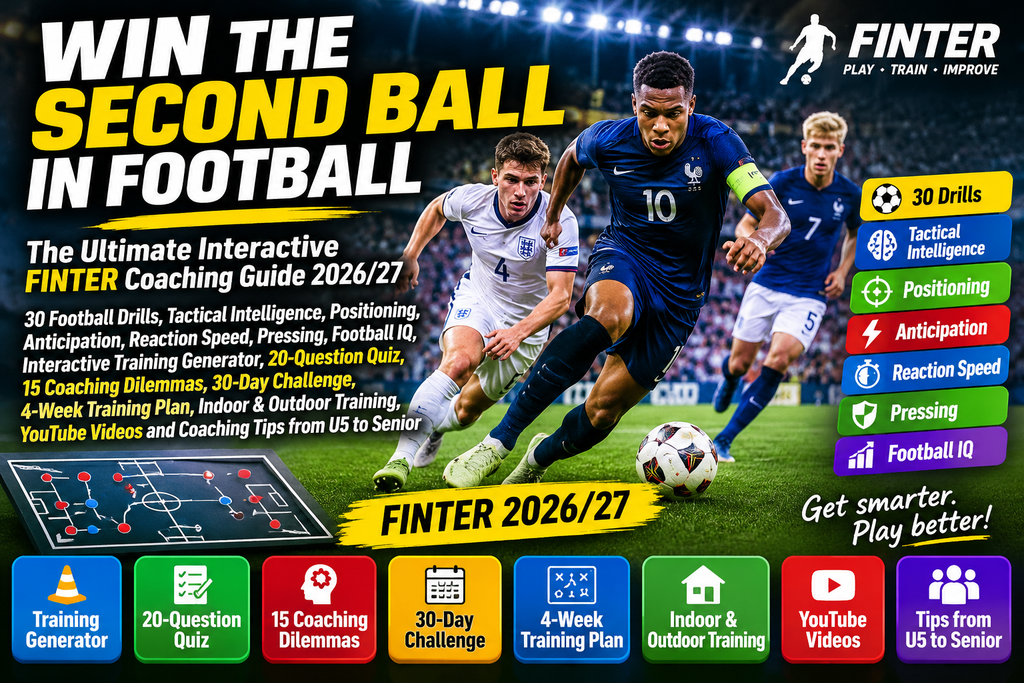
⚽ WIN THE SECOND BALL!
The Ultimate Interactive Football Coaching Guide
Why loose-ball recoveries change matches — and how to train anticipation, positioning, reactions, pressing and the next action.
30 drills · Working training-plan generator · Interactive pitch · 20-question quiz · 15 coaching dilemmas · Football IQ · 30-day challenge · Printable coaching sheet
⚡ Build a training session⚽ Explore drills📍 Jump to a section
🧠 1. What is a second ball in football?
A second ball is a loose ball available after an initial challenge, clearance, save, block, deflection or contested pass. Picture a centre-back heading a long pass away: whoever collects the dropping ball wins the second ball. Winning the header does not mean the team has kept possession.
Before
Scan opponents and teammates. Predict the most likely landing spaces.
During
One player contests the first ball; others cover short, long and behind.
After
Secure possession, assess pressure, then pass, dribble, shoot or reset.
FINTER principle: 👀 ANTICIPATE → 📍 POSITION → ⚡ REACT → ⚽ RECOVER → 🎯 DECIDE. The aim is not simply to reach the ball first; it is to make the next action count.
Five match situations to observe
Aerial duels: where will the header fall? Blocked shots: who follows the rebound? Defensive clearances: who protects space just outside the box? Long balls: who supports the target player? Pressing: who collects a rushed pass or deflection?
What coaches should reward
Early movement, balanced body shape, safe competitiveness, communication, effective first touch and a smart decision after recovery — not just physical strength or winning every duel.
🔬 2. What does research say?
A peer-reviewed 2025 study by Šunjić and colleagues analysed matches from the 2018 and 2022 FIFA World Cups. It reported associations between more second-ball recoveries in the defensive and attacking thirds and several attacking indicators, including passes and entries into advanced areas. In the middle third, the study did not find significant associations with the technical outcomes assessed.
Important: these are associations at elite level, not proof that a particular drill creates goals, and they cannot automatically be applied to U7 teams. The 30 training practices below are FINTER coaching ideas, not exercises taken from the research.
🗺️ 3. Interactive pitch: where should players move?
Tap a third of the pitch to reveal a coaching scenario. The direction is left → right for the team in possession. These are teaching zones, not official pitch boundaries.
⚽ 4. FINTER’s 30 match-related second-ball drills
Each drill includes setup, rules, age guidance, a coaching cue and an easier/harder variation. Distances are starting points: shorten spaces and simplify contact for younger players. Avoid forced aerial challenges or heading activities for younger age groups; follow your national association’s current age-specific guidance.
🎮 5. Interactive training-session generator
How it works: choose age, squad size, minutes, environment and focus. Press Generate. The tool selects suitable drills, suggests rotations and produces a timed session. Generate again for a new combination; print the plan below.
Select your settings and press Generate to create a complete training session.
The generator runs in your browser and does not send player data to FINTER. Printing depends on your browser’s print dialog.
🏆 6. Interactive 20-question second-ball quiz
Choose an answer and receive immediate feedback. Use Next to move forward. Your final score is displayed at the end.
🤔 7. Fifteen coaching dilemmas
Select a scenario and decide what you would do. These are reflection prompts rather than universal right/wrong answers.
🧠 8. Quick Football IQ scenario
A teammate challenges for a loose ball near midfield. You can choose your support position. Which response best keeps your team balanced?
📅 9. FINTER 30-day second-ball challenge
Complete one short learning task each day. Track your progress on this device. Tasks are designed for players and coaches and can be adapted to age, confidence and physical ability.
0 / 30 days completed
Progress uses this browser’s local storage when available. It may disappear if browser data is cleared.
📈 10. Four-week development plan
| Week | Priority | Suggested drills | Observe |
|---|---|---|---|
| 1 | Recognise loose balls and react | 1, 2, 3, 5, 7 | Who notices the next ball early? |
| 2 | Move into recovery spaces | 8, 9, 11, 13, 15 | Do teammates provide different angles? |
| 3 | Recover under pressure | 16, 17, 19, 22, 25 | What happens in the first two touches? |
| 4 | Transfer to game play and retest | 24, 26, 27, 29, 30 | Are decisions improving in matches? |
Age-based adaptations
Games, rolling balls, simple signals, no forced physical duels.
Simple partner roles, small goals, plenty of repetitions.
Introduce deliberate support angles and recovery-to-pass decisions.
Add pressing triggers, compactness and opponent pressure.
Use unit relationships, tactical video and game-specific triggers.
Simple observation scorecard
During a five-minute small-sided game, count (1) loose balls contested, (2) recoveries secured and (3) recoveries followed by a controlled next action. Repeat after four weeks. Compare similar games; this is a learning aid, not a scientific performance test.
🎥 11. Video analysis: look for the next action
Rather than embedding unverified clips, use these direct YouTube search links to find relevant footage. Pause before each first challenge. Ask: Where will it land? Who is the spare player? What should happen after recovery?
Second-ball coaching drills
▶ Watch training examplesCheck how coaches organise supporting players after the first duel.
Counterpressing and loose balls
▶ Watch tactical analysisFocus on compactness and short distances around the ball.
Rebounds and finishing
▶ Watch finishing examplesNotice how attackers prepare before a save or blocked shot.
Video search results change over time. FINTER does not claim these searches are endorsements of any particular video.
📥 12. Free printable FINTER coaching pack
Make a usable PDF without installing a plugin: generate a session above, click Print session / Save as PDF, and choose Save as PDF in your browser. For an additional blank coaching worksheet, use the template below.
FINTER Second-Ball Observation Sheet
Team: ______________________ Age: _______ Date: __________
Focus: ______________________ Session length: __________
Players anticipating early: ______ Recoveries: ______
Controlled next actions: ______ What improved: __________________
Next training goal: __________________________________________________
🔗 13. Continue learning with FINTER
Second-ball training connects naturally to dribbling, first touch, tactical intelligence and small-sided games. Explore these existing FINTER hubs and training resources:
FINTER Coach’s Guide · Tactical Understanding · Dribbling · Small-sided Games · 1v1 Football · Feints and Skills · FINTER Training Universe 2026/27
Frequently asked questions
What is the difference between a first ball and a second ball?
The first ball is the initial challenge or contested action; the second ball is the loose ball that follows. The terms describe a sequence, not an official law of football.
How can children learn second-ball positioning?
Start with safe rolling-ball games, partner support and small-sided matches. Encourage scanning and curiosity instead of demanding aggressive contact.
Should every player rush to the loose ball?
No. Teams also need balance and cover. Supporting players should occupy complementary spaces around the challenge.
Can second-ball drills work indoors?
Yes. Use rolled or low-bouncing balls, controlled intensity and small pitches suited to the floor surface.
Does winning more second balls guarantee victory?
No. Research found some positive associations with attacking indicators in elite World Cup matches; those findings do not establish a universal causal guarantee.
FINTER takeaway: The best second-ball player is often the one who notices what is about to happen — then makes the next action simple, fast and intelligent.
Research source: Šunjić, I., Pavlinović, V., Škomrlj, J., Morgans, R. & Modrić, T. (2025), International Journal of Performance Analysis in Sport, 25(5), 881–899. DOI. Drills, tools and coaching models: FINTER educational proposals.