
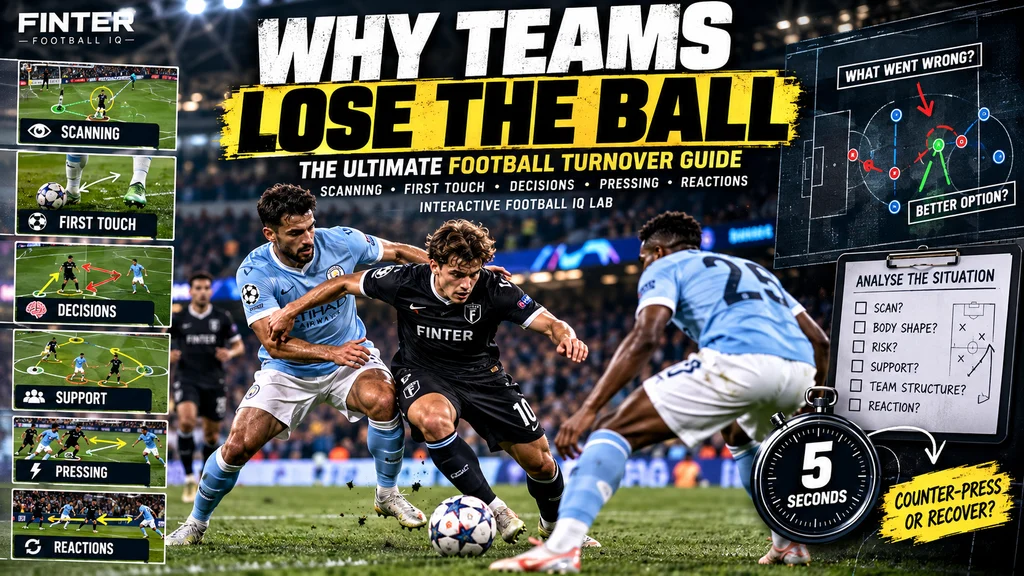
⚽🧠 Why Teams Lose the Ball
The pass looks simple.
The player receives under pressure.
One second later, possession is gone.
Was the problem the pass? The first touch? Poor scanning? Bad body orientation? No support? Too much risk? Or was the whole team badly positioned before the ball was even lost?
Welcome to the FINTER Football Turnover Lab — a complete guide to understanding why football teams lose possession and what smart players do in the first seconds afterwards.
🎮 Enter the Turnover Lab🤯 Losing the Ball Is Usually More Complicated Than It Looks
Football analysis often focuses on the player who made the final mistake.
A midfielder loses possession.
A winger gives the ball away.
A defender plays a bad pass.
But the visible mistake may only be the final part of the problem.
Do not only ask:
“Who lost the ball?”
Ask:
“Why did the situation become difficult before the ball was lost?”
🧠 The 7 Main Families of Football Turnovers
👀 1. Information
The player did not scan or recognise pressure before receiving.
⚽ 2. Technique
A poor first touch, pass, dribble or execution gives possession away.
🧠 3. Decision
The player sees the situation but chooses an unnecessarily risky action.
📐 4. Body Orientation
The player receives in a position that limits vision or the next action.
🤝 5. Support
The ball carrier has too few useful passing options.
📍 6. Team Structure
Distances and positioning make progression difficult or make the turnover dangerous.
🎲 7. Necessary Risk
Some possession losses are acceptable because the potential reward is worth the risk.
👀 Cause #1: The Player Did Not Scan
One of the most common possession problems begins before the player receives the ball.
If the player does not know:
- where pressure is coming from,
- where the free teammate is,
- where the space is,
- what the next action could be,
then the player must discover all of that after receiving.
By then, the opponent may already be close.
Information collected early creates more time later.
FINTER already has a complete guide to this skill: Football Scanning – exercises, awareness and decision-making .
⚽ Cause #2: The First Touch Creates the Problem
A player may make the correct decision but still lose possession because the first touch is poor.
A first touch can:
- move away from pressure,
- open the next pass,
- protect the ball,
- attack space,
- prepare a shot,
- or accidentally invite pressure.
The difference between a good and bad touch may only be 30 centimetres.
But at high speed, 30 centimetres can completely change the situation.
📐 Cause #3: Body Orientation
Imagine a midfielder receiving between two opponents.
Player A receives square, facing his own goal.
Player B receives half-turned and can see both the passer and the space ahead.
Both players may have identical technical ability.
But Player B begins with more information and more possible next actions.
It gives the player more solutions to choose from.
🤝 Cause #4: The Player Has No Support
Sometimes the player losing possession is blamed for a problem created by teammates.
A full-back receives near the touchline.
The winger is too high.
The midfielder is hidden behind an opponent.
The centre-back stays too far away.
The opponent presses aggressively.
The ball carrier now has almost no useful options.
The eventual turnover may look individual.
The real problem is collective spacing.
🎲 Cause #5: The Wrong Level of Risk
Not every possession loss is bad.
A striker attempting a difficult through ball around the penalty area may lose possession because the action has high difficulty.
That can still be a sensible decision.
But trying the same pass from your own penalty area may be a completely different level of risk.
| Situation | Possible Risk Level | Reason |
|---|---|---|
| Creative pass near opponent box | Higher risk acceptable | Reward can be a direct chance. |
| Square pass across own penalty area | High danger | Turnover may create an immediate chance. |
| 1v1 on the wing | Often acceptable | Winning the duel may break the defensive structure. |
| Dribbling through three players in central build-up | Usually dangerous | Loss can expose the centre. |
🧩 Cause #6: The Team Shape Was Already Poor
The most dangerous turnovers often happen when the team is badly organised behind the ball.
Imagine:
- both full-backs are high,
- both number 8s attack the box,
- the defensive midfielder moves forward,
- the centre-backs are left 2v2.
Now a simple misplaced pass can become a huge counter-attack.
This is why modern teams think about rest defence while attacking.
FINTER already has a complete guide to rest defence: Rest Defence – transitions, counter-pressing and 2-3 / 3-2 structures .
⚡ The First 3–5 Seconds After Losing Possession
The turnover is only half the story.
The next question is:
What happens immediately afterwards?
🔥 Counter-Press
If teammates are close, the team may try to win the ball back immediately.
🛑 Delay
The nearest defender may slow the counter while teammates recover.
📍 Protect the Centre
Stopping the first vertical pass can be more important than chasing the ball blindly.
🔙 Recover
If the ball cannot be won immediately, the team may need to regain compact organisation.
LOSE → READ → REACT → PROTECT → RECOVER
🔥 Counter-Press or Drop?
One of football’s most important transition decisions is whether to attack the ball immediately or recover.
Counter-pressing may make sense when:
- several teammates are close,
- the opponent receives facing their own goal,
- the next passing options can be blocked,
- your defensive structure behind the press is secure.
Dropping may be smarter when:
- the opponent has escaped the first pressure,
- your team is stretched,
- there is a dangerous numerical disadvantage,
- one forward pass can eliminate many players.
The intelligent reaction is not always:
“PRESS!”
Sometimes the smartest action is:
“RECOVER!”
📊 15 Common Turnovers – and What They Really Mean
| Turnover | Likely Cause | Training Focus |
|---|---|---|
| Blind-side tackle | No scan | Scanning before receiving |
| Heavy first touch | Technical execution | Directional first touch |
| Pass into pressure | Decision | Recognise safer option |
| Trapped near touchline | Poor support | Passing angles |
| Intercepted square pass | Risk selection | Passing lanes |
| Receiver cannot turn | Body orientation | Half-turn receiving |
| Dribbler isolated 1v2 | Team structure | Overlap / underlap support |
| Extra touch kills attack | Slow decision | One- and two-touch games |
| Clearance straight back | No next-action awareness | First action after regain |
| Counter after corner | Poor rest defence | Transition structure |
| Forward pass forced | Impatience | Secure vs progress decision |
| Player surrounded centrally | Spacing | Width and support |
| Pass underhit | Technique | Passing quality |
| Receiver surprised by pressure | Communication + scanning | Information habits |
| Risky final-third pass fails | Possibly acceptable risk | Risk/reward understanding |
🎮 FINTER Football Turnover Lab
Now test yourself.
You will receive ten match situations.
For every situation, answer two questions:
- Why was possession lost?
- What should the team do next?
Your final score becomes your FINTER Turnover Football IQ Rating.
⚽🧠 Football Turnover Lab
Read the situation. Identify why possession was lost. Then choose the best immediate reaction.
1️⃣ Why was the ball lost?
2️⃣ What should happen next?
🧠 What Your Turnover Lab Score Really Tests
The challenge is not designed to test whether you can memorise football vocabulary.
It tests whether you can connect three important moments:
1️⃣ Before
What created the difficult situation before possession was lost?
2️⃣ The Turnover
Why was possession actually lost?
3️⃣ After
What is the smartest immediate reaction?
This is one of the most useful ways to analyse mistakes because the final player on the ball is not always the real cause of the problem.
👦 How Young Players Can Learn From Turnovers
Young footballers should not become afraid of losing possession.
Mistakes are part of development.
Instead of simply shouting:
“Don’t lose the ball!”
a coach can ask:
- What did you see before receiving?
- Did you scan?
- Where was the pressure coming from?
- Could your body position have been better?
- Was another passing option available?
- Could your first touch have moved away from pressure?
- Was the risk worth taking?
- What did you do immediately after losing possession?
🚫 Do Not Coach Creativity Out of Players
A player who never loses possession may simply be choosing the safest action every time.
That is not automatically intelligent football.
Creative players sometimes need to:
- attempt difficult through balls,
- attack defenders 1v1,
- turn under pressure,
- play through small spaces,
- break defensive lines,
- attempt actions that may fail.
The goal is making better decisions about when, where and why risk is worth taking.
⚡ Football Speed Is More Than Sprint Speed
A fast footballer is not only someone who runs quickly.
Football speed also includes:
- seeing pressure early,
- recognising the next pass,
- positioning the body correctly,
- processing information quickly,
- deciding before the ball arrives,
- executing the action quickly.
This is one reason elite midfielders can appear to have more time than everyone else.
They often start solving the situation before they receive the ball.
👉 Continue with FINTER’s guide: Why the World’s Best Footballers Never Panic Under Pressure .
🔄 Winning the Ball Back Is Not Enough
Another common turnover occurs immediately after a team wins possession.
A defender makes an excellent interception.
But the next action is rushed.
The defender passes blindly forward and possession immediately returns to the opposition.
The team technically regained the ball.
But it never gained control.
This connects closely to FINTER’s guide to what happens after the first duel:
👉 Second-Ball Football – The Hidden Battle After the First Duel .
⚽ Training Drill #1 – Scan Before Receiving
Setup
- 4 attacking players around a small square.
- 1–2 defenders inside.
- One ball.
Rule
Before receiving, the player should check away from the ball and gather information.
Progressions
- Unlimited touches.
- Maximum two touches.
- One touch when appropriate.
- Add another defender.
- Reduce the playing area.
- Give players specific targets to identify before receiving.
Coaching Focus
Do not reward scanning simply because the player turns their head.
Reward scanning when the information improves the player’s next action.
⚽ Training Drill #2 – The 5-Second Turnover Game
Setup
Play 4v4, 5v5 or 6v6 in an appropriately sized area.
Rule
Whenever possession changes, the team that lost the ball has a short period to attempt an immediate regain.
If the opponent escapes the first pressure, the team should recover into a compact defensive structure.
Teach Players To Recognise:
- who is closest to the ball,
- which opponent can receive next,
- where the dangerous central space is,
- whether the counter-press is still possible,
- when to stop chasing and recover.
It requires coordinated pressure, cover and protection of dangerous space.
⚽ Training Drill #3 – Safe Zone vs Risk Zone
Divide the pitch into three zones.
🔴 Defensive Third
Possession losses can create an immediate chance for the opponent.
🟡 Middle Third
Players must balance progression with control.
🟢 Final Third
More attacking risk may be acceptable because the potential reward is higher.
Question after every turnover:
Was the risk appropriate for this area of the pitch?
⚽ Training Drill #4 – First-Touch Escape
Create a receiving area where pressure can arrive from different directions.
The receiving player must use the first touch to:
- escape pressure,
- protect possession,
- open the body,
- create a passing lane,
- or attack the next space.
Change the location and timing of pressure regularly.
The aim is to select the right first touch for the information available.
⚽ Training Drill #5 – Support the Ball
Play 4v4 with neutral players.
Give the possession team a bonus point whenever the player on the ball has at least two realistic passing options.
This changes the focus from only the player in possession to the entire team.
Now teammates must ask:
“How can my movement make the next action easier?”
🎥 Football Turnover Video Study
Use the following video searches to study these situations in real football.
👀 Scanning Before Receiving
Study how midfielders look around before the ball arrives.
▶ Watch Videos⚽ First Touch Under Pressure
Watch how players use their first touch to escape defenders.
▶ Watch Videos🧠 Football Decision-Making
Explore exercises designed to train faster football decisions.
▶ Watch Videos🖨 FINTER Turnover Analysis Sheet
Print this section or save it as a PDF and use it while watching a match.
| Analysis Question | Your Notes |
|---|---|
| Where was possession lost? | ____________________________ |
| Who lost possession? | ____________________________ |
| Where was pressure coming from? | ____________________________ |
| Did the player scan? | ____________________________ |
| Was the body orientation helpful? | ____________________________ |
| Did the first touch help or hurt? | ____________________________ |
| Were good support angles available? | ____________________________ |
| Was the action technically difficult? | ____________________________ |
| Was the risk appropriate? | ____________________________ |
| How did the nearest teammate react? | ____________________________ |
| Was counter-pressing possible? | ____________________________ |
| Was central space protected? | ____________________________ |
| Was the team prepared behind the ball? | ____________________________ |
| What could have prevented the turnover? | ____________________________ |
📋 FINTER’s 30-Second Turnover Checklist
👀 Information
Did the player know what was around them?
📐 Position
Was the player positioned to see and use the next space?
⚽ Technique
Did technical execution cause the turnover?
🧠 Decision
Was there a better option available?
🤝 Support
Did teammates provide useful passing angles?
🎲 Risk
Was the potential reward worth the danger?
📍 Structure
Was the team organised behind the attack?
⚡ Reaction
What happened in the first seconds after losing possession?
🔗 Continue Your FINTER Football IQ Journey
This article is part of FINTER’s growing Football IQ universe.
🧠 Playing Under Pressure
Learn why elite footballers appear to have more time on the ball.
Read the Guide →🏃 Football Without the Ball
Understand movement, pressing, space creation and Football IQ without possession.
Read the Guide →🧑🏫 Football Coach Academy
Build your coaching and tactical understanding with FINTER.
Enter Coach Academy →❓ FAQ – Losing Possession in Football
Why do football players lose the ball?
Possession can be lost because of technical mistakes, poor scanning, poor body orientation, bad decision-making, inadequate support, opponent pressure or problems in team structure.
Is losing possession always bad?
No. Football requires risk. A creative pass around the opponent’s penalty area may fail but still be a sensible action because of the potential reward.
What should a player do immediately after losing possession?
Read the new situation quickly. If immediate pressure can be applied effectively, react. If the opponent escapes, recover and protect dangerous areas.
How can footballers lose possession less often?
Improve scanning, first touch, body orientation, support angles, passing technique, decision-making and awareness of risk.
What is counter-pressing?
Counter-pressing is an immediate attempt to pressure the opponent and potentially regain possession after losing the ball.
What is rest defence?
Rest defence describes how attacking teams organise players behind and around the attack so they are prepared for a possible turnover.
Is every bad pass a technical mistake?
No. A technically accurate pass can still be the wrong decision. Likewise, a good tactical idea can fail because of poor execution.
Should young players avoid risky passes?
Not automatically. Players need to learn when risk is appropriate rather than simply learning to avoid mistakes.
How can coaches train faster decision-making?
Use realistic small-sided games, positional games, variable pressure, scanning tasks, transition games and match analysis.
What should coaches analyse after a turnover?
Look at the information available before the action, the technical execution, support around the player, team structure and the reaction after possession changes.
🏁 The Best Players Do Not Simply Avoid Mistakes
They understand them.
They collect information earlier.
They recognise pressure.
They prepare their body.
They control the first touch.
They select the correct level of risk.
And if possession is lost, they react immediately.
👀 SCAN
↓
📐 POSITION
↓
⚽ RECEIVE
↓
🧠 DECIDE
↓
🎯 EXECUTE
↓
⚡ REACT
↓
🛡 PROTECT
↓
🔄 RECOVER
Football intelligence is not about never losing the ball.
It is about understanding why possession is lost, recognising when risk is worthwhile and reacting faster when the game suddenly changes.