
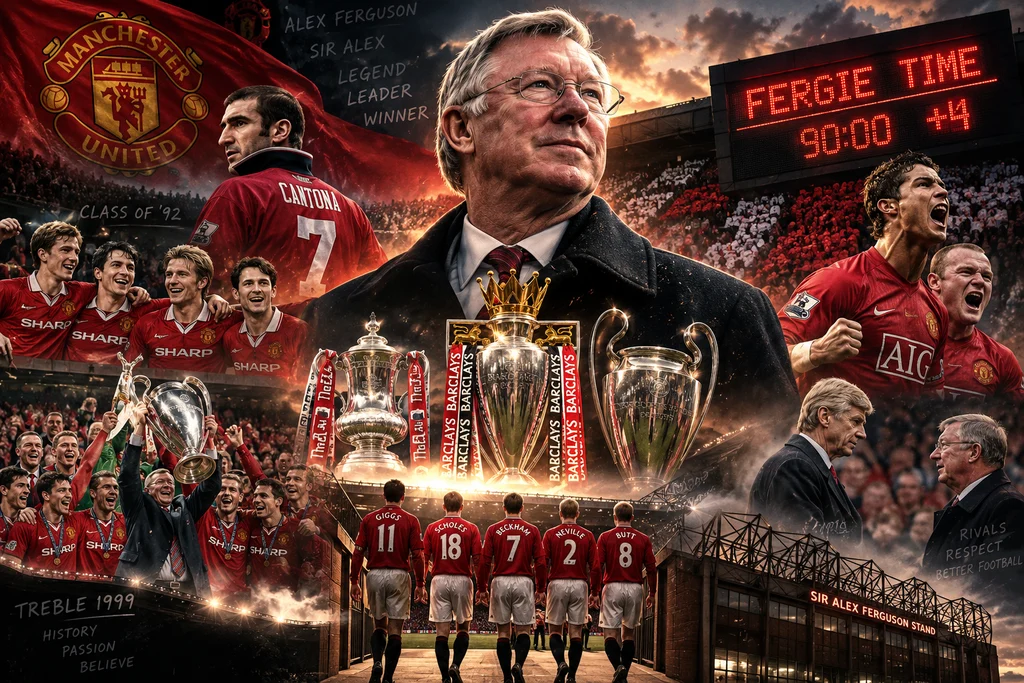
SIR ALEX
FERGUSON
27 years. 13 Premier League titles. Two Champions League triumphs. The Class of ’92. Cantona. Beckham. Keane. Rooney. Ronaldo. Incredible comebacks – and the final minutes that became known around football as Fergie Time.
👑 The man who built a football empire
Sir Alex Ferguson’s Manchester United story is not the story of one great team. It is the story of a manager who repeatedly built new winning teams across different generations.
When Ferguson became Manchester United manager in November 1986, the club had not won the English league championship since 1967. By the time he retired after the 2012/13 season, he had won an extraordinary 13 Premier League titles.
That longevity is a huge part of the Ferguson story. Players changed. Rivals changed. Football changed. Ferguson kept rebuilding.
Ferguson’s greatest strength may not simply have been building a great team. It was recognising when that team needed to evolve – and then creating the next one.
📚 Explore the Ferguson story
🏴 Ferguson was already a winner before Manchester United
Ferguson’s story did not begin at Old Trafford. At Aberdeen he had already challenged the traditional balance of power in Scottish football and achieved success at both domestic and European level.
Aberdeen’s achievements demonstrated something that would later define Ferguson’s United: the ability to convince players that established giants could be beaten.
🔴 6 November 1986
Alex Ferguson became manager of Manchester United. Nobody could have known that the appointment would develop into one of the most celebrated managerial eras in football history.
📅 The interactive Ferguson timeline
👇 Click each year to reveal the story.
🌱 Class of ’92 – the kids who became champions
David Beckham. Paul Scholes. Nicky Butt. Gary Neville. Phil Neville. Ryan Giggs. A generation became synonymous with Manchester United’s belief in developing its own players.
Ryan Giggs
Pace, dribbling and extraordinary longevity.
David Beckham
Crossing, set pieces, work rate and one of football’s most famous right feet.
Paul Scholes
Vision, passing, timing and long-range shooting.
Gary Neville
Leadership, consistency and tactical intelligence.
Nicky Butt
Duels, balance and discipline in midfield.
Phil Neville
Versatility and the ability to perform several different roles.
Developing young players is only half the job. The bigger question is: are you brave enough to actually play them?
👑 Eric Cantona – The King
Cantona became a central figure in Manchester United’s transformation. He brought creativity, confidence and personality.
Ferguson also understood that managing elite players did not mean treating every personality in exactly the same way.
🏆 1999 – The Treble
Manchester United entered the decisive weeks of the season chasing something no English club had previously achieved: the Premier League, FA Cup and European Cup/Champions League in the same season.
Premier League
The first part of the Treble was secured.
FA Cup
Newcastle United were beaten 2-0 in the final.
Champions League
Bayern Munich awaited at Camp Nou.
⏱️ 90 minutes – Bayern lead 1-0
Mario Basler’s early goal had Bayern ahead. United were seconds away from defeat.
⚽ 90+1 – Teddy Sheringham
United equalise.
⚽ 90+3 – Ole Gunnar Solskjær
Beckham delivers the corner. Sheringham heads the ball on. Solskjær reacts – and Manchester United are champions of Europe.
– Sir Alex Ferguson after the final
⏱️ FERGIE TIME
When Manchester United needed a late goal at Old Trafford, the match never seemed completely over.
“Fergie Time” became part of Premier League folklore – a phrase associated with Ferguson’s United, stoppage time and dramatic late goals.
📚 Why was it called Fergie Time?
Where did the phrase come from? Were United really better in stoppage time? Which famous late goals helped create the legend?
⏱️ Read FINTER’s complete Fergie Time story →🔥 The famous Ferguson stories
Click the cards to reveal the story.
Beckham and the boot
Click to reveal →
2003
Following an FA Cup defeat to Arsenal, a boot kicked by Ferguson in the dressing room struck David Beckham above the eye. The incident became one of the most famous stories from the Ferguson-Beckham relationship.
The Hairdryer Treatment
Click to reveal →
Ferguson’s temper
“The Hairdryer Treatment” became a famous description of Ferguson confronting players at close range. Yet his management style also involved loyalty, encouragement and understanding individual personalities.
Mind games
Click to reveal →
The battle outside the pitch
Ferguson’s press conferences became part of the competitive environment surrounding major title races and rivalries. His battles with Arsène Wenger became particularly famous.
⚔️ Ferguson vs. Wenger
Arsène Wenger transformed Arsenal into one of United’s greatest rivals. Their competition helped define an era of the Premier League.
Keane against Vieira. Henry against United’s defence. Beckham, Scholes and Giggs against Wenger’s Arsenal.
🧠 FINTER Football IQ
Can a great rival actually make your team better?
Yes. A powerful rival creates new tactical problems and forces players, coaches and clubs to keep evolving.
🚀 Ronaldo, Rooney – and another Ferguson superteam
Cristiano Ronaldo
From spectacular teenager to global superstar.
Wayne Rooney
Intensity, goals, creativity and enormous work rate.
Ferdinand + Vidić
A formidable defensive foundation behind the attacking stars.
With Ronaldo, Rooney, Carlos Tevez, Paul Scholes, Ryan Giggs, Rio Ferdinand, Nemanja Vidić and Edwin van der Sar, Ferguson created another side capable of dominating England and winning in Europe.
🌧️ Moscow 2008
The Champions League final against Chelsea finished 1-1 after extra time.
🥅 The penalty shootout
Edwin van der Sar saved Nicolas Anelka’s penalty.
🏆 Manchester United – Champions of Europe
Ferguson had won his second Champions League title.
United would reach another two Champions League finals under Ferguson, losing to Barcelona in 2009 and 2011.
💔 2012 → 👑 2013
Manchester City dramatically won the Premier League title in 2012. It was one of the most painful endings of the Ferguson era.
Ferguson’s response was immediate.
🎯 Robin van Persie
Ferguson signed Van Persie from Arsenal. The Dutch striker became a decisive figure as United returned to the top.
In April 2013, Van Persie scored a hat-trick against Aston Villa as United secured the championship.
Ferguson therefore left management as the reigning English champion.
🔄 Ferguson’s superpower: rebuilding winners
Generation I
Schmeichel • Bruce • Pallister • Cantona • Hughes
Generation II
Beckham • Giggs • Scholes • Keane • Neville
Generation III
Ronaldo • Rooney • Ferdinand • Vidić • Van der Sar
Building one championship team is difficult. Breaking parts of it apart and building another without suffering a long decline may be even harder.
⚽ Build your Ferguson Dream XI
Select a maximum of 11 players. Who makes your ultimate Ferguson team?
Your team is empty.
🎥 Watch the Ferguson era
🧠 FINTER Ferguson Quiz
1. When did Ferguson become Manchester United manager?
2. How many Premier League titles did Ferguson win?
3. Who scored the winning goal in the 1999 Champions League final?
4. Who saved Anelka’s penalty in Moscow in 2008?
5. Which striker played a central role in Ferguson’s final title?
🧠 What can coaches learn from Ferguson?
Trust young players
Youth development only becomes meaningful when young players receive genuine opportunities.
Rebuild before it is too late
A team can still be winning while already needing to evolve.
Play until the final second
A team’s mental state matters. Believing there is still another chance can change matches.
❓ Sir Alex Ferguson FAQ
How long was Sir Alex Ferguson Manchester United manager?
He became manager in November 1986 and retired after the 2012/13 season.
How many Premier League titles did Ferguson win?
13 Premier League titles.
How many Champions League titles did Ferguson win?
Two with Manchester United: 1999 and 2008.
What was Manchester United’s 1999 Treble?
United won the Premier League, FA Cup and Champions League during the 1998/99 season.
What does “Fergie Time” mean?
It is a popular football phrase strongly associated with Manchester United’s dramatic late goals and stoppage-time finishes during Ferguson’s era.
Who were the Class of ’92?
The famous generation included David Beckham, Nicky Butt, Ryan Giggs, Gary Neville, Phil Neville and Paul Scholes.
🔗 Continue exploring on FINTER
Discover the full story behind Fergie Time: the stoppage-time drama, famous late goals and the mythology surrounding Ferguson’s Manchester United.
⏱️ Read the Fergie Time story → ⚽ Explore more FINTER football stories →🏁 The legacy of Sir Alex Ferguson
Ferguson did not simply build one championship team. He created multiple generations of Manchester United sides capable of finding different ways to win.
Cantona. The Class of ’92. Keane. Beckham. Scholes. Giggs. Ronaldo. Rooney. Ferdinand. Vidić. Van Persie.
Camp Nou 1999. Moscow 2008. Thirteen Premier League titles. And one unmistakable feeling whenever the clock moved beyond 90 minutes:
It isn’t over until it’s over.
Few managers in football history became more closely associated with that feeling than Sir Alex Ferguson.