
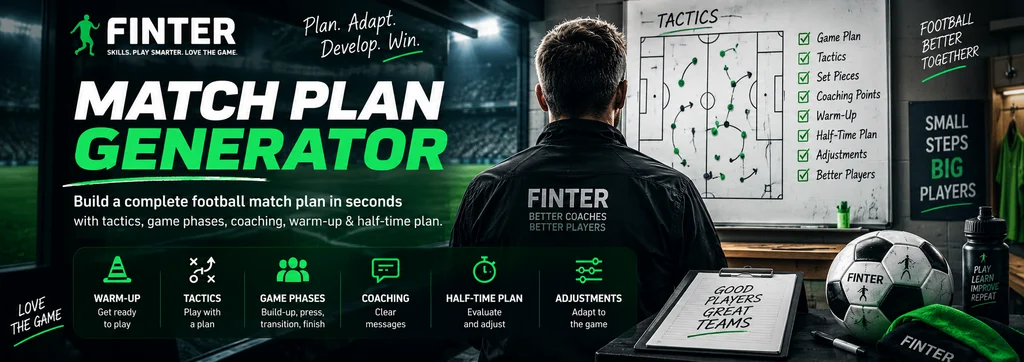
FINTER Match Plan Generator – Create a Complete Football Match Plan in Seconds
Choose age group, match format, opponent, playing style and today’s main focus. The generator then creates a simple match plan with a warm-up, the four game phases, coaching messages, a half-time check and ideas for tactical adjustments.
⚡ Create the match plan first – read the guide afterwards
The goal is not to overload players with 20 instructions. A good match plan should be simple enough for players to remember when the game becomes fast, chaotic and intense.
⚽ When we have the ball → make the pitch big
🔄 When we lose the ball → react
🛡️ When the opponent has the ball → be compact
⚡ When we win the ball → look forward
Use the generator below as a coaching tool. It is not a fixed answer. The coach still has to read the game and help players understand why a solution works.
FINTER Match Plan Generator
Create a simple, usable match plan in seconds. Choose age, match format, opponent and your preferred style of play – and get key points for the warm-up, all four game phases, half-time and coaching from the touchline.
1️⃣ Choose the match setup
2️⃣ Choose today’s main focus
🔗 Become a better coach with FINTER.dk
Use the match plan together with FINTER’s guides on technique, tactics and training.
🔥 Before the match – warm-up
🧠 The four game phases
1️⃣ When WE have the ball
2️⃣ When WE lose the ball
3️⃣ When the OPPONENT has the ball
4️⃣ When WE win the ball
🗣️ Short coaching messages
⏸️ Half-time check: ask only these 3 questions
🔄 If the match develops differently
🔗 FINTER.dk recommends for this match plan
🧠 What is a good football match plan?
A match plan is the team’s shared starting point before the game. It should give players a few clear principles for what they are trying to do with and without the ball – without turning them into robots.
FINTER’s approach to tactical understanding is that the player should learn to see the situation, understand it and choose a solution. Tactics should therefore combine shared team principles with individual decision-making.
✅ A good match plan
- has a few clear messages
- fits the players’ age
- can be adjusted during the game
- covers both attacking and defending
- leaves room for creativity
- connects training and match day
❌ A poor match plan
- contains 20 tactical rules
- changes after every mistake
- is controlled constantly from the touchline
- focuses only on formation
- makes players afraid to take risks
- forgets enjoyment and individual skill
1️⃣ When we have the ball: Make the pitch big
When your team has possession, the aim is to create space and more options for the player on the ball. That does not mean everybody has to stand on the touchline. It means players should understand distances, angles, width, depth and support.
- Width: stretch the opponent sideways.
- Depth: have at least one option further forward.
- Support: help the player on the ball.
- Movement: move after the pass.
- Scanning: look before the ball arrives.
2️⃣ When we lose the ball: React
Losing possession is one of the most important moments in the game. Players must quickly read whether the team can try to win the ball back immediately or whether it is better to recover and become compact.
- The nearest player reacts first.
- Players around the ball close the most dangerous passing options.
- If the ball cannot be won quickly, the team becomes compact again.
- Avoid one player pressing alone while the rest of the team stays too far away.
3️⃣ When the opponent has the ball: Make the pitch small
Without the ball, the team generally tries to do the opposite of what it does in possession: distances between players become smaller and the team protects the most important spaces.
- Protect the central area and the space in front of your own goal.
- Press together – not one player at a time.
- Support the player who presses the ball.
- Use simple communication: “press”, “cover”, “drop”, “turn”.
4️⃣ When we win the ball: Look forward
Winning possession often creates a short moment when the opponent is not yet organised. The first thought should therefore be: Can we attack? If the answer is no, the team can keep the ball and build a new attack.
- Scan forward immediately after winning the ball.
- Players without the ball move into free space.
- Attack with speed if space is available.
- Keep possession if the quick option is not there.
👶 Match plans by age group
| Age | What should the match plan focus on? | Avoid |
|---|---|---|
| U6–U8 | Direction, goals, bravery, 1v1, helping each other and winning the ball back. | Long tactical meetings and fixed positions. |
| U9–U12 | Space, choices, width, support, simple game phases and scanning. | The coach controlling every decision from the touchline. |
| U13–U15 | Game phases, pressing, relationships, transitions and more tactical choices. | Too many instructions at the same time. |
| U16–U19 | Pressing triggers, build-up, rest defence, roles and match adjustments. | A plan so rigid that players cannot adapt. |
| Senior | Shared principles, opponent analysis, formation, pressing triggers and scenarios. | Changing the whole plan after a few poor minutes. |
Also read FINTER’s guide to tactical understanding by age group.
⚽ 3v3, 5v5, 8v8 or 11v11 – the match plan must change
3v3
Keep it extremely simple. Everyone attacks and everyone defends. There are lots of 1v1 moments, so bravery, dribbling, finishing and reaction after losing the ball should be central.
5v5
Players can start to recognise triangles, use the goalkeeper and understand how one player can help the player on the ball in front, beside and behind.
8v8
8v8 creates opportunities for clearer relationships between players and units. Width, depth, build-up and transitions can be introduced without turning the match into a tactical lecture.
11v11
In 11v11, formation and collective organisation become more relevant, but principles are still more important than arrows on a tactics board. Players should understand the situation, not just remember their starting position.
🆚 How to adjust the plan to the opponent
| Opponent | Possible FINTER plan |
|---|---|
| Presses high | Create several short options around the ball, but be ready to play through the press and attack the space behind. |
| Defends deep | Use width, patience, switches of play, 1v1s and movement between defenders. |
| Very good in possession | Avoid chasing the ball one player at a time. Stay compact and choose clear moments to press. |
| Very physical | Move the ball quickly, use the first touch away from pressure and avoid unnecessary static duels. |
| Dangerous in transition | Keep balance behind the ball and pay special attention to central turnovers. |
🔥 Match warm-up: Use the ball from the start
A match warm-up does not need to start with long runs around the pitch. Use the warm-up to prepare ball control, scanning, dribbling, passing, movement and decision-making.
- 3–5 min: light ball mastery, movement and changes of direction.
- 4–6 min: passing, first touch or short 1v1 actions.
- 5–8 min: a small-sided game based on the main match theme.
- Finish: 2–3 short accelerations and a few finishes.
⏸️ The simple half-time plan
Half-time is rarely the moment to introduce five new tactical ideas. Ask the players three things instead:
- What are we doing well?
- Where is the space when we have the ball?
- What happens immediately after we lose and win possession?
Then choose no more than one or two clear focus points for the next period.
🗣️ Touchline coaching – say less, help more
A match can easily be ruined by constant instruction. Players need the chance to see and solve situations themselves. Use short messages that guide their attention without dictating the exact action.
Good short messages
- “Scan!”
- “Make the pitch big!”
- “Help the player on the ball!”
- “Press together!”
- “Look forward!”
- “React!”
Questions that teach players to think
- “Where was the space?”
- “What options did you have?”
- “Who could help?”
- “What happens if we lose it here?”
- “Could we have played forward?”
🎥 Video: Build-up play ideas
Video can be useful inspiration for coaches, but every activity should be adapted to the age group, number of players and level of your own team.
Video: Creating an Effective Build Up Session at Youth Level.
🎥 Video: Attacking principles that work in different formations
Video: How to Build Attacking Principles (That Work in Any Formation).
🎮 Train your match plan through small-sided games
If the match plan exists only on a tactics board, it will be hard to use. Small-sided games repeatedly expose players to the ball, opponents, teammates, goals and decisions.
Example: The match theme is counter-pressing
Play 4v4. When a team loses the ball, give them five seconds to try to win it back. If they fail, they must quickly recover into a compact shape.
Example: The match theme is width
Play 4v4 with four mini-goals. Each team attacks two goals, forcing players to constantly identify where the opponent leaves space.
Example: The match theme is transition
Play 3v3 or 4v4 with a new ball played in quickly whenever the ball goes out. This forces players to switch mentality between attack and defence.
⚔️ Individual skills still matter
A tactical match plan only works if the players can execute the actions. Tactics should never replace technique. Players still need to receive the ball, turn, dribble, pass, win a 1v1 and finish.
❓ FAQ – FINTER Match Plan Generator
What is a football match plan?
A match plan is the team’s shared starting point for the game. It can include principles for how the team attacks, defends and reacts after losing or winning possession.
How many tactical focus points should young players get?
The younger the players, the fewer. For the youngest age groups, one simple message may be enough. The goal is understanding and decision-making – not memorising a long list of rules.
Can the generator be used for 3v3, 5v5, 8v8 and 11v11?
Yes. Choose the match format at the top and the generator adapts its recommendations.
Should we always build from the back?
No. Build from the back when the situation makes sense. If the opponent commits many players to a high press and leaves large spaces further forward, a longer solution can be the right decision.
Should we change the match plan if we go behind?
Not necessarily straight away. First see whether the plan is actually creating the situations you want. If you need to adjust, change only a few things at a time so the players still understand what they are trying to do.
How do young players learn tactics best?
Through games, experiences, questions and guided discovery. Small-sided games and realistic match situations allow players to experience tactical problems rather than only hearing about them.
Can I copy the generated match plan?
Yes. The generator includes a copy button so coaches can save the plan or send it to others.
⚽ Make FINTER.dk your coaching toolbox
Use the Match Plan Generator together with FINTER’s guides on training, technique, small-sided games and tactical understanding. The goal is not to give players more instructions – it is to help them see the game, understand the situation and make better decisions.
Coaching Guide · Tactical Understanding · Small-Sided Games · FINTER.dk