
I
⚽ FINTER WORLD | PARENT & COACHING GUIDE 2026/27
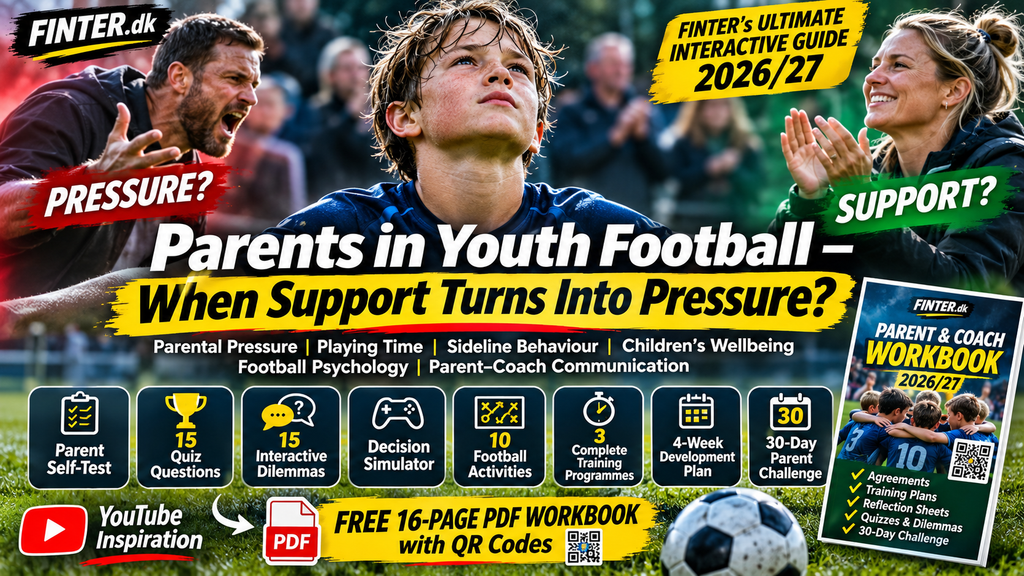
Parents in Youth Football – When Support Turns Into Pressure?
Are we helping children become better footballers, or are we accidentally making football harder for them?
FINTER’s ultimate interactive guide to parental pressure, playing time, sideline behaviour, youth development, football psychology, child wellbeing, coach-parent communication and positive football environments.
15 Quiz Questions · 15 Dilemmas · Parent Self-Test · Decision Simulator · 10 Football Activities · 3 Complete Training Sessions · 4-Week Plan · 30-Day Challenge · YouTube Inspiration · Free PDF Workbook
📘 FREE FINTER PARENT & COACH WORKBOOK
Download the printable 16-page workbook with parent agreements, reflection sheets, coaching activities, quizzes, dilemmas, training plans and QR codes.
📥 DOWNLOAD FREE PDF WORKBOOK16 pages · Printable · Free · FINTER 2026/27
⚽ Football Belongs to Children
Imagine a nine-year-old footballer arriving at the pitch.
The child is excited to see friends, play football and try new things.
The match begins.
Within seconds, adults start shouting instructions.
“Pass the ball!”
“Shoot!”
“Run faster!”
“Why didn’t you pass?”
The adults believe they are helping.
But what does the child experience?
FINTER’s Central Question
Are parents supporting children’s football development, or are they unintentionally taking control of their football experience?
Parents are essential to children’s participation in football. They provide transport, encouragement, emotional support and countless hours of commitment.
Without parents, grassroots football would struggle.
But love and ambition can sometimes become pressure.
Children may begin to feel that every mistake disappoints someone.
Some become afraid to try new things. Others lose confidence or enthusiasm.
The objective should not be to remove parents from children’s football.
It should be to help them support their children in the most constructive way possible.
🧠 When Does Parental Support Become Pressure?
The difference between encouragement and pressure is not always obvious.
A parent may believe that demanding more effort will help a child improve.
However, children can interpret adult expectations very differently.
🟢 Helpful Support
Encouraging effort.
Recognising improvement.
Allowing mistakes.
Supporting teammates.
Respecting coaches.
Listening to the child.
Protecting enjoyment.
🔴 Potential Pressure
Constant criticism.
Unrealistic expectations.
Comparing children.
Shouting instructions.
Focusing only on winning.
Questioning every decision.
Making football feel like an obligation.
Five Warning Signs
- The child becomes unusually anxious before matches.
- The child is afraid of making mistakes.
- Football conversations focus mainly on performance.
- The child worries excessively about disappointing adults.
- Enjoyment and motivation begin to disappear.
These signs do not prove that parental pressure is the cause.
Parents and coaches should listen carefully and explore what the child is experiencing.
📣 Sideline Behaviour – Green, Yellow and Red
Parents do not need to remain completely silent.
Positive encouragement can help create an enjoyable atmosphere.
The problem begins when encouragement becomes constant instruction or criticism.
🟢 GREEN
“Great effort!”
“Well done!”
“Keep trying!”
“Good teamwork!”
Applaud both teams and respect the referee.
🟡 YELLOW
“Pass!”
“Shoot!”
“Run!”
“Stay wide!”
Constant tactical instructions can create confusion and interfere with decision-making.
🔴 RED
“You’re playing terribly!”
“The referee is useless!”
“You’re better than your teammates!”
Insults, humiliation and aggressive behaviour are unacceptable.
FINTER’s Sideline Principle
Let coaches coach.
Let players play.
Let parents encourage.
⏱ Playing Time – The Biggest Source of Conflict?
Playing time is among the most emotional issues in youth football.
Parents naturally want their children to receive meaningful opportunities.
Coaches must consider the development and wellbeing of the entire group.
Both perspectives deserve to be heard.
Questions Parents Should Ask
- What is the club’s playing-time policy?
- Does every child receive meaningful opportunities?
- Does my child enjoy attending training and matches?
- Are players given opportunities in different positions?
- Is there a repeated problem rather than one difficult match?
Questions Coaches Should Ask
- Are our playing-time principles clear?
- Are less experienced players included?
- Do results influence our decisions too much?
- Are children learning and developing?
- Are parents receiving understandable explanations?
A Better Conversation
Instead of:
“Why does my child always sit on the bench?”
Try:
“Could we discuss your approach to playing time and how we can support my child’s development?”
Repeated exclusion should be taken seriously.
The goal is not simply to avoid conflict. It is to ensure fair opportunities and a positive football experience.
🚗 The Car Ride Home – A Crucial Moment
The match is finished.
Your child enters the car.
What happens next?
Some children want to discuss the match. Others want to relax or talk about something else.
Helpful Questions
“Did you enjoy yourself?”
“What was the best part?”
“What did you learn?”
“Would you like to talk about the match?”
Questions to Avoid
“Why didn’t you score?”
“Why did you make that mistake?”
“Why was your teammate better?”
“Why didn’t the coach play you more?”
“I really enjoyed watching you play.”
Sometimes those words are enough.
🤝 Better Communication Between Parents and Coaches
Strong youth football environments depend on respectful cooperation.
Parents should feel comfortable raising concerns.
Coaches should explain their principles and listen to different perspectives.
Five Communication Principles
- Discuss ordinary concerns privately.
- Listen before making assumptions.
- Focus on the child’s experience.
- Avoid comparisons with other children.
- Agree on practical next steps.
Concerns involving abuse, bullying, serious intimidation or children’s safety should be reported promptly through appropriate club safeguarding procedures.
🎯 Interactive Football Parent Self-Test
How supportive are your sideline habits?
Answer 10 questions and receive your personal reflection score.
This is a FINTER reflection exercise, not a validated psychological assessment.
🧠 FINTER’s 15-Question Football Parent Quiz
Test your knowledge about parental pressure, positive coaching and youth football development.
🎮 Interactive Parent Decision Simulator
What would you do in a difficult football situation?
Choose a scenario and explore the consequences of different adult reactions.
🤔 15 Interactive Football Parent Dilemmas
There is rarely one perfect answer to every situation in youth football.
Explore these situations and discuss the best approach with coaches and other parents.
⚽ 10 Practical Football Activities That Reduce Pressure
The following activities are FINTER suggestions designed to encourage creativity, decision-making and enjoyment.
1. Creative 1v1
Age: U6–U12
Time: 10 minutes
Play 1v1 on small pitches with two goals.
Encourage dribbling, feints and experimentation.
Parent lesson: Celebrate attempts rather than only goals.
2. Play and Move
Age: U8–U14
Time: 12 minutes
Play 3v3 and encourage continuous movement after passing.
Parent lesson: Recognise teamwork and movement without the ball.
3. Mistakes Are Allowed
Age: U6–U12
Time: 10 minutes
Play 2v2 and encourage children to try unfamiliar solutions.
Parent lesson: Avoid criticising unsuccessful attempts.
4. The Decision Game
Age: U9–U15
Time: 12 minutes
Play 3v3 with two small goals at each end.
Players decide which goal to attack.
Parent lesson: Allow children to solve football situations.
5. Everyone Contributes
Age: U6–U11
Time: 12 minutes
Use rotating 3v3 matches.
Encourage different players to experience attacking and defending.
Parent lesson: Recognise everyone’s contribution.
6. The Comeback Game
Age: U9–Senior
Time: 15 minutes
Start a 4v4 game with one team two goals behind.
Parent lesson: Praise persistence rather than only results.
7. Positive Communication
Age: U8–U15
Time: 12 minutes
Play 3v3 and encourage helpful communication between teammates.
Parent lesson: Notice encouragement and teamwork.
8. Position Rotation
Age: U7–U13
Time: 15 minutes
Play 4v4 and rotate positions between matches.
Parent lesson: Avoid labelling children too early.
9. React After Losing Possession
Age: U8–Senior
Time: 12 minutes
Play 3v3 with immediate pressure after losing the ball.
Parent lesson: Recognise effort following mistakes.
10. Football Joy Festival
Age: U5–U12
Time: 20 minutes
Rotate between creative dribbling, small-sided games and football challenges.
Parent lesson: Football should remain enjoyable.
📋 Three Complete Football Training Programmes
These FINTER training plans combine small-sided games, creativity, movement and positive coaching.
Programme 1 – 60 Minutes
| Time | Activity | Focus |
|---|---|---|
| 0–10 | Ball mastery | Creativity and confidence |
| 10–25 | 1v1 and 2v2 | Individual decisions |
| 25–40 | 3v3 | Movement and teamwork |
| 40–55 | Small-sided matches | Playing freely |
| 55–60 | Reflection | Enjoyment and learning |
Programme 2 – 75 Minutes
| Time | Activity | Focus |
|---|---|---|
| 0–10 | Creative warm-up | Ball confidence |
| 10–25 | 1v1 stations | Dribbling |
| 25–40 | 2v2 | Cooperation |
| 40–55 | 3v3 | Decision-making |
| 55–70 | 4v4 tournament | Game intelligence |
| 70–75 | Player feedback | Reflection |
Programme 3 – 90 Minutes
| Time | Activity | Focus |
|---|---|---|
| 0–15 | Ball mastery | Creativity |
| 15–30 | 1v1 | Individual skills |
| 30–45 | 2v2 | Cooperation |
| 45–60 | 3v3 | Movement and decisions |
| 60–80 | 4v4 tournament | Game understanding |
| 80–90 | Reflection and team discussion | Learning and confidence |
Important Coaching Principle
Avoid unnecessary interruptions.
Let the games run long enough for children to experience real football situations.
Coach individual players when appropriate, but avoid constantly stopping everyone.
Encourage movement when the team has possession and immediate collective reactions after losing the ball.
📅 Four-Week Parent and Coach Development Plan
Week 1 – Observe
Notice sideline behaviour, adult communication and children’s reactions.
Ask children what makes football enjoyable.
Week 2 – Improve Communication
Agree on club expectations, playing-time principles and positive sideline language.
Week 3 – Encourage Independence
Reduce unnecessary adult instructions.
Create more opportunities for children to make decisions.
Week 4 – Evaluate
Ask children how they experience matches.
Discuss what parents and coaches have improved.
Agree on the next development goals.
🏆 FINTER’s 30-Day Positive Football Parent Challenge
Can you improve your football parenting habits over the next 30 days?
Tick each activity when completed.
🤝 A 30-Minute Parent Meeting
Every youth football team should establish clear expectations between parents and coaches.
| Minutes | Topic |
|---|---|
| 0–5 | Football enjoyment and club values |
| 5–12 | Positive sideline behaviour |
| 12–20 | Playing time and player development |
| 20–27 | Parent dilemmas and communication |
| 27–30 | Common agreement and next steps |
👧 Children’s Own Football Wellbeing Check
Children should have a voice in their football experience.
Do you enjoy going to football training?
Do you feel safe and welcome?
Are you allowed to make mistakes?
Do you feel listened to?
Do you enjoy playing matches?
Do you feel pressure from adults?
Do you have friends on the team?
What could adults do better?
These questions should start a supportive conversation, not become another performance test.
🎥 12 YouTube Resources About Positive Football Parenting
Explore videos and presentations about youth football, sideline behaviour, coaching and child development.
These links open topic-based YouTube searches, not individually verified videos.
1. Positive Football Parenting
Watch on YouTube →2. Sideline Behaviour
Watch on YouTube →3. Parental Pressure
Watch on YouTube →4. The FA Respect
Watch on YouTube →5. U.S. Soccer Parenting
Watch on YouTube →6. Children’s Football Psychology
Watch on YouTube →7. Football Motivation
Watch on YouTube →8. Coach-Parent Communication
Watch on YouTube →9. Playing Time
Watch on YouTube →10. Football Confidence
Watch on YouTube →11. Small-Sided Games
Watch on YouTube →12. Child-Centred Coaching
Watch on YouTube →📋 Printable Football Parent Agreement
Our Positive Football Parent Agreement
We encourage without excessive instructions.
We respect coaches, referees and opponents.
We never criticise other children.
We allow mistakes and experimentation.
We prioritise enjoyment and development.
We communicate concerns respectfully.
We listen to children’s experiences.
We take safeguarding seriously.
We remember that football belongs to children.
Parent: __________________________
Team: ____________________________
Date: ____________________________
❓ Frequently Asked Questions
How can parents support children in football?
Encourage effort and enjoyment, respect coaches and officials, and listen to children’s experiences.
Can parents put too much pressure on young players?
Yes. Constant criticism, comparisons, unrealistic expectations and excessive instructions can create unnecessary pressure.
Should parents coach from the sidelines?
Positive encouragement is generally more helpful than constant tactical instructions.
What should parents do about playing time?
Understand the club’s principles, listen to the child and discuss repeated concerns respectfully.
How should parents react after a defeat?
Offer support, recognise effort and allow the child to decide whether to discuss the match.
What if a coach behaves unfairly?
Raise concerns through appropriate club channels. Serious welfare and safeguarding issues should be reported promptly.
Are the FINTER self-tests scientific assessments?
No. They are practical reflection tools designed to encourage discussion.
🔗 Explore More FINTER Football Guides
Myths About Children’s Football
Read FINTER’s Guide →Positive Football Parenting
Explore the Parent Guide →Children’s Football Coaching
Read the Coaching Guide →Small-Sided Football Training
Discover Small-Sided Games →Official Resources
🏁 Final Thoughts – Let Children Own Their Football Journey
Every parent wants the best for their child.
But supporting a footballer does not mean controlling every pass, mistake or result.
Sometimes the most important thing an adult can do is step back.
Let children dribble.
Let them pass.
Let them make mistakes.
Let them celebrate.
Let them learn.
And most importantly:
Let them enjoy football.
Because football development should not only create better players.
It should also help children become confident, curious and resilient people.
FINTER.dk – Better Football Through Knowledge, Creativity and Development.