
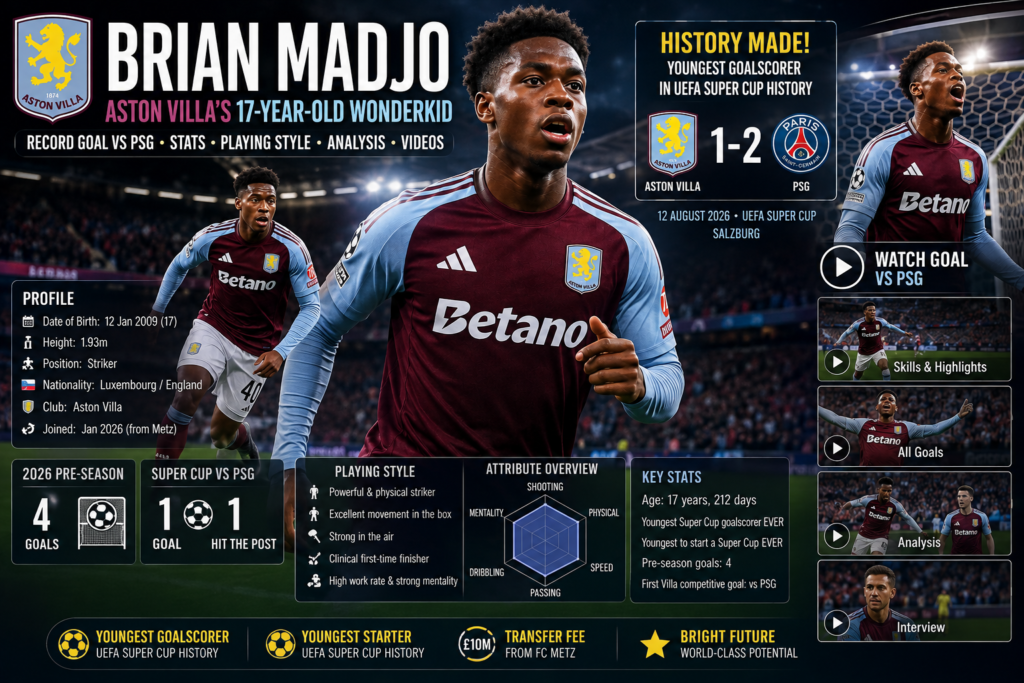
Who Is Brian Madjo? Aston Villa’s 17-Year-Old Sensation Who Made History Against PSG
Seventeen years old.
Making his official Aston Villa debut.
Facing Paris Saint-Germain.
Playing in the UEFA Super Cup.
And scoring.
Brian Madjo could hardly have chosen a bigger stage for his breakthrough.
On 12 August 2026, Aston Villa faced European champions Paris Saint-Germain in the UEFA Super Cup in Salzburg.
Villa eventually lost 2-1.
But one of the biggest stories of the night was not PSG.
It was Aston Villa’s teenage centre-forward.
Madjo started the match aged just 17 years and 212 days, making him the youngest player on record to start a UEFA Super Cup match.
Before half-time, he went one step further.
John McGinn delivered from the right, Madjo fought off PSG defender Willian Pacho and volleyed the ball into the roof of the net.
He had become the youngest goalscorer in UEFA Super Cup history.
And suddenly football fans across Europe were asking the same question:
Who is Brian Madjo?
This is the complete story of Aston Villa’s extraordinary 17-year-old striker: his childhood, Metz breakthrough, transfer to Villa, unusual FIFA registration battle, historic PSG performance, statistics, playing style, strengths, development areas, tactical potential, training ideas and the best Brian Madjo videos to watch.
Brian Madjo: Quick Facts
| Information | Brian Madjo |
|---|---|
| Full name | Brian Djomeni Madjo |
| Date of birth | 12 January 2009 |
| Birthplace | Enfield, England |
| Age in August 2026 | 17 |
| Position | Centre-forward |
| Height | Approx. 1.93m / 6’4″ |
| Current club | Aston Villa |
| Former senior club | FC Metz |
| Joined Aston Villa | January 2026 |
| Reported transfer fee | Around £10 million |
| International background | Luxembourg senior team / England youth |
| Major breakthrough | UEFA Super Cup vs PSG |
| Super Cup record | Youngest goalscorer |
| Age when scoring | 17 years, 212 days |
Reuters reports that the England-born striker stands around 6’4″, grew up in Luxembourg and joined Aston Villa from Metz for approximately £10 million.
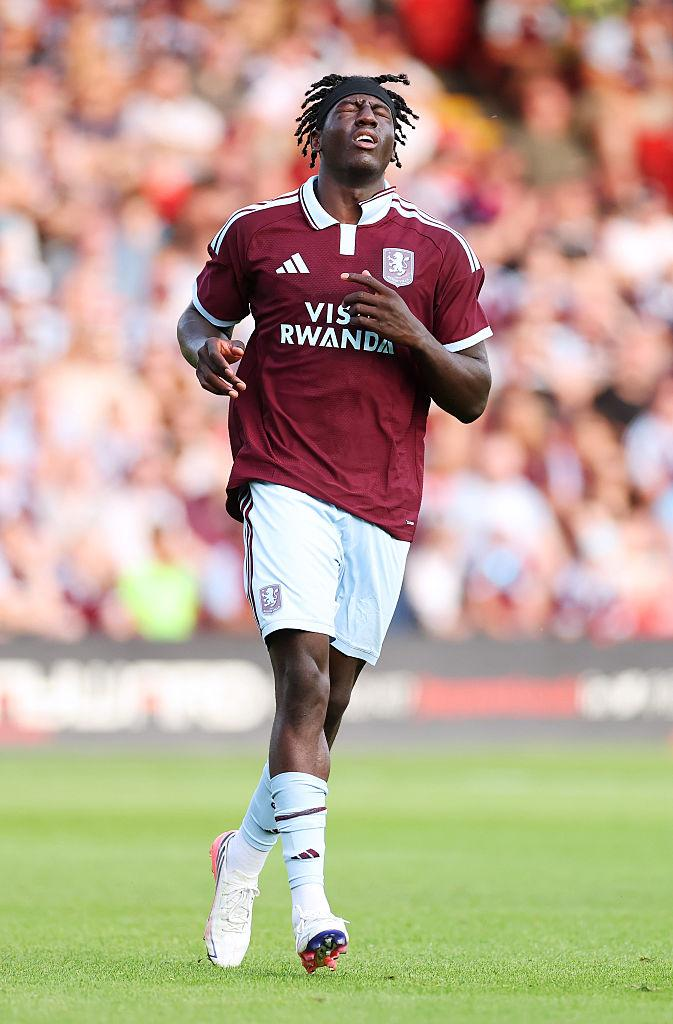
Brian Madjo vs PSG: The Match That Changed Everything
This was not an easy first official match.
Madjo was facing one of the strongest teams in world football.
Paris Saint-Germain had won consecutive Champions League titles and Villa were facing defenders accustomed to playing against elite international forwards.
Yet Unai Emery trusted the teenager from the start.
And Madjo did not hide.
He repeatedly attacked the penalty area.
He competed physically.
He challenged PSG’s central defenders.
And most importantly, he kept putting himself into goalscoring positions.
UEFA’s match report records that Madjo:
- headed two opportunities wide,
- hit the post from close range,
- continued searching for another chance,
- and finally scored just before half-time.
That sequence tells us almost as much about Madjo as the goal itself.
Brian Madjo vs PSG – Attacking Analysis
| Situation | Outcome | What It Shows |
|---|---|---|
| Early header | Wide | Attacks dangerous crossing positions |
| Second headed chance | Wide | Repeated penalty-box movement |
| Close-range effort | Post | Natural instinct for goal areas |
| McGinn cross | Goal | Strength, timing and first-time finishing |
| Second-half transition | Created McGinn chance | Ability to carry the ball and connect attacks |
Reuters noted that Madjo kept getting himself into threatening positions despite several earlier misses. Shortly before half-time, McGinn found him again and Madjo physically competed with Pacho before finishing first-time.
That mentality matters.
A striker cannot allow one missed opportunity to destroy the next one.
Madjo did exactly the opposite.
He kept arriving.
The Historic Goal Against PSG
The goal itself is worth analysing.
John McGinn received possession on Aston Villa’s right.
The Villa captain delivered towards the far side of the six-yard area.
Madjo had Willian Pacho close to him.
Instead of moving away from the defender, the 17-year-old accepted the physical contact.
He protected his space.
He tracked the flight of the ball.
And he finished without needing an additional controlling touch.
The ball flew into the roof of the net.
PSG 1-1 Aston Villa.
UEFA recorded Madjo as the youngest Super Cup goalscorer ever at 17 years and 212 days.
Why the Goal Was So Impressive
Young forwards often want an extra touch.
Madjo did not have time.
Against elite defenders, one extra touch can allow:
- the centre-back to recover,
- another defender to block,
- the goalkeeper to close the angle.
Madjo therefore used one of football’s most valuable finishing weapons:
the first-time finish.
That ability will be extremely important if he develops into a Premier League-level striker.
Brian Madjo Broke Patrick Kluivert’s Record
Before Madjo, Patrick Kluivert had been one of the youngest players to make a major impact in this competition.
Madjo’s goal moved the record to a completely different age category.
| Player | Age |
|---|---|
| Brian Madjo | 17 years, 212 days |
| Patrick Kluivert | 19 years, 220 days |
Madjo was therefore more than two years younger than Kluivert when setting the record. UEFA confirms both Madjo’s starting and goalscoring records.
Two Records in One Night
Madjo did not only become the youngest scorer.
He also became the youngest player on record to start a UEFA Super Cup match.
So his official Aston Villa debut produced:
Record No. 1: Youngest Super Cup starter.
Record No. 2: Youngest Super Cup goalscorer.
Not bad for your first competitive match for a new club.
Where Was Brian Madjo Born?
Brian Madjo was born in Enfield in north London on 12 January 2009.
However, his football development is more international than his birthplace suggests.
He grew up in Luxembourg and progressed through football there before eventually moving into FC Metz’s academy system in France.
That background explains his unusual international career.
Madjo has already represented Luxembourg at senior international level and later played for England at U17 level. Reuters reported nine England U17 appearances before his Villa breakthrough.
Brian Madjo’s International Career
The striker’s international pathway is unusual.
He played three times for Luxembourg’s senior national team before later representing England at youth level.
England selected him for their U17 programme during the 2025/26 season.
He quickly scored.
Against Venezuela in September 2025, Madjo equalised with a first-time finish in England’s 2-1 victory.
That finish is particularly interesting when compared with his PSG goal.
Both demonstrate confidence attacking the ball directly rather than always taking extra touches.
Madjo Scored Twice Against Sweden
His England U17 performances included another important scoring display against Sweden.
Madjo opened the scoring after 13 minutes and later added a second goal in stoppage time.
England lost the match 5-3, but Madjo again demonstrated his ability to score internationally.
England U17 vs USA
Madjo also scored from the penalty spot as England U17 defeated the United States 5-2 in Dubai in November 2025.
His early international experience therefore already includes:
- senior international football,
- England youth football,
- European youth qualifiers,
- international tournament environments,
- different tactical systems,
- different football cultures.
That can be valuable for a player’s development.
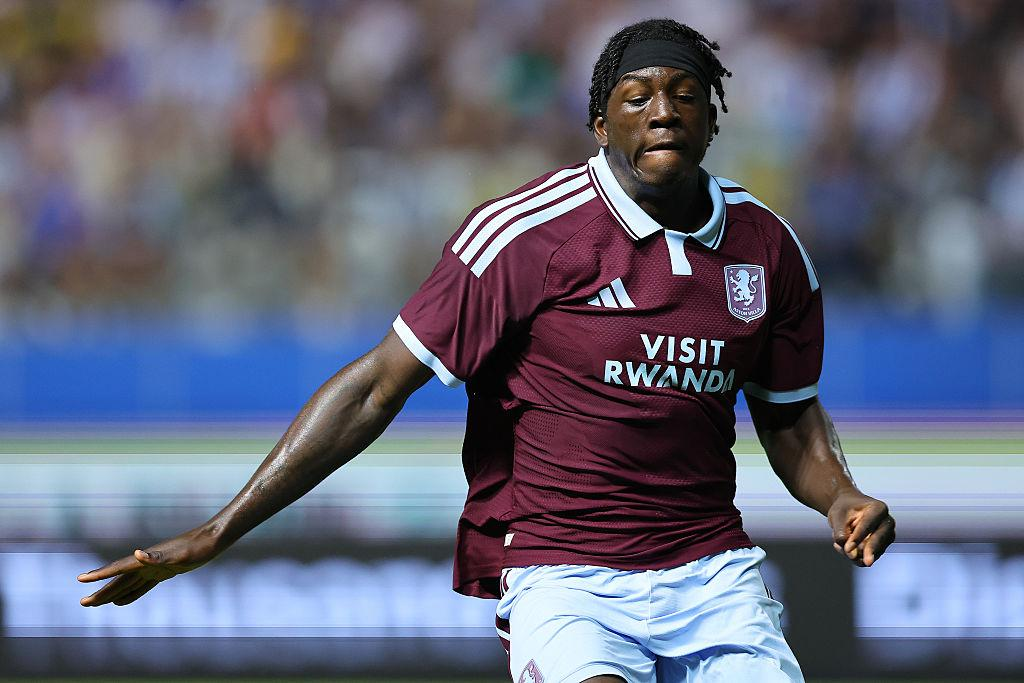
Brian Madjo at FC Metz
Madjo’s route into professional football continued in France.
FC Metz have a strong reputation for developing talented young footballers.
The teenager began attracting attention before he had established himself as a senior professional.
He eventually reached Ligue 1 football at just 16.
Playing senior football at that age is significant.
The physical difference between youth football and Ligue 1 can be enormous.
Yet Madjo’s physical profile helped him make the transition unusually early.
Why Aston Villa Wanted Him
Aston Villa were not buying a finished Premier League striker.
They were investing in what Madjo could become.
The profile was extremely attractive:
| Quality | Why Villa Could Value It |
|---|---|
| Height | Gives a natural aerial threat |
| Strength | Useful against Premier League defenders |
| Youth | Huge development window |
| Penalty-box movement | Essential for elite strikers |
| International experience | Already exposed to senior football |
| Athletic potential | Can develop into a powerful No.9 |
| Finishing instinct | Regularly arrives in scoring areas |
| Mentality | Does not disappear after missing chances |
A striker with size is useful.
A striker with size, movement and technical potential is much more interesting.
Aston Villa Signed Him on His 17th Birthday
Madjo joined Aston Villa from Metz in January 2026.
Remarkably, the deal was completed around his 17th birthday.
Reuters reported a transfer value of approximately £10 million.
That is a substantial investment in a player with very limited senior experience.
It shows how highly Villa rated his long-term potential.
Then Came the FIFA Registration Problem
Madjo’s Aston Villa story became extremely unusual before he had even played.
FIFA initially blocked Villa from registering him.
The dispute centred on regulations limiting international transfers of players under the age of 18.
Villa’s position was unusual because Madjo:
- was born in England,
- held UK citizenship,
- but had grown up in Luxembourg,
- and had represented Luxembourg internationally.
Villa argued that he should be treated as an English player.
FIFA initially considered the Metz-to-Villa move an international transfer involving a minor.
Aston Villa Took the Case to CAS
Villa appealed to the Court of Arbitration for Sport.
On 4 August 2026, CAS upheld the club’s appeal.
Madjo could finally be registered for competitive matches.
Consider the timeline:
| Date | Event |
|---|---|
| January 2026 | Villa sign Madjo |
| First half of 2026 | Registration dispute prevents official appearances |
| 4 August 2026 | CAS clears the registration |
| 12 August 2026 | Madjo starts against PSG |
| 12 August 2026 | Madjo scores and breaks Super Cup record |
Eight days after the CAS decision, he was scoring against PSG.
It is a remarkable football story.
Four Pre-Season Goals Before PSG
The PSG goal did not appear from nowhere.
Madjo had already scored four times during Aston Villa’s pre-season before competitive football started. Reuters specifically highlighted the four-goal return when reporting Villa’s successful appeal.
Two came against Walsall.
He later scored again during Villa’s preparation, with his fourth pre-season goal coming in the 3-1 victory over Indonesia All Stars.
This mattered.
It gave Emery evidence that the teenager could affect senior matches.
Brian Madjo: Career Timeline
| Year | Age | Development |
|---|---|---|
| 2009 | 0 | Born in Enfield |
| Youth career | – | Develops in Luxembourg |
| 2023 | 14 | Progresses to Metz |
| 2025 | 16 | Senior Luxembourg appearances |
| 2025 | 16 | Makes Ligue 1 breakthrough |
| 2025 | 16 | Joins England U17 setup |
| January 2026 | 17 | Signs for Aston Villa |
| Summer 2026 | 17 | Scores four pre-season goals |
| August 2026 | 17 | CAS clears registration |
| 12 August 2026 | 17 | Competitive Aston Villa debut |
| 12 August 2026 | 17 | Scores against PSG |
| 12 August 2026 | 17 | Becomes youngest Super Cup scorer |
What Type of Striker Is Brian Madjo?
The easiest description is:
a powerful modern centre-forward.
But that description alone does not explain why he is so interesting.
The most promising feature of Madjo’s game may eventually be the combination of:
size + movement + aggressive penalty-box positioning.
Many tall strikers become static.
Madjo does not appear to want to wait for the ball.
Against PSG, he repeatedly made movements towards areas where a cross could reach him.
That is encouraging.

Finter.dk Scouting Analysis: Brian Madjo
Important: The ratings below are Finter.dk editorial scouting assessments based on his emerging senior profile and performances such as the Super Cup. They are not official Opta or UEFA ratings.
| Attribute | Finter Rating | Analysis |
|---|---|---|
| Physical strength | 9/10 | Exceptional physical profile for a 17-year-old |
| Penalty-box movement | 8.5/10 | Constantly attacks dangerous areas |
| Mentality | 9/10 | Responded impressively after missed chances |
| Heading potential | 8/10 | Height and movement create aerial threat |
| First-time finishing | 8/10 | PSG and England goals offer good examples |
| Movement without ball | 8.5/10 | Potentially one of his biggest weapons |
| Hold-up potential | 8/10 | Size allows him to protect possession |
| Acceleration | 7.5/10 | Mobile for such a large striker |
| First touch | 7/10 | Important development area |
| Dribbling | 7/10 | Capable but not yet the defining part of his game |
| Link play | 7/10 | Can improve combinations with midfielders |
| Pressing | 7.5/10 | Physical tools are present |
| Overall potential | 9.5/10 | Exceptionally interesting profile, but still very young |
1. Physical Strength
This is the obvious starting point.
At approximately 1.93m, Madjo already has the frame of a senior centre-forward.
But size alone means little.
The real question is whether a player can use it.
Against PSG, Madjo showed he was willing to accept physical contact against Willian Pacho.
For the equaliser, he did not try to avoid the defender.
He competed.
Reuters noted that his powerful appearance has already encouraged comparisons with Romelu Lukaku and former Aston Villa striker Emile Heskey.
Those comparisons are about profile, not current ability.
Madjo still has a long way to go before being compared with Lukaku’s career achievements.
2. Penalty-Box Movement
This may be more important than his height.
The PSG match provided repeated evidence.
Madjo kept appearing where dangerous deliveries arrived.
Elite strikers understand that scoring is partly about probability.
The more often you arrive in dangerous spaces, the greater your chance of receiving a valuable opportunity.
Madjo’s Super Cup performance showed excellent early instincts in this area.
3. Aerial Ability
A 1.93m striker should naturally become a threat from crosses.
Madjo already attacks aerial balls aggressively.
But heading is much more than being tall.
Top-level heading requires:
- scanning the defender,
- anticipating the delivery,
- changing running speed,
- jumping at the correct moment,
- creating separation,
- controlling body position,
- directing the header rather than simply hitting it hard.
For more English Finter.dk reading on football’s greatest aerial scorers:
The guide examines heading specialists including Cristiano Ronaldo, Peter Crouch and Miroslav Klose.
4. First-Time Finishing
Madjo’s PSG goal is an excellent learning example.
The ball arrives.
He finishes.
There is no unnecessary additional touch.
This is particularly valuable in the six-yard box.
Against elite defenders, the difference between scoring and having a shot blocked may be less than one second.
5. Mentality After Missing Chances
Perhaps the most impressive part of Madjo’s Super Cup debut was not the goal.
It was what happened before the goal.
He had missed.
Again.
And again.
He also lost possession before PSG’s opener.
A 17-year-old making his debut could easily have disappeared mentally.
Madjo continued attacking.
McGinn praised exactly that ability after the game: good strikers continue putting themselves into goalscoring positions.
That is a major lesson for every young striker.
The Striker Rule: The Next Chance Matters Most
Every goalscorer misses.
Harry Kane misses.
Erling Haaland misses.
Kylian Mbappé misses.
The difference is that elite goalscorers keep searching for the next opportunity.
Young players should remember:
Miss → reset → move → demand the next ball.
For more English reading about mentality and composure:
This English Finter.dk guide explores composure, scanning, decision-making and first touch.
6. Movement Without the Ball
Football highlights naturally focus on the player with possession.
But strikers often create their most important advantage before touching the ball.
Study Madjo and watch:
- where he positions himself between defenders,
- when he attacks the back post,
- when he moves across a centre-back,
- whether he checks away before attacking the box,
- when he accelerates.
Movement can turn an ordinary cross into a major opportunity.
7. Link-Up Play
Madjo’s second-half action against PSG also showed another possibility.
He drove into attacking territory before connecting with McGinn, whose shot forced a save.
The next stage of his development will include becoming more than a penalty-box striker.
A top modern No.9 may need to:
- receive between lines,
- protect possession,
- set midfielders,
- combine with wingers,
- switch play,
- create space for runners.
8. First Touch Under Pressure
This is an area that should naturally develop with experience.
Premier League defenders do not allow much time.
Madjo will increasingly receive the ball with:
- a centre-back directly behind him,
- a midfielder closing from the side,
- another defender anticipating the layoff.
A clean first touch therefore becomes essential.
Young players can learn the technical foundations here:
9. Scanning
Scanning may become one of the most important additions to Madjo’s game.
Before receiving, an elite striker needs to know:
Where is the centre-back?
Where is the second defender?
Can I turn?
Should I protect the ball?
Where is the goalkeeper?
Which teammate is running beyond me?
Read Finter.dk’s full English guide:
10. Football Intelligence
A player can be bigger and faster than everyone at youth level.
Senior football changes the equation.
The best players need to solve situations faster.
That includes understanding:
- space,
- timing,
- pressure,
- numerical advantages,
- defender movements,
- transition moments.
Read:
https://finter.dk/the-complete-guide-to-football-game-intelligence
Finter.dk’s English football intelligence material focuses on these exact decision-making principles.
What Do Scouts See in Brian Madjo?
Scouts are unlikely to evaluate him only by counting goals.
They will consider whether his attributes are transferable to elite senior football.
| Scouting Question | Madjo |
|---|---|
| Does he have elite physical potential? | Yes |
| Can he compete against senior defenders? | Early evidence says yes |
| Does he attack scoring positions? | Very promising |
| Is he mentally aggressive? | Promising |
| Does he have international experience? | Yes |
| Can technique improve further? | Yes |
| Is he already a finished player? | Absolutely not |
| Is the ceiling unusually high? | Potentially |
Learn what professional scouts actually look for:
Brian Madjo Tactical Analysis
4-2-3-1
This looks like a natural system for him.
Madjo operates as the central No.9.
A creative No.10 plays underneath.
Two wide attackers provide:
- crosses,
- cutbacks,
- combinations,
- runs behind.
Madjo can pin the central defenders and create space behind midfield.
Finter rating for fit: 9/10
Brian Madjo in a 4-3-3
Another excellent fit.
Madjo can become the reference point.
The two wingers can make diagonal movements around him.
His tasks could include:
- occupying centre-backs,
- attacking crosses,
- receiving direct passes,
- creating wall passes,
- pressing central defenders.
Finter rating for fit: 9/10
Brian Madjo in a Two-Striker System
This could also become interesting.
Pair Madjo with a smaller, faster forward.
Madjo occupies defenders.
The second striker attacks the space around him.
The combination can produce:
Power + movement.
Finter rating for fit: 8/10
Why Small-Sided Games Can Help His Development
Even a physically dominant striker needs frequent technical decisions.
Small-sided games force players to:
- receive under pressure,
- scan,
- combine quickly,
- turn,
- finish,
- transition,
- press.
Finter.dk’s complete English guide:
Brian Madjo vs Romelu Lukaku
The Lukaku comparison is understandable physically, and Reuters reported that observers were already making it after the PSG match.
But comparisons need context.
| Attribute | Madjo Profile | Lukaku Profile |
|---|---|---|
| Large frame | Yes | Yes |
| Centre-forward | Yes | Yes |
| Physical power | Major weapon | Major weapon |
| Attacks space | Yes | Yes |
| Aerial potential | High | High |
| Senior experience | Very limited | Vast |
| Elite goalscoring record | Not yet | Proven |
| Development stage | 17 years old | Established veteran |
The useful comparison is style.
Not achievement.
Brian Madjo vs Erling Haaland
There will inevitably be Haaland comparisons as well.
Both profiles involve a large striker attacking the penalty area directly.
But comparing a 17-year-old to one of the world’s most established goalscorers is premature.
The interesting lesson from Haaland is not simply physical size.
It is how aggressively elite strikers attack high-value spaces.
Madjo’s PSG performance showed early signs of the same fundamental principle:
Get where goals happen.
Brian Madjo vs Harry Kane
Harry Kane offers another interesting developmental reference.
Kane combines scoring with:
- link play,
- scanning,
- passing,
- movement,
- finishing from different zones.
Madjo does not currently have Kane’s complete passing game.
But developing more link play would make the young Villa forward substantially harder to defend.
Read the full English Harry Kane story:
What Brian Madjo Still Needs to Improve
The hype should not hide reality.
Madjo is 17.
He is nowhere near a finished footballer.
Five Major Development Areas
| Priority | Area | Why It Matters |
|---|---|---|
| 1 | First touch under pressure | Premier League defenders close instantly |
| 2 | Weak-foot development | Makes finishing less predictable |
| 3 | Link-up passing | Essential in possession structures |
| 4 | Scanning | Improves speed of decisions |
| 5 | Finishing consistency | More chances must become goals |
The exciting part is that his physical base is already unusual.
Technical improvement could multiply its value.
How Young Players Can Train Like a Brian Madjo-Type Striker
You cannot train yourself to become 1.93m tall.
But you can train the football qualities behind his game.
Drill 1: Cross and First-Time Finish
Setup:
One player wide.
One striker central.
The striker initially moves away from goal.
Then accelerates into the penalty area.
The wide player delivers.
Finish with one touch.
Variations
- right foot,
- left foot,
- near post,
- far post,
- low cutback,
- header.
The key is timing.
Drill 2: Hold-Up Play Under Pressure
Place a defender directly behind the striker.
Pass into the striker’s feet.
The attacker must:
- receive,
- protect the ball,
- lay it off,
- spin,
- receive again,
- finish.
This develops one of the most important skills for a powerful No.9.
Drill 3: Near Post vs Far Post
A striker starts centrally.
A server attacks from wide.
The striker must read the server’s body position and choose:
Near post
or
Far post.
Do not make the movement automatic.
The player must read the situation.
That develops football intelligence.
Drill 4: Five Chances – No Reaction
Give the striker five shots in quick succession.
After every attempt, immediately serve the next ball.
Score?
Next ball.
Miss?
Next ball.
Hit the post?
Next ball.
The purpose is psychological:
Do not allow the previous finish to affect the next one.
That principle was clearly visible in Madjo’s PSG debut.
Drill 5: 2v2 to Goal
Two attackers.
Two defenders.
Small area.
Real goal.
Play quick rounds.
This forces the striker to:
- protect possession,
- create separation,
- combine,
- finish under pressure,
- react to transitions.
More English exercises:
Complete Training Session for Young Strikers
Coaches can combine the Madjo-inspired ideas into one session.
| Section | Time | Focus |
|---|---|---|
| Ball warm-up | 10 min | Touches and mobility |
| First touch | 10 min | Receive under pressure |
| Hold-up play | 15 min | Protect and combine |
| Crossing | 15 min | Penalty-box timing |
| Finishing | 15 min | One-touch scoring |
| 3v3/4v4 game | 20 min | Decisions and movement |
| Free finishing | 10 min | Confidence |
For a complete English session structure:
Best Brian Madjo YouTube Videos
1. Brian Madjo Joins Aston Villa
NEW SIGNING | Brian Madjo Joins Aston Villa
https://www.youtube.com/watch?v=-MXGdIBobsg
This is the Aston Villa signing video introducing Madjo after his move from Metz.
2. Brian Madjo vs PSG – Super Cup Reaction
Magic Madjo impresses in Aston Villa’s 2-1 defeat to PSG
The video focuses on his historic Super Cup performance.
3. Brian Madjo Makes History Against PSG
https://www.youtube.com/watch?v=DqMxDnjRDS8
Analysis and reaction to the 2-1 Super Cup final and Madjo’s record-breaking goal.
4. Walsall 0-5 Aston Villa – Madjo Scores Twice
https://www.youtube.com/watch?v=ikqtVCsQ7ok
Madjo scored a first-half double as Villa began pre-season strongly.
5. Brian Madjo – Metz Goals, Skills and Passes
https://www.youtube.com/watch?v=LftKOjkn6Xg
A useful compilation for studying his game before Aston Villa.
6. Brian Madjo at 16
https://www.youtube.com/watch?v=4tISr20HyjI
Footage from his development period at Metz.
7. Brian Madjo – Young Striker Compilation
https://www.youtube.com/watch?v=prk1l2zFF7o
Another compilation showing his physical and attacking qualities.
8. Tactical Analysis of Brian Madjo
https://www.youtube.com/watch?v=NLtbklfPMeI
An analysis of Villa’s young striker and his playing profile.
9. Brian Madjo Transfer Lowdown
https://www.youtube.com/watch?v=ckHjUUuBRv0
A French-football perspective on Aston Villa signing Madjo.
10. Aston Villa Win the Brian Madjo Appeal
https://www.youtube.com/watch?v=loP8EGYuYUU
Discussion of the CAS decision that finally allowed Madjo to play competitive football for Villa.
What Should You Watch in the Videos?
Do not only watch the goals.
Study the moments before the finish.
Look for:
Positioning: Where is Madjo when the attack begins?
Scanning: Does he look behind himself?
Movement: When does he accelerate?
Contact: How does he use his body against defenders?
First touch: Does it move him towards the next action?
Finishing: How many touches does he use?
Mentality: What happens after he misses?
That is how players and coaches can turn highlights into real football learning.
More English Football Analysis on Finter.dk
Every Finter.dk link in this section leads to an English-language football article or guide.
English Finter.dk Football Homepage
Finter.dk’s English football universe includes training, tactics, player development, records, videos and player stories.
World’s Youngest Football Teams in 2026
World’s Best Dribblers 2025/26
Most Goals Ever
Football Skills for Kids
Ultimate Football Drills for Kids
Small-Sided Games in Football
Soccer Training Session Plan
Football Scanning Explained
What Do Football Scouts Really Look For?
Bradley Barcola – PSG’s Lightning-Fast Superstar
Jude Bellingham – The Ultimate Guide
Harry Kane – England’s Greatest Goalscorer
The Strangest Football Records Ever
The Ultimate Football YouTube Encyclopedia
The 100 Greatest Football “What If?” Stories
World Cup 2026 – Most Goals and Assists
Brian Madjo: Five Key Takeaways
| No. | Key Fact |
|---|---|
| 1 | Madjo was born on 12 January 2009 |
| 2 | Aston Villa signed him from Metz in January 2026 |
| 3 | He scored four goals during Villa’s 2026 pre-season |
| 4 | He scored against PSG on his official Aston Villa debut |
| 5 | At 17 years and 212 days, he became the youngest UEFA Super Cup scorer ever |
The Super Cup age and record are confirmed by UEFA.
Brian Madjo FAQ
How old is Brian Madjo?
Brian Madjo was born on 12 January 2009, making him 17 during the start of the 2026/27 season.
Which club does Brian Madjo play for?
He plays for Aston Villa.
What position does Brian Madjo play?
Madjo is primarily a centre-forward.
How tall is Brian Madjo?
He is approximately 1.93 metres or 6’4″.
Where was Brian Madjo born?
He was born in Enfield, England but grew up in Luxembourg.
Which club did Aston Villa sign Brian Madjo from?
Villa signed him from FC Metz in January 2026.
How much did Aston Villa pay for Brian Madjo?
Reuters reported a fee of approximately £10 million.
Did Brian Madjo score against PSG?
Yes.
He equalised for Aston Villa against PSG in the 2026 UEFA Super Cup.
How old was Brian Madjo when he scored against PSG?
He was 17 years and 212 days old.
What record did Brian Madjo break?
He became the youngest goalscorer in UEFA Super Cup history and was also the youngest player on record to start a Super Cup match.
Did Brian Madjo play for Luxembourg?
Yes.
He made three senior appearances for Luxembourg before later representing England at youth level.
Has Brian Madjo played for England?
Yes.
He has represented England U17 and scored goals for the Young Lions.
How many pre-season goals did Brian Madjo score for Aston Villa?
He scored four goals before the 2026/27 competitive season began.
Why could Brian Madjo not play for Aston Villa immediately?
FIFA initially blocked his registration because of regulations surrounding international transfers involving players under 18. Aston Villa appealed to CAS and won, allowing him to be registered.
Is Brian Madjo the next Romelu Lukaku?
It is far too early to make that claim.
The comparison is based mainly on Madjo’s size, power and striker profile. Reuters reported that Lukaku and Emile Heskey comparisons were already being made after his Super Cup display.
Can Brian Madjo become world class?
Possibly, but his career is still at a very early stage.
His physical qualities, movement, penalty-box instincts and mentality provide an exciting foundation.
The next challenge is turning potential into consistent Premier League performances.
Final Verdict: How Good Can Brian Madjo Become?
Football loves a wonderkid.
But it also teaches us to be careful.
One great match does not create a superstar.
One goal does not guarantee a brilliant career.
Brian Madjo will have difficult matches.
He will miss chances.
He will sit on the bench.
He will make technical mistakes.
He will discover that Premier League defenders are stronger, faster and more experienced than almost anything he has faced before.
That is normal.
But the early signs are extremely interesting.
At just 17, Madjo has already experienced senior international football, Ligue 1, an international transfer, a complicated FIFA registration dispute, Premier League-level training and a European final.
Then came PSG.
He missed opportunities.
He hit the post.
He lost possession before PSG scored.
But he never stopped.
He continued attacking the box.
McGinn crossed.
Madjo fought with Pacho.
One touch.
Goal.
17 years and 212 days.
Youngest UEFA Super Cup goalscorer ever.
The physical potential is obvious.
The mentality may be even more exciting.
The next questions will decide his future:
Can his first touch reach elite level?
Can he become equally dangerous with both feet?
Can his link-up game improve?
Can he consistently read Premier League defenders?
Can he keep finding chances when opponents begin studying his movements?
If the answers become yes, Aston Villa may have found something very special.
Brian Madjo does not need to become the next Romelu Lukaku.
He does not need to become the next Erling Haaland.
He does not need to become the next Harry Kane.
At 17 years old, his only job is to keep developing.
Because after one remarkable night against Paris Saint-Germain, European football already knows the name: