
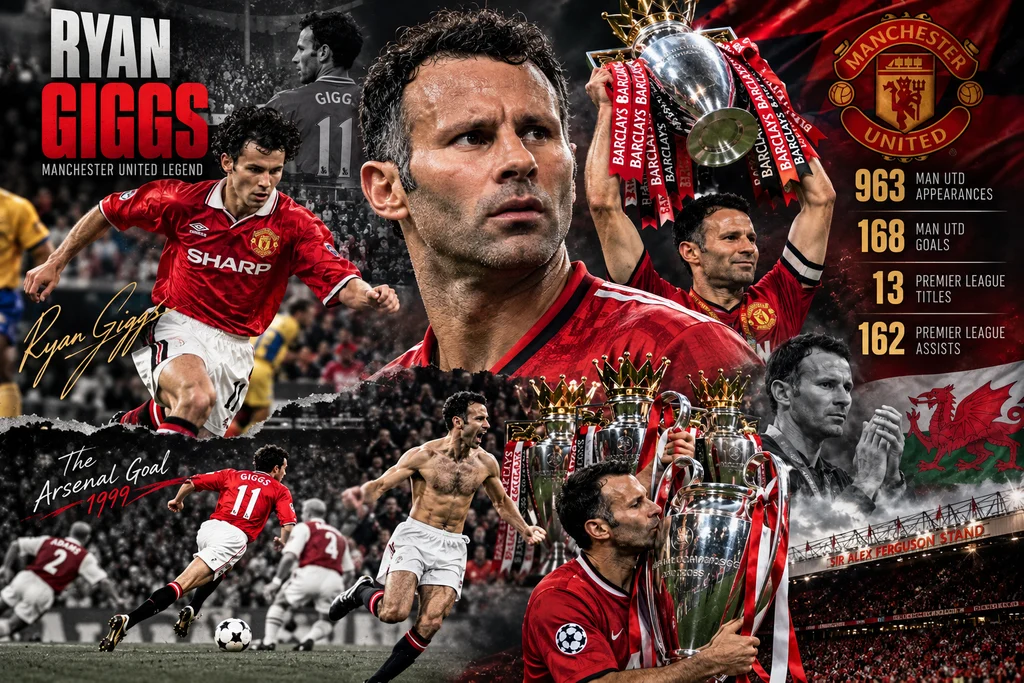
Ryan Giggs – The Manchester United Legend
963 Manchester United appearances. 168 goals. A record 13 Premier League titles. A record 162 Premier League assists. Two Champions League triumphs. More than two decades at the highest level – and one of the most iconic solo goals English football has ever seen.
🔴 The boy who became part of Manchester United history
Ryan Giggs was not simply a great Manchester United player. For more than two decades, he was part of the fabric of the club. Managers, team-mates, opponents and entire football eras changed around him – but Giggs remained.
Born in Cardiff on 29 November 1973, Giggs spent much of his childhood in the Manchester area.
From an early age, his football ability attracted attention. What immediately separated him from many young players was the way he could move with the ball.
He was quick.
But plenty of players are quick.
Giggs could change direction without losing momentum. He could control the ball while accelerating. He could make defenders shift their balance and then explode into the space they had just surrendered.
Those qualities would become the foundation of one of the longest elite careers in English football.
No player has made more competitive appearances for Manchester United.
🌱 From teenage prodigy to first-team football
Giggs entered Manchester United’s first-team environment while still a teenager.
He made his senior debut in March 1991 at the age of 17.
The timing could hardly have been better.
English football was approaching a major transformation. The Premier League would begin in 1992, Manchester United were growing into the dominant force of the coming decade, and Sir Alex Ferguson was building a side capable of ending the club’s long wait for a league title.
Giggs was there almost from the beginning.
And unlike many teenage sensations, he did not disappear after the hype.
He became better.
⚡ What did the young Ryan Giggs actually look like?
Explosive
He could create separation from a defender in only a few strides.
Direct
Giggs frequently attacked defenders rather than simply circulating possession.
Unpredictable
He could attack down the line or move inside, forcing defenders to protect more than one route.
Balanced
He could maintain control of his body and the ball while changing direction.
Creative
His dribbling frequently led to crosses, cut-backs and chances for team-mates.
Brave
He was willing to try things and attack opponents repeatedly, even after losing previous duels.
🕰️ Interactive Ryan Giggs career timeline
Open each year to explore the story.
🔥 Arsenal 1999 – the goal that became immortal
Villa Park.
14 April 1999.
Manchester United versus Arsenal.
FA Cup semi-final replay.
The rivalry between the clubs was enormous.
Sir Alex Ferguson against Arsène Wenger.
Roy Keane against Patrick Vieira.
Manchester United and Arsenal were two of the strongest teams in European football.
The match was level.
United had been reduced to ten men after Roy Keane’s dismissal.
Dennis Bergkamp was given the opportunity to win the game from the penalty spot.
Peter Schmeichel saved.
Then came Ryan Giggs.
Patrick Vieira’s attempted pass was intercepted.
Giggs collected the ball.
He accelerated.
One defender.
Then another.
Another change of direction.
Into the penalty area.
Left foot.
The ball flew high beyond David Seaman.
Manchester United 2–1 Arsenal.
Giggs removed his shirt and sprinted towards the corner.
It became one of the most recognisable celebrations in English football history.
🎥 Watch the legendary goal
▶ Watch the official FA Cup clip on YouTube
Don’t just watch the finish.
- When does Giggs accelerate?
- When does he slow slightly?
- How often does he change direction?
- How close is the ball to his feet?
- When does he take a longer touch?
- How do the defenders shift their weight?
- When does the shooting opportunity finally appear?
🏆 The goal was only part of the story – 1999 became The Treble
The Arsenal semi-final was not an isolated classic. It became part of one of the most famous seasons in Manchester United history.
Premier League
United became champions of England.
FA Cup
Newcastle United were beaten in the final.
Champions League
Bayern Munich were defeated in one of the competition’s most dramatic finals.
🌙 Barcelona 1999 – another impossible finish
Manchester United’s Champions League final against Bayern Munich appeared to be slipping away.
Bayern led 1–0.
The clock moved into stoppage time.
Then United equalised.
Moments later they scored again.
2–1.
European champions.
For Giggs and several of his team-mates, the victory completed a season that would permanently define that Manchester United generation.
⚡ Why was Giggs so difficult to defend against?
1. Acceleration
A defender may be fast over 30 metres and still struggle against a player who can win the first three metres.
2. Change of pace
Constant top speed is predictable. Giggs could slow a defender down, then suddenly accelerate.
3. Change of direction
He could threaten outside and then attack inside, or reverse the pattern.
4. Balance
His ability to stay upright and coordinated made rapid directional changes far more effective.
5. End product
The dribble was not the final objective. Crosses, passes and chances followed.
6. Courage
He repeatedly challenged opponents. Losing one duel did not prevent him from attacking again.
🔄 Ryan Giggs effectively became two different players
⚡ Young Giggs
- Left winger
- Explosive acceleration
- 1v1 dribbling
- Runs down the touchline
- Crossing
- Counter-attacking threat
- Directness
- High-risk creativity
🧠 Experienced Giggs
- More central positioning
- Greater passing influence
- Tempo control
- Combination play
- Scanning
- Through balls
- Movement between lines
- Game management
Elite players do not always stay elite by preserving exactly the same qualities.
Sometimes they remain elite because they learn how to play differently.
📊 Ryan Giggs records and career numbers
| Category | Giggs | Context |
|---|---|---|
| Manchester United appearances | 963 | Club record |
| Manchester United goals | 168 | All competitive competitions |
| Premier League appearances | 632 | One of the highest totals in competition history |
| Premier League goals | 109 | More than 100 league goals despite primarily being a winger/midfielder |
| Premier League assists | 162 | Premier League record |
| Premier League titles | 13 | Player record |
| Premier League seasons played | 22 | 1992/93 through 2013/14 |
| Consecutive PL seasons with a goal | 21 | Scored in each of the first 21 Premier League seasons |
| Champions League titles | 2 | 1999 and 2008 |
| Wales appearances | 64 | Senior internationals |
| Wales goals | 12 | Senior internationals |
🤯 21 consecutive Premier League seasons with a goal
Ryan Giggs scored in each of the Premier League’s first 21 seasons.
Think about what that means.
Opponents changed.
Managers changed.
Tactics changed.
Team-mates changed.
The pace of the league changed.
Giggs was still scoring.
From 1992/93 through 2012/13, every Premier League season included at least one Ryan Giggs goal.
🏆 Ryan Giggs’ major trophy cabinet
Premier League
Champions League
FA Cup
League Cup
Premier League material credits Giggs with 24 major trophies during his Manchester United career.
🎓 Class of ’92
Ryan Giggs is closely associated with one of the most famous academy generations in football history.
Alongside him came players including:
David Beckham
Crossing, passing, set pieces and one of football’s most famous right feet.
Paul Scholes
Passing range, awareness, goals from midfield and control of matches.
Gary Neville
Right-back, leader and long-term Manchester United first-team player.
Phil Neville
Versatility and the ability to perform in several positions.
Nicky Butt
Midfield discipline, aggression and tactical reliability.
Ryan Giggs
Dribbling, acceleration, creativity and remarkable longevity.
👥 From Bryan Robson to Cristiano Ronaldo – the scale of Giggs’ career
One of the easiest ways to understand Giggs’ longevity is to look at the players who shared a dressing room with him.
Early years
Bryan Robson
Mark Hughes
Steve Bruce
Gary Pallister
Cantona generation
Eric Cantona
Roy Keane
Peter Schmeichel
Andy Cole
Class of ’92
David Beckham
Paul Scholes
Gary Neville
Nicky Butt
New superstars
Cristiano Ronaldo
Wayne Rooney
Carlos Tevez
Robin van Persie
A player who shared Manchester United teams with both Bryan Robson and Robin van Persie was not simply part of one successful team.
He survived several football generations.
👑 Sir Alex Ferguson and the art of rebuilding
Giggs’ career cannot be separated from Sir Alex Ferguson.
Ferguson repeatedly rebuilt Manchester United.
Senior players left.
Young players emerged.
New stars were signed.
Tactical approaches changed.
Giggs repeatedly found a role.
That was partly because Ferguson managed the squad intelligently, but also because Giggs himself developed.
Talent + adaptation + fitness + tactical intelligence + strong team environment.
🌍 Moscow 2008 – Giggs becomes European champion again
By 2008, the Manchester United team looked very different from the side that won the Champions League in 1999.
Cristiano Ronaldo had become one of the world’s best players.
Wayne Rooney was a major attacking force.
Rio Ferdinand and Nemanja Vidić formed an elite defensive partnership.
Edwin van der Sar was in goal.
But Ryan Giggs was still there.
The Champions League final against Chelsea ended 1–1.
The trophy would be decided by penalties.
Giggs converted his kick.
Van der Sar eventually saved Nicolas Anelka’s attempt.
Manchester United were European champions again.
🧱 One of Giggs’ hardest opponents: Javier Zanetti
Giggs played against many outstanding full-backs during his career.
One name he later highlighted was Inter Milan legend Javier Zanetti.
It makes tactical sense.
Zanetti possessed several qualities that are useful against a player like Giggs:
- pace
- strength
- stamina
- positioning
- discipline
- timing
You do not always stop an elite dribbler by tackling more.
Sometimes the best defence is to position yourself so well that the dribbler never gets the situation he wants.
🐉 Ryan Giggs and Wales
Giggs’ international career was very different from his club career.
Manchester United regularly competed for the biggest trophies.
Wales were fighting simply to qualify for major tournaments.
Giggs made 64 senior appearances for Wales and scored 12 goals.
He never played at a World Cup or European Championship finals as a Wales player.
Could Ryan Giggs have played for England?
This remains one of the most frequently repeated Giggs myths.
He represented England Schoolboys because of the school system he was part of.
That did not mean he had represented England in an official FIFA youth international and then changed national teams.
Giggs was Welsh and represented Wales at senior international level.
⏳ How did a winger survive at the top until 40?
This may be the most interesting question in the entire Giggs story.
Goalkeepers sometimes play into their late thirties or forties.
Centre-backs occasionally do the same.
But explosive wingers?
Much less often.
A young Giggs depended heavily on acceleration.
No human being keeps exactly the same explosive physical qualities forever.
So Giggs adapted.
🧠 Positioning
Better positioning reduced the need to solve every situation through speed.
👀 Awareness
Scanning before receiving the ball allowed him to play quicker.
🎯 Passing
A great pass can eliminate an opponent just as effectively as a dribble.
🧘 Mobility
Giggs became associated with yoga and increased attention to mobility and recovery later in his career.
🧘 Ryan Giggs and yoga
Later in his career, Giggs became well known for incorporating yoga into his physical preparation.
He had suffered hamstring problems during his career and increasingly focused on flexibility, mobility and recovery.
Yoga alone does not explain why he played until 40.
But it illustrates a broader point.
Older elite players cannot simply train exactly as they did at 20 and expect identical results.
Recovery becomes part of performance.
🎯 162 Premier League assists – the other side of Giggs
The popular image of Giggs is often the young winger running at defenders.
But his Premier League assist record tells another story.
162 assists.
That remains the official Premier League record.
The total reflects much more than traditional crosses.
Over his long career Giggs could create opportunities through:
- crosses
- cut-backs
- through balls
- short combinations
- counter-attacks
- set plays
- passes from central areas
He also asks: “What can I create after I beat him?”
⚽ 109 Premier League goals
Giggs was never primarily a striker.
Yet he still scored 109 Premier League goals.
Some came from runs into the penalty area.
Some came after dribbles.
Some arrived from midfield positions.
Others came through timing rather than spectacular skill.
Combined with his 162 assists, it gives a picture of a player who contributed to goals in many different ways.
🧠 FINTER Football IQ Challenge – think like Giggs
Situation 1 – The isolated full-back
You receive the ball on the left wing. The defender is three metres away. There is space behind him.
Situation 2 – You beat the defender
What should happen next?
Situation 3 – You’re no longer the fastest player
A younger defender is now quicker than you. How can you still influence the game?
🛡️ Defender Challenge – how would you stop Giggs?
You are the right-back. A young Giggs is running towards you.
What should you avoid?
⚽ Train like a Ryan Giggs-style winger
⚡ Drill 1 – Change of pace
- Dribble slowly for five metres.
- Approach a cone.
- Use a body feint.
- Explode for 5–8 metres.
- Finish with a pass or shot.
Key idea: Slow → deceive → explode.
↔️ Drill 2 – Inside or outside?
- Start on the wing.
- Approach a defender.
- Read the defender’s body shape.
- Choose inside or outside.
- Do not decide before the duel begins.
Key idea: Read before acting.
🎯 Drill 3 – Beat + create
- Win a 1v1 duel.
- Lift your head immediately.
- Choose a cross, cut-back, pass or shot.
A dribble without a useful next action is only half the job.
🧠 Drill 4 – Experienced Giggs
- Play 4v4 or 5v5.
- Use two-touch zones.
- Scan before every reception.
- Award bonus points for line-breaking passes.
Focus: game intelligence rather than raw speed.
🎮 FINTER Giggs Training Score
Complete 10 attempts in each category and enter your successful actions.
This is a FINTER training challenge, not an official scouting assessment.
🤔 Ryan Giggs – Myth or Fact?
“Giggs only played as a left winger.”
“Giggs holds the Premier League assist record.”
“Giggs won 13 Premier League titles.”
“He scored in every Premier League season he played.”
“He played only one senior club.”
“Giggs chose Wales after playing official youth internationals for England.”
🤯 12 Ryan Giggs numbers that tell the story
Competitive Manchester United appearances.
Manchester United goals.
Premier League titles.
Premier League assists.
Premier League appearances.
Premier League goals.
Premier League seasons played.
Consecutive Premier League seasons with a goal.
Champions League titles.
Senior Wales appearances.
Senior Wales goals.
Still playing Premier League football after turning 40.
🎮 The Ultimate Ryan Giggs Quiz
Can you score 10/10?
🔗 Explore more football on FINTER.dk
❓ Ryan Giggs FAQ
How many games did Ryan Giggs play for Manchester United?
Ryan Giggs made 963 competitive appearances for Manchester United, the most in the club’s history.
How many goals did Ryan Giggs score for Manchester United?
Giggs scored 168 competitive goals for Manchester United.
How many Premier League games did Ryan Giggs play?
He made 632 Premier League appearances.
How many Premier League goals did Ryan Giggs score?
He scored 109 Premier League goals.
How many Premier League assists did Ryan Giggs make?
The Premier League officially credits Giggs with 162 assists, the competition record.
How many Premier League titles did Ryan Giggs win?
Giggs won 13 Premier League titles with Manchester United, a player record.
How many Champions League titles did Giggs win?
He won the Champions League with Manchester United in 1999 and 2008.
When did Giggs score his famous goal against Arsenal?
He scored the legendary solo goal in the FA Cup semi-final replay at Villa Park on 14 April 1999.
What position did Ryan Giggs play?
He became famous as a left winger but also played more centrally in midfield later in his career.
What number did Ryan Giggs wear?
The number 11 shirt is most closely associated with Giggs at Manchester United.
Did Ryan Giggs play for England?
No. He represented Wales at senior international level. His appearances for England Schoolboys are frequently misunderstood and were not equivalent to official senior international football.
How many times did Ryan Giggs play for Wales?
Giggs made 64 senior appearances for Wales and scored 12 goals.
How old was Ryan Giggs when he retired?
Giggs continued playing Premier League football after turning 40 and ended his playing career in 2014.
📚 Sources & fact checking
Premier League:
Official Premier League records and player statistics are used for
Giggs’ 632 league appearances, 109 goals, 162 assists and 13 titles.
Manchester United:
Manchester United’s official material records Giggs as the club’s
record appearance holder with 963 competitive appearances and 168 goals.
The FA Cup:
The official FA Cup archive provides footage of the famous
1999 semi-final goal against Arsenal.
⭐ The Ryan Giggs legacy
Ryan Giggs’ story is easy to reduce to spectacular numbers.
963 Manchester United appearances.
168 goals.
162 Premier League assists.
13 Premier League titles.
Two Champions League trophies.
But the most interesting part of the story may be what happened between the numbers.
The teenage winger was explosive.
The veteran midfielder was intelligent.
The young player attacked defenders with speed.
The older player manipulated space with timing, positioning and passing.
He did not survive for more than two decades by remaining exactly the same footballer.
He survived because he changed.
And that may be the most useful Ryan Giggs lesson of all.
Speed can make you dangerous.
Technique can make you better.
Football intelligence can help you evolve.
And the ability to evolve can extend a career far beyond
what raw talent alone can achieve.