
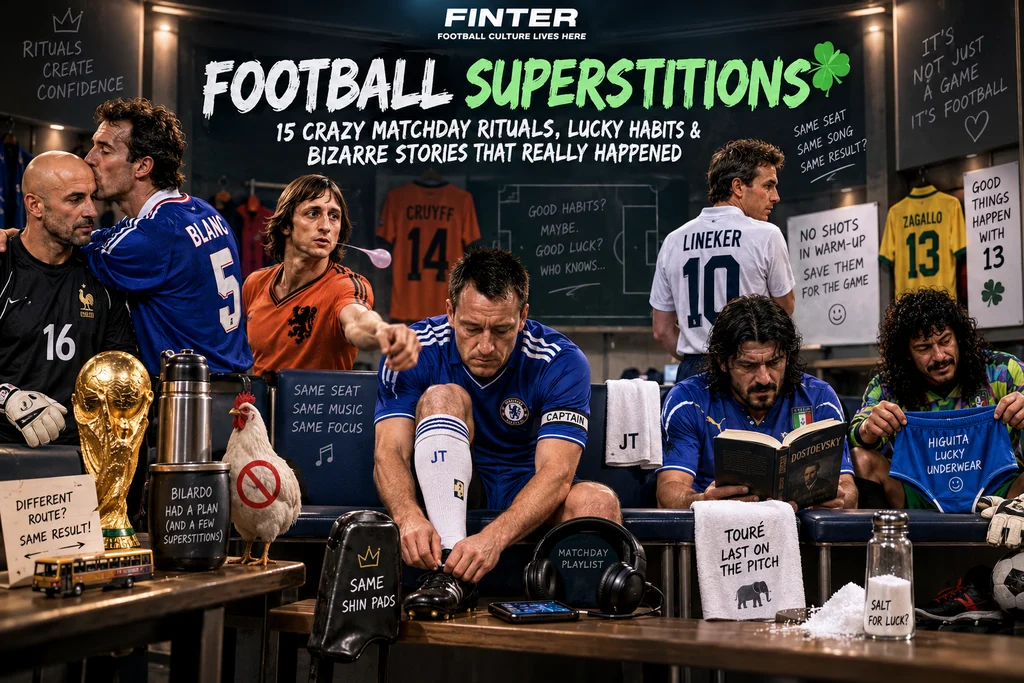
⚽🍀 Football Superstitions: 15 Crazy Matchday Rituals & Lucky Habits That Really Happened
Lucky shin pads used for years. A kiss on a goalkeeper’s bald head. Chewing gum thrown into the opposition half. A striker refusing to shoot during the warm-up because he feared wasting a goal before kick-off.
Elite football is increasingly driven by data, sports science and analysis. Yet some of the greatest players, managers and teams in football history have also followed extraordinary superstitions.
Welcome to football’s strangest dressing room.
🔄 Updated September 2026 · FINTER English Football Universe
⚡ The Short Version
Footballers have used lucky clothes, fixed bus seats, special music, specific dressing-room routines, unusual toilet habits, lucky numbers, kisses, chewing gum and even particular routes to the stadium.
The objects themselves have no demonstrated magical effect on football results. But routines can still matter psychologically because familiarity may help athletes manage uncertainty, nerves and concentration.
This FINTER guide separates documented football stories from folklore and explores why even world-class professionals can become deeply attached to unusual matchday habits.
🍀 What Is a Football Superstition?
A football superstition is a habit, action, object or belief that a player or team associates with good luck, bad luck or a particular result even though there is no demonstrated football mechanism connecting the two.
That makes superstition different from useful preparation.
A structured warm-up prepares muscles, movement patterns and concentration.
Breathing, visualisation and familiar preparation may help athletes control attention and nerves.
Believing a particular pair of socks, seat or object directly determines the match result.
If a lucky object has no magical effect but makes a player feel calmer and more confident, can it still influence performance indirectly?
🔥 15 Famous Football Superstitions That Really Happened
These examples have been reported by FIFA, UEFA or by the people involved. Some are harmless routines. Others became remarkably elaborate.
👕 John Terry – same seat, same music, same parking place
Former Chelsea captain John Terry openly described himself as highly superstitious.
His reported matchday habits included sitting in the same place on the team bus, listening to the same music on the journey to the stadium, parking in the same spot and using multiple layers of tape around his socks.
His relationship with lucky shin pads became particularly famous. Terry used the same pair for an extended period and later adopted a pair belonging to Frank Lampard after losing his own.
FINTER rating: this was not one ritual. It was practically an entire matchday operating system.
💋 Laurent Blanc kissed Fabien Barthez’s head
One of the most famous football rituals of all time occurred during France’s victorious 1998 World Cup campaign.
Before matches, Laurent Blanc would kiss goalkeeper Fabien Barthez on his bald head.
France eventually lifted their first men’s World Cup.
The kiss did not magically make Barthez save shots, of course, but it became a visual symbol of that French team’s tournament.
🍬 Johan Cruyff – chewing gum into the opposition half
Johan Cruyff is remembered as one of football’s greatest tactical thinkers.
UEFA has also documented a much less scientific habit: Cruyff would leave his chewing gum in the opposition half before kick-off.
A man who helped change football forever still had room for superstition.
🎯 Gary Lineker refused to waste his goals in the warm-up
Most strikers practise finishing before kick-off.
Gary Lineker reportedly avoided shooting at goal during his warm-up because he feared that scoring then might mean he would not score when the match started.
FIFA also records that if Lineker remained goalless after the first half, he could change his shirt at half-time.
And during a prolonged scoring drought? A haircut could become part of the solution.
🎵 Mario Gómez stopped singing the anthem
Mario Gómez developed an unusual habit after scoring for Germany’s youth side on an occasion when he had remained silent during the national anthem.
The association stuck.
FIFA also reported another highly specific Gómez routine: using the leftmost urinal in the dressing room before matches.
Some football rituals are definitely easier to explain to teammates than others.
🧴 Gary Neville – never change a winning aftershave
Gary Neville revealed that he would continue using the same aftershave while results were going well.
It is a perfect example of one of sport’s oldest unwritten rules:
🚪 Kolo Touré wanted to be last onto the pitch
UEFA recorded Kolo Touré’s habit of needing to be the final player entering the field.
The action itself obviously had no tactical impact, but repeated order-based rituals are common in sport because they create a predictable sequence before competition.
🚕 Carlos Bilardo – taxis, clothes, chicken and extraordinary luck
Carlos Bilardo may belong in a category of his own.
FIFA has documented an extraordinary collection of beliefs associated with the World Cup-winning Argentine coach.
They included avoiding chicken, associating specific clothes with victories and repeating particular routes to the stadium.
On one occasion, after an alternative taxi journey coincided with success, transport itself became part of the ritual.
Bilardo’s superstitions demonstrate how quickly coincidence can turn into a rule when elite competition places enormous importance on results.
🟡 Luis Aragonés and the colour yellow
Former Spain coach Luis Aragonés was famously associated with an aversion to yellow.
FIFA recounts occasions when that dislike affected clothing and even his reaction to yellow flowers.
Colour superstition occurs far beyond football, but in elite sport it can become part of team folklore.
1️⃣3️⃣ Mario Zagallo and his obsession with number 13
Brazilian legend Mario Zagallo had a remarkably positive relationship with the number 13.
FIFA documented multiple connections between Zagallo and the number, including dates, shirts and personal beliefs.
Some people avoid 13.
Zagallo embraced it.
📚 Gennaro Gattuso – lucky sweatshirt and Dostoevsky
Gennaro Gattuso told FIFA about some particularly unusual tournament behaviour during Germany 2006.
He repeatedly wore the same sweatshirt and developed other routines as Italy progressed through the competition.
FIFA also noted his habit of reading Dostoevsky before matches.
Aggressive midfielder on the pitch.
Russian literature before kick-off.
Football contains multitudes.
🩲 René Higuita and the lucky blue underwear
Goalkeeper René Higuita told FIFA about an extraordinary belief involving blue underwear.
After Atlético Nacional had struggled against Millonarios, a fortune teller reportedly became involved. Blue underwear became associated with changing the team’s fortunes, and Higuita continued the habit.
It is difficult to imagine a modern performance analyst including that recommendation in a goalkeeper development plan.
🤍 Iván Zamorano’s white wristband
Iván Zamorano initially wore a white wrist support because of a physical problem.
Then he scored three goals.
According to FIFA, the white band subsequently became his lucky object.
This is almost a perfect illustration of how superstitions form:
🚪 Bobby Moore and Paul Ince both wanted to leave last
FIFA has described two English internationals with unusual dressing-room exit routines.
Bobby Moore wanted privacy while putting on his shorts, while Paul Ince developed a routine involving leaving late and putting on his shirt on the way toward the pitch.
Imagine both rituals existing in the same dressing room.
Somebody would eventually have to leave second-last.
🧤 Sergio Goycochea and one of football’s strangest penalty rituals
Argentina goalkeeper Sergio Goycochea became famous for his penalty-saving performances.
FIFA also recounts perhaps the most unusual superstition in this entire article: before certain penalty shoot-outs, he reportedly relieved himself on the pitch while teammates helped conceal what was happening.
This one definitely belongs in the category:
Do not copy every habit used by professional footballers.
📊 Football Superstitions at a Glance
| Person | Ritual | Category |
|---|---|---|
| John Terry | Bus seat, music, parking, shin pads | Repeated routine |
| Laurent Blanc / Barthez | Head kiss | Team ritual |
| Johan Cruyff | Chewing gum in opposition half | Pre-match superstition |
| Gary Lineker | No warm-up shooting | Scoring superstition |
| Mario Gómez | Anthem and dressing-room routine | Repeated ritual |
| Gary Neville | Same aftershave when winning | Lucky object |
| Kolo Touré | Last player onto pitch | Order ritual |
| Carlos Bilardo | Routes, transport, clothes and more | Multiple superstition |
| Luis Aragonés | Avoiding yellow | Colour superstition |
| Mario Zagallo | Number 13 | Numerology |
| Gattuso | Same sweatshirt and other routines | Tournament ritual |
| René Higuita | Blue underwear | Lucky clothing |
| Iván Zamorano | White wristband | Lucky object |
| Bobby Moore / Paul Ince | Leaving dressing room last | Order ritual |
| Sergio Goycochea | Unusual pre-shoot-out toilet ritual | Penalty superstition |
🧠 Why Do Footballers Become Superstitious?
At first glance it seems contradictory.
Elite footballers work inside environments built around sports science, video analysis, nutrition, medical expertise, GPS tracking and detailed tactical planning.
Yet superstition remains surprisingly easy to understand psychologically.
1. Football is full of uncertainty
A team can dominate possession, create the better chances and still lose because of one deflection.
Players cannot control everything.
Ritual provides structure inside uncertainty.
2. The brain loves patterns
Imagine wearing new boots and scoring a hat-trick.
The rational explanation may involve movement, finishing, opponents and chance.
But emotionally the brain may remember:
3. Success reinforces behaviour
Win after sitting in seat number four?
Sit there again next week.
Win again?
Now nobody is allowed in your seat.
4. Familiarity may calm nerves
A World Cup final is not a normal day.
Repeating familiar actions can make part of that extraordinary environment feel predictable.
5. Team rituals create belonging
Songs, handshakes and shared routines can also help reinforce group identity.
That does not mean they control luck.
It means rituals can have social meaning even when their supposed magical power does not exist.
⚖️ Routine vs Ritual vs Superstition
Sleep well.
Hydrate.
Prepare equipment.
Eat appropriately.
Complete your warm-up.
Same playlist.
Breathing routine.
Visualisation.
Consistent preparation order.
Lucky socks determine victory.
A bus seat controls the result.
Scoring in warm-up uses up your goals.
👦⚽ What Should Young Players Learn From This?
Young footballers often copy professionals.
Copy their scanning.
Copy their first touch.
Copy their movement.
Copy their work ethic.
But you do not need to copy every superstition.
Good sleep
Preparation
Warm-up
Positive self-talk
Concentration
Lucky underwear
A particular seat
A magical shirt
One specific route
Fear of changing routine
The strongest matchday routine is one that helps you prepare but does not control you.
🎲 FINTER Matchday Superstition Generator
Need an entirely unnecessary superstition for your next match?
FINTER can help.
Your ritual: Press the button.
🕵️ Myth or Fact?
Laurent Blanc really kissed Barthez’s head before France matches.
Gary Lineker deliberately avoided shooting at goal during warm-ups.
Johan Cruyff left chewing gum in the opposition half.
Lucky socks have been scientifically proven to improve finishing.
John Terry had several matchday superstitions rather than just one.
🧠 Football Superstitions Quiz
Five questions. Can you get 5/5?
Score: 0 / 5
1. Whose head did Laurent Blanc famously kiss?
2. Who avoided shooting during warm-ups?
3. Who had the chewing-gum ritual?
4. Which number was especially important to Mario Zagallo?
5. Who kept using the same aftershave during successful periods?
🗳 Which Ritual Is the Strangest?
Choose your favourite bizarre football ritual.
Your vote: none yet.
This is a local interactive vote and does not claim to represent other FINTER readers.
🎥 Football Superstitions Video Zone
Want to see more football rituals and superstition stories?
BBC – Football Pregame Rituals & Superstitions
10 Crazy Soccer Player Rituals
Video availability can change over time. If an embedded video becomes unavailable, use the direct YouTube link or replace it with a current official/reputable source.
🏟️ Fans Are Superstitious Too
Players are not alone.
Supporters regularly develop their own matchday rituals:
- wearing the same lucky shirt;
- sitting in the same seat;
- watching matches with the same people;
- taking the same route to the stadium;
- eating the same pre-match meal;
- carrying a particular scarf;
- refusing to predict the result;
- avoiding certain colours;
- performing the same celebration after goals.
In other words, superstition is part of football culture far beyond the dressing room.
🔎 Related Questions Football Fans Search For
❓ Football Superstitions FAQ
Do professional footballers really have superstitions?
Yes. FIFA and UEFA have documented numerous examples involving elite players, coaches and national teams.
What is one of the most famous football superstitions?
Laurent Blanc kissing Fabien Barthez’s head during France’s 1998 World Cup campaign is one of the best-known visual examples.
Why did Gary Lineker avoid shooting in the warm-up?
FIFA reported that Lineker feared scoring during the warm-up could mean he would not score during the actual match.
What were John Terry’s superstitions?
Reported habits included the same bus seat, music, parking place, sock-taping routine and attachment to particular shin pads.
Did Johan Cruyff have a superstition?
UEFA reported that Cruyff would leave his chewing gum in the opposition half before kick-off.
Can football superstitions improve performance?
There is no demonstrated magical connection between a lucky object and a match result. However, familiar routines can potentially provide psychological comfort, structure and focus.
Are rituals and superstitions the same thing?
No. A ritual can simply be a consistent preparation routine. Superstition specifically involves attributing luck or outcomes to an action, object or event without a demonstrated causal mechanism.
Do football fans have superstitions?
Yes. Lucky shirts, scarves, seats, stadium routes, viewing routines and pre-match meals are common supporter traditions.
📚 Sources & Further Reading
FINTER has prioritised established football organisations for the historical stories in this guide.
FIFA:
Football superstitions – FIFA
UEFA:
Your #superstitions revealed – UEFA
Historical superstition stories should be treated as reported player traditions rather than evidence that the rituals themselves caused sporting success.