
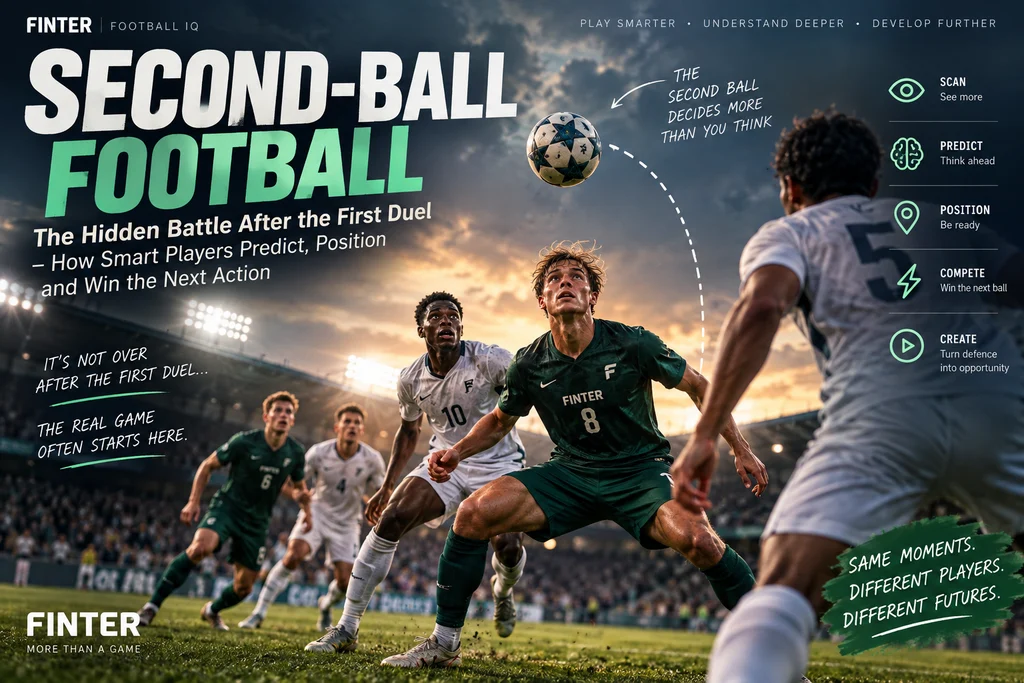
FINTER FOOTBALL IQ · INTERACTIVE PLAYER & COACH GUIDE
⚽🧠 Second-Ball Football
The Hidden Battle After the First Duel – How Smart Players Predict, Position and Win the Next Action
Everyone watches the header, tackle, save or clearance.
The smartest players are already thinking about what happens next.
That next action is one of football’s most underestimated battles: the second ball.
🧠 Take the IQ Test 📍 Find Your Position ⚽ Training Games 📋 Coach Section🌍 Welcome to FINTER in English
FINTER is a football universe for players, coaches, parents and fans who want to understand the game more deeply.
Training, tactics, Football IQ, player development, football history, interactive challenges and much more.
📚 In This Guide
- What is a second ball?
- Why second balls matter
- Rodri and anticipation
- The FINTER second-ball model
- Where second balls appear
- Interactive Football IQ test
- Advice for every position
- Corners and second phases
- Counterpressing and transitions
- Video challenge
- FINTER reader vote
- Eight training games
- Coach observation sheet
- Player checklist
- FAQ
🤔 What Is a Second Ball in Football?
A second ball is a loose, redirected or contested ball created when the first action does not result in secure possession.
It can appear after:
- a header
- a clearance
- a tackle
- a blocked shot
- a goalkeeper save or punch
- a long goal kick
- a cross
- a corner
- a flick-on
- a deflection
- a physical duel
- a rebound from the post
↓
FIRST DUEL
↓
HEADER / DEFLECTION / CLEARANCE
↓
⚽ SECOND BALL
↓
WHO READS IT FIRST?
The first duel decides where the ball might go.
The second action can decide which team controls what happens next.
🔥 Why Second Balls Matter
Football is not a sequence of perfect passes.
Matches are full of unstable situations:
- half-clearances
- rebounds
- deflections
- loose touches
- blocked shots
- 50/50 duels
- headers
- scrambles
Winning these moments can allow your team to:
- continue an attack
- escape pressure
- stop a counterattack
- create a shot
- recover possession
- control territory
- keep the opponent pinned back
Second-ball football is therefore not simply about aggression.
It is about seeing, predicting and moving before the situation becomes obvious.
👀 The Biggest Mistake: Watching
Imagine your striker and an opposing centre-back jumping for a long ball.
Many players simply stop and watch the duel.
They ask:
“Who is going to win the header?”
A smarter player asks:
“Where will the ball go after the header?”
That question immediately changes your positioning.
SEE
Understand the duel, body positions, space and nearby opponents.
PREDICT
Estimate the most likely direction of the next ball.
MOVE
Adjust your position before the ball actually becomes loose.
🧠 Rodri: Winning the Ball Before Everyone Else Understands Where It Is Going
Elite midfielders often appear to be in the right place again and again.
That is not always because they are quicker or stronger.
UEFA’s technical material featuring Rodri highlights the importance of studying where second balls, rebounds and half-clearances are likely to land.
The idea is simple:
This is one reason intelligent midfielders can dominate areas of the pitch without constantly making spectacular tackles.
Their advantage begins before the ball arrives.
Source inspiration: UEFA – The Technician: Midfield Masterclass.
👀 Second Balls Begin With Scanning
You cannot predict what happens next if you have no information.
Before the first duel, scan for:
- the nearest opponent
- the nearest team-mate
- open space
- the direction players are facing
- which player is favourite to win the duel
- possible passing options if you win the loose ball
- danger if your team loses it
Scanning is not simply turning your head as many times as possible.
The purpose is to collect useful information before you need it.
👉 Read FINTER’s complete guide to scanning and awareness →
🔄 The FINTER Second-Ball Cycle
↓
🧠 PREDICT
↓
📍 POSITION
↓
⚔️ COMPETE
↓
⚽ SECURE
↓
➡️ PLAY THE NEXT ACTION
Winning the ball is only part of the job.
If you win the second ball and immediately lose it again, much of the advantage disappears.
Therefore your first touch after winning the loose ball matters.
👉 Improve your first touch with FINTER →
📍 Where Do Second Balls Usually Land?
There is no guaranteed location.
But specific actions create recurring patterns.
| First Action | Possible Second-Ball Area | What to Think About |
|---|---|---|
| Long goalkeeper kick | Around or behind the aerial duel | Get underneath the duel without standing directly underneath the ball. |
| Defensive header | Central midfield or edge of the box | Read defender’s body orientation. |
| Cross cleared | Edge of box or opposite side | Can you recycle the attack? |
| Blocked shot | Inside or around penalty area | Expect a rebound immediately. |
| Near-post corner | Central or far-post area | Stay alive for the second phase. |
| Striker holds up long pass | Underneath the striker | Support close enough to collect the drop. |
| Tackle | Near either side of the duel | Don’t assume the tackler will automatically control it. |
| Goalkeeper parry | Around the six-yard box or penalty spot | Attackers anticipate; defenders react and clear. |
⚔️ You Can Lose the First Duel and Still Win the Situation
This is one of the most important ideas in this guide.
Suppose your goalkeeper plays long toward the striker.
The opposition centre-back wins the header.
Did your team lose the play?
Not necessarily.
↓
OPPOSITION DEFENDER WINS HEADER ✅
↓
YOUR MIDFIELDER READS THE CLEARANCE
↓
YOUR TEAM WINS SECOND BALL ✅
↓
ATTACK CONTINUES
The defender won the aerial duel.
Your team may still have won the tactical situation.
🎮 Interactive Second-Ball Football IQ Test
Do not open the answer until you have made your decision.
1️⃣ Your striker challenges for a long goalkeeper kick. Where should you move as a central midfielder?
Answer: generally underneath and around the likely duel zone, rather than running directly toward the striker.
Your job is to give yourself access to the loose ball created by either player’s header.
2️⃣ Your winger crosses and the centre-back clears toward the edge of the box. What should an attacking midfielder do?
Stay alive to the clearance.
If your position is balanced, you may be able to collect the ball and immediately restart the attack.
3️⃣ A team-mate shoots inside the penalty area. Do you stop and watch the shot?
No.
Start anticipating a goalkeeper parry, defensive block, post rebound or loose ball.
4️⃣ Your centre-back challenges a striker in the air. What should the second defender think about?
Possible flick-ons, loose balls and runs behind the duel.
Supporting the first defender does not always mean standing right beside them.
5️⃣ Your team loses the first header. Is the attack over?
No.
The second-ball battle may be more important than the first header.
6️⃣ You win the second ball. What should happen next?
Secure it and immediately recognise whether you can play forward, protect possession or recycle the attack.
7️⃣ Should you always run toward the ball after a duel?
No.
Sometimes the smarter movement is toward the space where the ball is likely to travel.
8️⃣ Is second-ball football mainly about strength?
No.
Strength can help, but scanning, anticipation, balance, positioning and reaction speed are critical.
Give yourself one point for every answer you predicted correctly before opening it.
0–2: Second-Ball Rookie
3–5: Game Reader
6–7: Football IQ Player
8: Second-Ball Master 🧠⚽
📍 Second Balls by Position
🧤 Goalkeeper
Your distribution can create the first duel.
Before playing long, recognise whether your team has players positioned to compete for what happens after the header.
🧱 Centre-Back
When your partner attacks the aerial ball, think about depth, flick-ons and the area behind or underneath the duel.
🧠 No. 6
This may be the most important second-ball role.
Scan early, protect central space, collect clearances and be ready to stop counterattacks.
⚡ No. 8
Be ready to move forward into attacking second balls or backward to support defensive ones.
Your starting position must allow you to do both.
🏃 Winger
Don’t switch off when a cross from the opposite side is cleared.
Many second balls travel toward the far side.
🎯 Striker
You may not need to win every aerial duel cleanly.
Sometimes making the defender’s header difficult is enough to create a favourable second ball for your midfield.
🚩 Corners: The First Cross Is Only Phase One
A corner does not necessarily end when a defender heads the ball away.
↓
FIRST CONTACT
↓
CLEARANCE
↓
SECOND BALL
↓
RECYCLE / CROSS / SHOT / COUNTERATTACK
Attacking teams therefore need players with different responsibilities:
- attack the first cross
- challenge the goalkeeper
- attack rebounds
- collect clearances
- recycle possession
- protect against the counterattack
If every player attacks the six-yard box, nobody may be available to collect the clearance.
If everybody waits outside, nobody attacks the original cross.
The solution is balance.
🥅 Why “Ugly Goals” Are Often Intelligent Goals
Highlights naturally celebrate beautiful strikes.
But many goals are created by players who keep participating after the first action.
For example:
CROSS → CLEARANCE → SECOND CROSS → GOAL
CORNER → HEADER → SCRAMBLE → GOAL
A player who repeatedly arrives at rebounds can appear lucky.
But repeated anticipation is not simply luck.
🔄 Second Balls and Counterpressing
Imagine your team attacks and the opponent clears.
If you immediately collect that clearance, the opponent never gets the chance to establish possession.
That is why second-ball positioning is closely connected to counterpressing.
Players around the attack are not simply waiting.
They are preparing for the next transition.
🛡 Second Balls and Rest Defence
While your team attacks, someone must prepare for what happens if possession is lost.
A good position can allow you to:
- collect a clearance
- stop a counterattack
- challenge a long outlet pass
- protect central areas
- restart the attack
The best position can sometimes solve two problems at once:
🎥 FINTER Video Challenge – Can You Spot the Second Ball?
Challenge 1 – Long Ball
Find a professional match clip containing a goalkeeper or centre-back playing long.
Pause the video before the aerial duel.
Ask:
- Where will the header probably go?
- Which midfielder is best positioned?
- Who starts moving first?
- Does the winner of the first duel also win possession?
Challenge 2 – Corner
Pause a corner immediately after the first defensive contact.
Look outside the obvious action.
Which players are positioned for:
- the clearance?
- a second cross?
- a shot from distance?
- the counterattack?
Challenge 3 – Blocked Shot
Watch a series of finishing situations.
Instead of following the shooter, watch the other attackers.
Who begins attacking the rebound before the goalkeeper has completed the save?
🗳 What Do FINTER Readers Think?
Now that you understand the second-ball battle, vote:
What is the most important skill for winning second balls?
🗳 FINTER Reader Vote
What is the most important skill for winning second balls?
Vote below and see what other FINTER readers think.
📊 Current Results
The poll above uses the FINTER Second Ball Poll plugin. Reader votes are stored by WordPress and the current results are shown automatically.
⚽ 8 Second-Ball Training Games
1. Double-Point Game
Play 5v5 or 6v6.
Normal goal = 1 point.
A goal created after winning a rebound, clearance or loose ball = 2 points.
Players quickly begin recognising second actions.
2. Long Ball + Midfield Battle
Set up:
- two defenders
- two attackers
- two or three midfielders per team
Coach or goalkeeper plays long.
Attackers and defenders compete for the first ball.
Midfielders compete for the second.
The team that secures possession immediately attacks.
3. Clearance Wave
One team attacks the penalty area.
Defenders attempt to clear.
Two attackers remain outside the penalty area.
If they collect the clearance, the attack restarts.
If the defenders control possession, they counter toward mini-goals.
4. Rebound Finishing
Do not allow the shooting drill to finish after the first shot.
Create:
- parries
- blocks
- post rebounds
- loose balls
Attackers must stay involved until the ball is dead.
5. Three-Second Chaos
Whenever a duel creates a loose ball, players have three seconds to secure it and find the next action.
The coach can shout:
“SECOND!”
This trains players not to mentally switch off.
6. Second-Ball Rondo
Play a normal rondo.
When the defending team touches but does not clearly win the ball, play continues.
The original possession team earns an extra point if they recover the loose ball immediately.
7. Cross – Clear – Recycle
Attackers cross into the box.
Defenders must clear.
Midfielders outside the penalty area try to collect the clearance and immediately create a new attack.
This develops second-phase positioning.
8. Coach’s Chaos Ball
Play a small-sided game.
Whenever the original ball goes out after an attack, the coach immediately throws or passes another ball into a contested area.
Players must reorganise instantly.
👶 Teaching Second Balls to Young Players
Do not begin with a long tactical lecture.
Use simple coaching language:
“Where will it land?”
“Don’t watch – get ready.”
“Who gets the next ball?”
“Help underneath.”
“First duel – second action.”
Then design games that force children to experience the situation.
Learning through football situations is usually more powerful than memorising explanations.
📋 FINTER Coach Challenge
For ten minutes during your next match, ignore normal statistics.
Count only second-ball situations.
| Situation | First Duel | Second Ball | What Happened N
|
|---|