
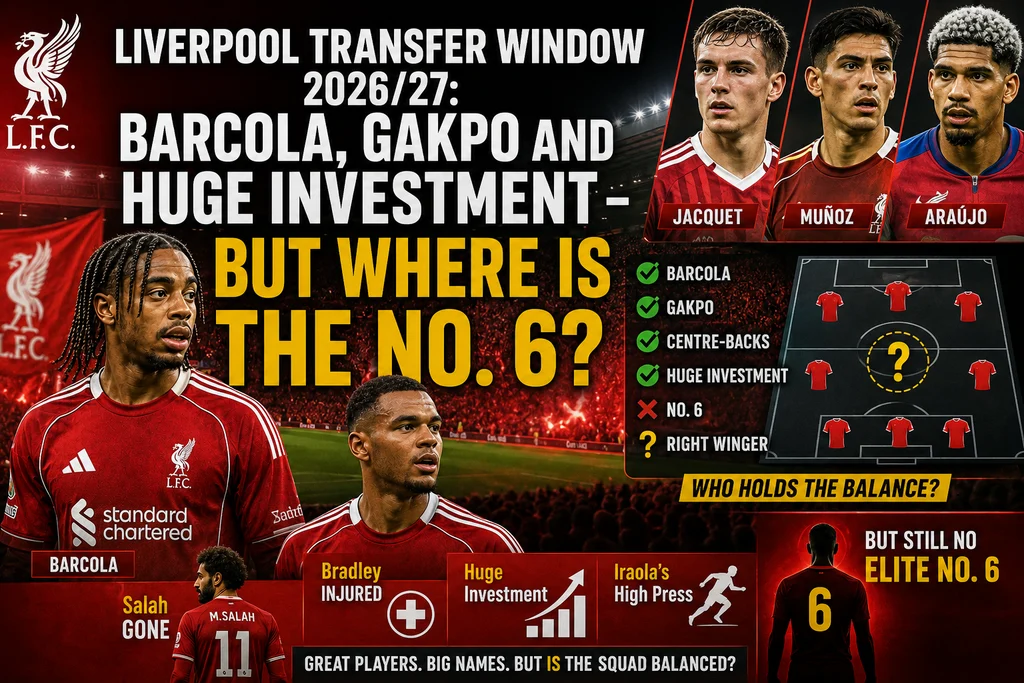
Liverpool have spent big again.
They have signed exciting players. They have added quality. They have invested in both the present and the future.
Bradley Barcola could become a superstar at Anfield.
Jérémy Jacquet looks like one of Europe’s most exciting young centre-backs.
Víctor Muñoz has pace, courage and huge potential.
Ronald Araújo adds experience, physical strength and top-level defensive quality.
Cody Gakpo stays.
Liverpool unquestionably have a lot of very good footballers.
So the criticism of Liverpool’s 2026 transfer window should not be that the club have bought bad players.
They have not.
The much bigger question is:
Did Liverpool buy the RIGHT types of players?
Because after another summer of enormous investment, Andoni Iraola is still left with a strangely unbalanced squad.
Liverpool needed help at centre-back.
They got it.
Liverpool needed more attacking quality.
They got it.
Liverpool needed to continue building for the future.
They certainly did that.
But Liverpool also needed:
- a natural long-term solution on the right wing after Mohamed Salah
- more certainty at right-back with Conor Bradley unavailable
- enough defensive balance for Iraola’s aggressive football
- and, above everything else, a genuine elite defensive No. 6
That last player never arrived.
And for Finter, that is comfortably the biggest weakness of Liverpool’s transfer window.
Liverpool do not have too few midfielders.
The problem is almost the opposite.
They have lots of very good midfielders.
But most of them naturally want to go:
FORWARD.
📊 Finter’s Liverpool Transfer Window Ratings
| Area | Finter rating |
|---|---|
| Individual quality signed | 8.5/10 |
| Bradley Barcola | 9/10 |
| Jérémy Jacquet | 8.5/10 |
| Víctor Muñoz | 8/10 |
| Ronald Araújo | 8/10 |
| Young players / future | 9/10 |
| Keeping Cody Gakpo | 9/10 |
| Centre-back recruitment | 8.5/10 |
| Salah succession planning | 3/10 |
| Right-wing balance | 3/10 |
| Defensive No. 6 | 2/10 |
| Right-back planning | 3/10 |
| Left-back depth | 5/10 |
| Squad balance | 4/10 |
| Overall window | 5.5/10 |
At first glance, that looks contradictory.
How can several individual signings score eight or nine while the overall window only gets 5.5?
Because:
Buying good players is not the same as building a good squad.
That is the central argument of this entire analysis.
🚨 Liverpool’s Biggest Problem: STILL No Elite No. 6
If Finter could add only one more player to Liverpool’s current squad, the decision would be easy.
We would not buy another attacking midfielder.
We would not buy another left winger.
We would not buy another player whose description begins with:
“He can play in several positions…”
We would buy:
A TOP-CLASS DEFENSIVE MIDFIELDER.
There is an important distinction here.
Liverpool do have players who can play as a No. 6.
Ryan Gravenberch can.
Wataru Endo can.
Alexis Mac Allister can operate deep.
Stefan Bajcetic may again become an option.
Other midfielders can be moved into the role.
But playing in the position is not the same as naturally being the type of player Liverpool are missing.
Liverpool need someone whose first instinct is:
Protect the centre-backs.
Stop the counterattack.
Win the second ball.
Stay behind the ball.
Cover the attacking full-back.
Control the central space.
Allow everybody else to attack.
Liverpool do not necessarily need another midfielder in terms of numbers.
They need another profile.
And that difference matters enormously.
For more on how elite players read space and make decisions before receiving the ball, see Finter’s English guide to Football Scanning, Awareness and Decision-Making.
⚠️ A Liverpool Midfield Full of Players Who Want to Attack
Liverpool’s midfield has enormous quality.
But look at the profiles.
Alexis Mac Allister
Fantastic technically.
Intelligent.
Creative.
Press-resistant.
Able to control possession.
He can play deep.
But should one of Liverpool’s most intelligent creative midfielders spend large parts of every game putting out fires in front of the centre-backs?
Probably not.
Dominik Szoboszlai
Power.
Running.
Intensity.
Pressing.
Shooting.
Forward movement.
Szoboszlai works extremely hard without the ball, but his natural game is aggressive.
He wants to influence the game further forward.
Florian Wirtz
Wirtz should create.
He should receive between the lines.
He should combine around the penalty area.
He should assist.
He should score.
Liverpool did not spend huge money on a creative genius to make him the player who stays at home while everybody else attacks.
Ryan Gravenberch
Gravenberch may be Liverpool’s strongest current option in the deeper role.
He has size.
Physical strength.
Technique.
Press resistance.
The ability to turn away from pressure.
And perhaps most importantly:
the ability to carry Liverpool forward.
That last point is important.
Would Liverpool potentially get even more from Gravenberch if another player carried the majority of the defensive security work?
Finter believes they might.
Trey Nyoni
Nyoni could become a fantastic Liverpool midfielder.
He has technique.
Confidence.
Vision.
Passing ability.
Composure.
The courage to play forward.
Liverpool should give him minutes.
But Nyoni should not suddenly become the answer to every midfield problem simply because he is one of the club’s biggest young talents.
He can potentially replace many of Curtis Jones’ minutes.
That does not mean he should also be expected to become Liverpool’s defensive midfield specialist.
They are different jobs.
Wataru Endo
Endo is the most natural defensive option.
He competes.
He tackles.
He understands positioning.
He accepts the ugly work.
There is value in that.
But the bigger question is:
Is Endo the long-term starting No. 6 for a Liverpool team trying to win the Premier League and Champions League?
For Finter:
No.
🧱 A Defensive No. 6 Could Actually Make Liverpool MORE Attacking
This sounds strange.
Surely signing a defensive midfielder makes a team more defensive?
Not necessarily.
It can do the opposite.
Imagine a truly elite defensive midfielder behind:
Wirtz.
Mac Allister.
Szoboszlai.
Gravenberch.
Liverpool’s attacking full-backs.
Suddenly those players know:
If I run forward, somebody stays.
If I press high, somebody protects the middle.
If I arrive in the box, somebody is controlling the transition.
If the full-back overlaps, somebody covers the space.
One disciplined midfielder can give four or five creative players more freedom.
That is why Liverpool’s missing No. 6 is not simply another small hole in the squad.
The right player could improve:
the centre-backs,
the full-backs,
the midfield,
the press,
the counter-press,
the transition defence,
and ultimately even the attack.
The least glamorous player could make Liverpool’s most glamorous players better.
That is also one of the core ideas in Finter’s English feature on Football Leadership and How Great Players Make Their Team Better.
🔥 Iraola’s Football Makes the No. 6 Even More Important
Andoni Iraola has not arrived at Liverpool to play cautious football.
His football is associated with:
- high pressing
- aggressive counter-pressing
- vertical attacks
- quick transitions
- intense running
- players committing forward
- trying to recover possession quickly
That could be fantastic at Anfield.
But aggressive football creates risk.
Imagine:
The right-back goes forward.
Wirtz receives high between the lines.
Szoboszlai joins the press.
The winger stays high.
The opposite full-back advances.
Liverpool lose possession.
The opponent breaks the first pressure with two quick passes.
Suddenly Liverpool’s centre-backs are exposed.
Who puts out the fire?
Ideally:
your No. 6.
The more aggressively Iraola wants Liverpool to attack, the more important it becomes to have one player whose natural instinct is to protect the rest.
That is why failing to sign that profile feels even stranger under Iraola.
💰 Liverpool ARE Spending Money – That Is Not the Real Criticism
This is an important point regarding FSG.
The traditional accusation that:
“Liverpool never spend any money.”
does not really work anymore.
Liverpool have spent enormous sums over successive windows.
The club have invested heavily in players such as:
Wirtz.
Isak.
Ekitiké.
Barcola.
Jacquet.
Muñoz.
And others.
So the question is no longer:
WHY WON’T LIVERPOOL SPEND?
The better question is:
ARE LIVERPOOL SPENDING ON THE RIGHT PROFILES?
That is a very different criticism.
A £100 million attacker can be a brilliant footballer.
But if your biggest tactical weakness is defensive midfield, spending another £100 million in attack does not automatically make your team £100 million better.
For the wider context of the extraordinary 2026 market, see Finter’s English ranking of the Top 50 Most Expensive Football Transfers of 2026.
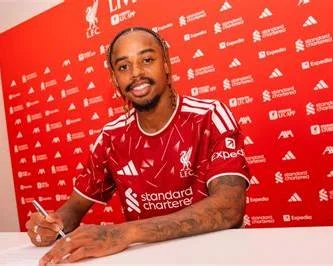
⭐ Bradley Barcola: A Fantastic Signing – But Is He What Liverpool Needed Most?
This article should not be interpreted as criticism of Bradley Barcola.
Finter loves the signing.
Barcola offers:
- explosive acceleration
- elite one-against-one ability
- goals
- assists
- movement behind defences
- Champions League experience
- transition threat
- versatility across the front line
He could become one of Liverpool’s biggest stars.
He could become world class.
The problem is not:
Why did Liverpool sign Barcola?
The question is:
After signing Barcola, did Liverpool’s attack become properly balanced?
That is much less obvious.
For more on the value of elite one-against-one attackers, read Finter’s English ranking of the World’s Best Dribblers 2025/26.
🤯 Lots of Wingers – But Where Is the Natural Right Winger?
Liverpool have:
Bradley Barcola.
Cody Gakpo.
Rio Ngumoha.
Víctor Muñoz.
Federico Chiesa.
That sounds like plenty of wide players.
And it is.
But look at their natural strengths.
Barcola is extremely comfortable from the left.
Gakpo is at his best from the left.
Ngumoha has developed largely from the left.
Muñoz is more flexible and can play on both sides.
Chiesa can operate from the right.
But Liverpool still do not have the obvious new elite right-wing player everybody points to and says:
THERE IS THE LONG-TERM SUCCESSOR TO SALAH’S POSITION.
Liverpool did not need to find the next Mohamed Salah.
That may be impossible.
But the right side still needed a clear long-term plan.
👑 Salah Leaving Was Not Necessarily the Mistake
This needs nuance.
Mohamed Salah is 34.
At some point, Liverpool had to begin a new generation.
Even one of the greatest players in the club’s history could not remain the automatic solution forever.
So Finter is not saying:
Liverpool should have kept Salah at any cost.
The real criticism is:
Liverpool knew this moment was coming.
Salah did not suddenly disappear at the end of August.
Liverpool had months to prepare.
And what did Salah leave behind?
Goals.
Assists.
Penalties.
Runs in behind.
Chance creation.
A left-footed goalscorer starting from the right.
A player who changed the way every opponent defended against Liverpool.
Replacing that output might require several players.
That is completely understandable.
But replacing the role and balance still required a clear plan.
Finter raised many of the same questions before deadline day in our English article Liverpool 2026/27 RIGHT NOW – Where Is the Transfer Plan?.
⚡ The Late Search for a Right Winger Raises Questions
Liverpool were looking at additional right-sided attacking solutions late in the window.
That is not automatically bad.
Every elite club should have several targets.
But timing matters.
If Salah’s departure had been known for so long, why was Liverpool still trying to solve the right-wing question in the final stages of the window?
That gives supporters the impression of a reactive process.
Maybe Liverpool had detailed plans internally.
Maybe several preferred deals simply became impossible.
That happens.
But supporters can only judge the final execution.
And the final execution left Liverpool without an obvious elite specialist on the right.
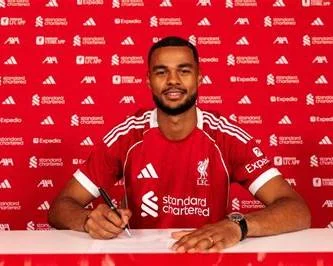
🔥 Cody Gakpo: Keeping Him Became the Sensible Decision
This is one area where Finter believes Liverpool ultimately made the correct decision.
Once Liverpool did not secure the right attacking replacement:
KEEP GAKPO.
Gakpo has been one of Liverpool’s strongest attacking players at the beginning of the season.
He knows the Premier League.
He scores goals.
He can create.
He offers physical power.
He can play several attacking positions.
He is in his prime.
Salah is gone.
Ekitiké is injured.
Selling another proven attacker without a guaranteed replacement would have been unnecessarily risky.
So:
Keeping Gakpo = 9/10.
But this still creates another question.
❓ If Liverpool Were Open to Selling Gakpo – Why Was the Replacement Not Ready?
This may be one of the strangest parts of the entire window.
If Liverpool were prepared to accept or consider an enormous fee for Gakpo, the ideal process surely would have been:
- Identify the new right winger.
- Make sure the deal is realistic.
- Progress negotiations.
- Sell Gakpo for a huge fee.
- Complete the replacement.
- Create a better-balanced attack.
Instead, Liverpool reached the closing stage without having that new player secured.
So Gakpo stayed.
The final decision makes sense.
The process before it is much harder to understand.
💥 Ekitiké’s Injury Changed Everything
Hugo Ekitiké had been one of Liverpool’s more encouraging attacking investments.
Then came the serious injury.
That changes the calculation enormously.
Salah is gone.
Ekitiké is unavailable.
Suddenly:
Gakpo becomes more important.
Isak becomes more important.
Barcola becomes more important.
Wirtz’s output becomes more important.
Muñoz becomes more important.
That makes selling Gakpo without a guaranteed replacement even less sensible.
Finter’s full English Premier League analysis already highlighted the challenges around Liverpool’s attack and placed the club fifth in our pre-season prediction.
Read the full guide:
🧱 Centre-Back: Liverpool Got This Part Right
Liverpool needed more at centre-back.
They acted.
That section of the window looks much more logical.
Jérémy Jacquet
Young.
Athletic.
Modern.
High upside.
A player who could potentially become a Liverpool defender for many years.
That is sensible long-term recruitment.
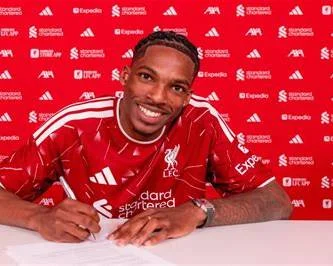
Ronald Araújo
A completely different profile.
Experience.
Physical power.
Recovery speed.
Top-level matches.
Immediate defensive quality.
One signing is primarily about Liverpool’s future.
The other provides experience now.
That is what balanced recruitment looks like.
Problem identified.
Relevant players signed.
Liverpool deserve credit here.
🚑 Right-Back: This Problem Was Not a Surprise
Conor Bradley may be Liverpool’s best natural traditional right-back.
But availability has become a major issue.
Liverpool knew Bradley would be unavailable.
Jeremie Frimpong offers enormous attacking upside.
His pace can destroy teams.
But his natural profile is highly offensive.
Again, that is not necessarily a problem.
It simply increases the need for defensive structure behind and around him.
If Frimpong attacks…
if the opposite full-back attacks…
if Wirtz is high…
if Szoboszlai joins the press…
someone has to protect the centre.
And once again we arrive at exactly the same position:
THE NO. 6.
That is why squad construction cannot be judged as a collection of individual positions.
Every player changes what the team needs somewhere else.
🛡️ Left-Back: Robertson Gone, Experience Reduced
Andy Robertson leaving does not automatically mean Liverpool made a mistake.
Another generational transition was coming.
Milos Kerkez has the potential to become a major Liverpool player.
But Robertson gave Liverpool much more than simply someone standing at left-back.
He gave:
experience,
leadership,
intensity,
reliability,
knowledge of huge matches,
years of understanding what Liverpool require.
That has disappeared.
Liverpool still have left-back options.
But the depth and experience on that side have not obviously improved.
🌟 Curtis Jones Out, Trey Nyoni Up? That Could Work Very Well
Curtis Jones leaving concerns Finter far less than the No. 6 situation.
Why?
Because Liverpool already have:
TREY NYONI.
Liverpool should give young players a route into the team.
If an academy or development player is good enough, the club should not automatically spend £40-50 million replacing someone who leaves.
Nyoni can potentially take many of Jones’ minutes.
He could eventually become even better.
That would be excellent squad management.
But there is one important warning.
Nyoni replacing Jones does not solve the defensive-midfield issue.
He is another technically gifted, progressive midfielder.
That is why Liverpool still needed the specialist.
For more on talent development and what elite clubs actually look for in young players, see Finter’s English guide: What Do Football Scouts Really Look For?.
🌱 Liverpool’s Young Recruitment May Be the Most Exciting Part
This is where Liverpool deserve real praise.
Look at the future.
Trey Nyoni.
Rio Ngumoha.
Jérémy Jacquet.
Víctor Muñoz.
Other young players moving through the system.
There is pace.
Technique.
Potential.
Development value.
Future resale value.
And the possibility that several become genuine first-team stars.
In fact, there is a strange irony.
Liverpool’s squad for 2028 may look better planned than Liverpool’s squad balance in 2026.
The future looks exciting.
The current senior squad looks less complete.
And that brings us directly to Richard Hughes.
🤔 Was Richard Hughes Actually Best When He Almost Did Nothing?
There is a strange irony in Richard Hughes’ time as Liverpool sporting director.
His first summer was extremely quiet.
Liverpool essentially made Federico Chiesa the only significant immediate first-team addition.
At the time, Hughes was criticised.
Where were the transfers?
Where was the ambition?
Why was Liverpool doing so little?
But with hindsight, there is a provocative question worth asking:
Was that actually Hughes’ best window?
Liverpool largely left a functioning squad alone.
They did not buy players simply to create activity.
They did not completely change the balance of the team.
They did not spend enormous amounts for the sake of headlines.
The squad still made sense.
Then came the opposite.
Huge expenditure.
Huge names.
Lots of new players.
And yet Liverpool arguably now look more unbalanced.
Which creates one of the harshest questions you can ask about Hughes:
Did Liverpool become better at BUYING players – but worse at BUILDING a squad?
That does not mean Hughes should have continued doing nothing.
Of course not.
Liverpool needed renewal.
Salah was ageing.
The defence had to evolve.
A younger generation had to emerge.
But if Liverpool can spend record amounts and still finish the process without:
a specialist No. 6,
an obvious elite right winger,
complete confidence at right-back,
and ideal squad balance,
then activity alone cannot be called success.
There is almost a case that Hughes was at his most effective when he interfered least with a team that already worked.
💸 Richard Hughes: Good at Spending Money – But What About Building a Squad?
A sporting director cannot simply be judged by the names he signs.
Liverpool have bought a lot of talent.
Wirtz.
Isak.
Ekitiké.
Barcola.
Jacquet.
Muñoz.
Araújo.
Those are serious investments.
But a sporting director’s job is not:
Buy as many talented players as possible.
The job is to build:
a complete squad,
different profiles,
succession plans,
contract value,
depth,
specialists,
and a group that fits the coach.
That is where the Hughes era becomes much more debatable.
Liverpool have spent heavily.
Yet obvious questions remain.
Where is the No. 6?
Where is the natural right winger?
What is the long-term right-back solution?
Why were important areas still being discussed so late in the window?
📉 Contract Management Is Part of the Job Too
Recruitment is not only buying.
A sporting director also needs to:
sell at the right time,
renew contracts,
protect market value,
manage ageing players,
prepare succession.
Liverpool have lost several major names at the end of contracts over a relatively short period.
Not every case is a disaster.
Salah was older.
Robertson was older.
Every great team eventually changes generation.
But when several important players reach the end of their deals close together, it is fair to evaluate the wider planning.
The transfer market is not just:
“Who did you sign?”
It is also:
“What value did you protect?”
👋 If Hughes Leaves Now, What Is His Liverpool Legacy?
If Richard Hughes leaves Liverpool shortly after this window, his time at the club will be fascinating to assess.
There has been huge spending.
There have been exciting signings.
There is significant young talent.
But there is also a squad that still looks strangely incomplete.
If this proves to be Hughes’ final major Liverpool window, his legacy may not ultimately be defined by whether Barcola or Jacquet become great players.
It may be defined by a simpler question:
Did all the pieces ever fit together?
🏢 FSG, New Investment and the Bigger Liverpool Question
Liverpool are also entering a fascinating period away from the pitch.
FSG have sold a significant minority stake while remaining in control.
That does not automatically mean Liverpool are about to be sold.
There is an important difference between:
a major minority investment
and
a confirmed full sale.
But it undoubtedly makes the long-term ownership picture more interesting.
The question is now legitimate:
Is this simply strategic investment – or the first step towards an eventual FSG exit?
Nobody outside the ownership group can answer that with certainty.
But Liverpool supporters will be watching closely.
🤔 Do FSG Lack Ambition – Or Is Sporting Direction the Bigger Problem?
This is another area where the criticism needs to be precise.
If Liverpool were refusing to invest, the argument would be simple.
But they are investing.
Heavily.
So perhaps the bigger issue is not:
MONEY.
Perhaps it is:
DIRECTION.
A club can spend hundreds of millions and still build an unbalanced team.
Transfer expenditure is not a trophy.
Big names are not a tactical structure.
A successful recruitment department has to connect:
the manager,
the playing style,
the current squad,
the weaknesses,
the age profile,
the contracts,
and the incoming players.
Liverpool still need to prove they have done that.
🔴 Is This One of Liverpool’s Most Unbalanced Squads in Years?
That may sound dramatic.
Because Liverpool still have tremendous individual quality.
But look at the profile distribution.
Left wing
Barcola.
Gakpo.
Ngumoha.
Muñoz can play there.
Right wing
Chiesa.
Muñoz can play there.
Gakpo can be moved.
Others can fill in.
But there is no obvious new elite long-term successor to Salah’s role.
Central midfield
Mac Allister.
Wirtz.
Szoboszlai.
Gravenberch.
Nyoni.
Endo.
Bajcetic.
An enormous amount of technical quality.
Plenty of players.
But no new elite defensive specialist.
Right-back
Bradley unavailable.
Frimpong offers a highly attacking profile.
Left-back
Kerkez.
Depth behind him.
Robertson’s experience gone.
This is not a bad Liverpool squad.
Far from it.
It is a strangely balanced Liverpool squad.
⚽ Liverpool Could Still Be Excellent
That is important.
This article is not predicting disaster.
Look at the talent available.
Alisson.
Van Dijk.
Jacquet.
Araújo.
Kerkez.
Gravenberch.
Mac Allister.
Szoboszlai.
Wirtz.
Barcola.
Gakpo.
Isak.
Muñoz.
Ngumoha.
Eventually Ekitiké again.
Liverpool could become extremely dangerous.
Barcola could explode.
Wirtz could become the player everybody expected.
Isak could produce a huge goalscoring season.
Gakpo could continue his good form.
Jacquet could develop faster than expected.
Muñoz could become one of the smartest signings of the summer.
Nyoni could break through.
Ngumoha could become a star.
Iraola could solve the midfield balance tactically.
There is absolutely a positive scenario.
Liverpool remain one of football’s biggest clubs, with one of the sport’s most iconic identities.
For more Liverpool history and atmosphere, read Finter’s English feature on You’ll Never Walk Alone – The Story of Football’s Most Iconic Anthem and our profile of Steven Gerrard – The Liverpool Legend Who Never Gave Up.
📉 But Finter Still Sees a Difficult Transition Season
There are simply many changes happening at once.
New manager.
New system.
Salah gone.
Ekitiké injured.
Bradley unavailable.
New defenders.
New attackers.
No specialist No. 6.
No obvious natural Salah successor.
Potential sporting-management changes.
Changes around ownership.
That is a lot of uncertainty in one season.
Before the campaign, Finter predicted Liverpool in fifth place with 69 points in our English Premier League preview.
That prediction was never based on Liverpool having poor players.
It was based on risk.
A top-five finish and Champions League qualification therefore would not necessarily represent disaster during a huge transition.
But after the amount Liverpool have invested, the club’s long-term ambition obviously has to be much higher.
🎥 What Do Liverpool Fans Think About the Transfer Window?
Liverpool supporters are discussing many of the same issues.
Did Liverpool buy enough?
Did Liverpool buy the correct profiles?
Should defensive midfield have been the priority?
Was keeping Gakpo now essential?
Why did the right-wing search go so late?
Two fan reactions worth watching alongside this article:
Liverpool Fan Transfer Window Reaction – Video 1
https://www.youtube.com/watch?v=2-6lYBUrSDc
Liverpool Fan Transfer Window Reaction – Video 2
https://www.youtube.com/watch?v=2Sf-OH_LEls
And for more Liverpool video content:
🇩🇰 A Danish Expert Raises Similar Questions
A Danish expert view shared with Finter also raises concerns around the overall balance of the window.
And that is important.
The debate does not have to be:
“Barcola is good”
versus
“Liverpool’s window was bad.”
Both things can be true at the same time.
You can believe:
Barcola is fantastic.
Jacquet is exciting.
Muñoz is promising.
Araújo makes sense.
Nyoni should get minutes.
And still conclude:
Liverpool did not solve all of their most important structural problems.
That is Finter’s position.
⭐ FINTER’S FINAL RATINGS
Bradley Barcola – 9/10
Outstanding talent.
Potentially world class.
The concern is not Barcola.
It is the balance around him.
Jérémy Jacquet – 8.5/10
Excellent long-term recruitment.
Young, athletic and potentially a major Liverpool centre-back.
Ronald Araújo – 8/10
Adds experience, power and immediate defensive quality.
Víctor Muñoz – 8/10
Fast, flexible, brave and exciting.
Could become an excellent signing.
Keeping Cody Gakpo – 9/10
Once Liverpool failed to secure the right replacement, this became the obvious decision.
Planning Around Gakpo – 4/10
If Liverpool were prepared to sell him for a huge fee, the replacement should have been far closer to completion.
Salah Succession – 6/10
Moving on from a 34-year-old Salah can be justified.
Doing it without an obvious long-term natural right-wing solution is harder to understand.
Curtis Jones → Trey Nyoni – 8/10
Potentially very good squad management.
Give the youngster a chance.
Centre-Back Recruitment – 8.5/10
One of Liverpool’s strongest areas of the window.
Right-Back Planning – 3/10
The Bradley situation was known.
Liverpool should look more secure here.
Defensive No. 6 – 2/10
THE BIGGEST FAILURE OF THE WINDOW.
🏁 FINAL VERDICT: Liverpool Bought Good Players – But Did They Build the Right TEAM?
That is the question that should define this transfer window.
Liverpool bought quality.
Liverpool bought pace.
Liverpool bought talent.
Liverpool bought young players.
Liverpool bought star power.
Liverpool spent heavily.
But football is not about collecting the maximum number of individually talented players.
Football is about building a team.
Liverpool needed centre-backs.
They acted.
Good.
Liverpool needed more attacking quality.
They added it.
Good.
Liverpool needed to keep refreshing the age profile.
They did.
Good.
Liverpool’s young-player pathway looks exciting.
Very good.
But Liverpool had months to prepare for life after Mohamed Salah.
The obvious elite right-wing successor did not arrive.
Liverpool knew Bradley had major injury problems.
Right-back still raises questions.
Robertson’s departure reduced experience on the left.
And most importantly:
Liverpool have a midfield full of players who want to attack – but still did not sign the player who could hold everything together.
That is Finter’s biggest criticism of the 2026 window.
An elite No. 6 does not need to score 15 goals.
He does not need to make 15 assists.
He does not need to cost £120 million.
He does not need to sell shirts.
He needs to make:
Wirtz better.
Mac Allister better.
Szoboszlai better.
Gravenberch better.
The full-backs better.
The centre-backs better.
And Iraola’s aggressive football safer.
Sometimes football’s least glamorous player is the one who allows all the glamorous players to shine.
Liverpool bought:
QUALITY.
Liverpool bought:
PACE.
Liverpool bought:
TALENT.
Liverpool bought:
THE FUTURE.
But the player who could provide:
BALANCE?
Liverpool still did not buy him.
And if Richard Hughes is now approaching the end of his Liverpool period, that may ultimately become the strange story of his transfer legacy.
Not simply how much money he spent.
Not simply how many famous players he signed.
But the one crucial profile Liverpool still never brought to Anfield.
🔴 Read More Liverpool & English Football on Finter
Continue with Finter’s English Liverpool and Premier League coverage:
Liverpool 2026/27 RIGHT NOW – Where Is the Transfer Plan?
Premier League 2026/27 – The Ultimate Season Preview
Top 20 Most-Watched Liverpool Videos on YouTube
You’ll Never Walk Alone – The Story of Football’s Most Iconic Anthem
Steven Gerrard – The Liverpool Legend Who Never Gave Up
James Milner – The Ultimate Squad Player and Premier League Record Holder
Premier League Rules 2026/27 – The Complete Guide
Top 50 Most Expensive Football Transfers of 2026
Football Scanning Explained – Awareness, Vision and Decision-Making