
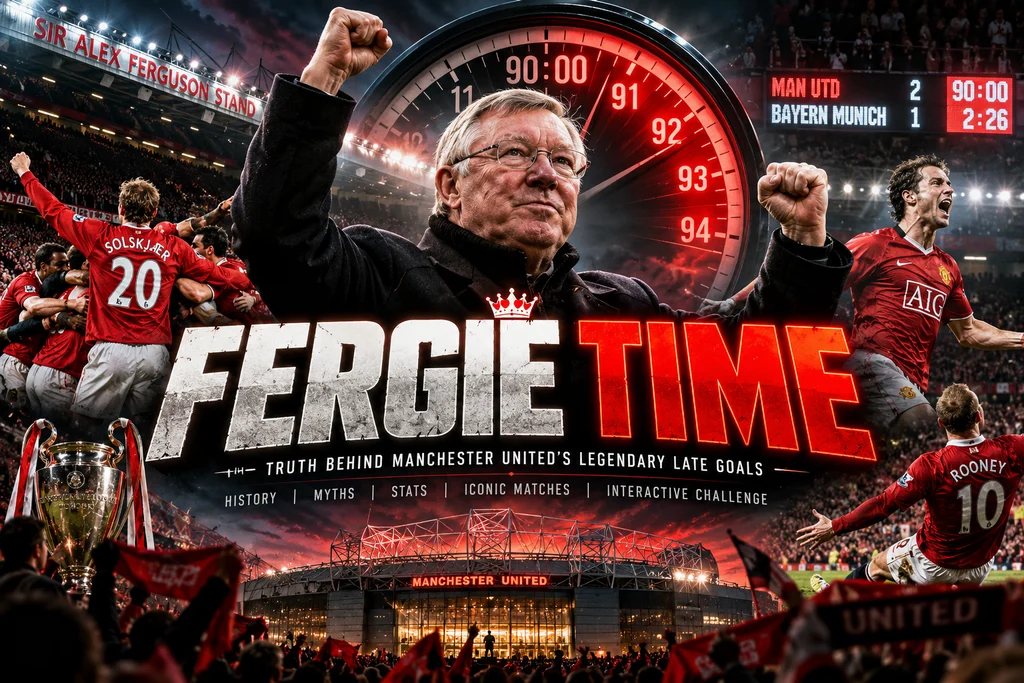
⏱️⚽ FERGIE TIME
The Truth Behind Manchester United’s Legendary Late Goals
90 minutes have gone. Manchester United need a goal. The opposition look at the referee. Old Trafford gets louder. Sir Alex Ferguson looks at his watch.
United attack again.
And somehow, the goal arrives.
🔥 Origin 🏆 1999 📊 Statistics 🕵️ MythBuster 🎮 Simulator 🏆 Quiz ⚽ Training 🖨️ Print / Save PDF🤯 THE BIG FERGIE TIME QUESTION
Was Manchester United genuinely football’s master of stoppage-time goals? Did United receive unusually long periods of added time? Or did extraordinary goals, relentless pressure and Sir Alex Ferguson’s psychology create one of football’s greatest myths?
The statistics provide a surprisingly complicated answer.
⏱️ What Is Fergie Time?
“Fergie Time” became the popular nickname for the dramatic final minutes of Manchester United matches during Sir Alex Ferguson’s reign — particularly when United were chasing an equaliser or winning goal.
For United supporters, it represented belief, resilience and the conviction that the match was never over until the referee finally blew the whistle.
For opposition supporters, the phrase could have a rather different meaning:
Fergie Time was never an official football rule. It became a cultural phenomenon: part joke, part accusation, part psychology and part celebration of United’s extraordinary ability to create memorable late drama.
🔥 10 April 1993 – The Match That Created the Legend
Manchester United were attempting to win their first English league championship since 1967.
Sheffield Wednesday arrived at Old Trafford.
John Sheridan converted a penalty.
United were losing 1-0.
The title race was threatening to swing away from Ferguson’s team.
⚽ Captain Bruce to the Rescue
Steve Bruce headed Manchester United level late in normal time.
That detail matters because Bruce’s first goal is sometimes incorrectly remembered as a stoppage-time goal.
The equaliser came before the end of normal time.
But Bruce was not finished.
United kept attacking.
Deep into an extraordinary period of additional time, Bruce struck again.
Manchester United had turned the match around.
⏱️ Why Was There So Much Added Time?
The match contained unusual interruptions. Referee Mike Peck was injured and linesman John Hilditch had to take over.
Hilditch later explained that the match had contained numerous stoppages.
Approximately seven minutes and 16 seconds of added time.
Today, lengthy periods of stoppage time are much more familiar. In 1993, more than seven minutes felt extraordinary.
United needed a goal. The clock had passed 90. United scored.
The mythology of Fergie Time had its origin story.
🎥 VIDEO WATCH CHALLENGE
Search YouTube for: Manchester United 2-1 Sheffield Wednesday 1993 Steve Bruce.
👀 Watch Bruce’s movement before the decisive header.
👀 Where does he position himself?
👀 When does he attack the ball?
👀 What happens to Wednesday’s defensive shape as the pressure increases?
⌚ Ferguson’s Psychological Weapon
Sir Alex Ferguson understood something that went beyond formations, passing patterns and substitutions:
football matches are psychological contests.
One of the most recognisable images of the Ferguson era was remarkably simple.
🔴 To United
There is still time. Keep going.
😰 To the Opposition
You haven’t survived yet.
🏟️ To Old Trafford
Turn up the pressure.
👨⚖️ To the Officials
We are watching the clock.
The gesture mattered because players do not experience the final five minutes of a match in the same way as the opening five.
Fatigue increases. Risk changes. The leading team may defend deeper. The chasing team commits additional players forward. Every clearance suddenly feels important.
🧠 Continue on FINTER
👉 Mentality & Learning in Football
👉 The Dark Arts of Football – Game Management, Psychology & Hidden Skills
🏆 26 May 1999 – The Ultimate Fergie Time
If one match transformed Manchester United’s never-say-die reputation into a global phenomenon, it was the 1999 UEFA Champions League final.
Mario Basler
Bayern Munich lead 1-0.
Teddy Sheringham
Manchester United equalise.
Ole Gunnar Solskjær
Manchester United win it.
Bayern Munich had led almost the entire match through Mario Basler’s early goal.
When 90 minutes arrived, Bayern were moments away from becoming European champions.
Then David Beckham delivered a corner.
The ball stayed alive.
Ryan Giggs sent it back towards goal.
Teddy Sheringham scored.
Extra time appeared inevitable.
Except United immediately attacked again.
Another corner.
Beckham delivered.
Sheringham redirected the ball.
Ole Gunnar Solskjær reacted.
⚽ SOLSKJÆR!
Two stoppage-time goals had transformed a European Cup final.
🏆 The Treble
— Sir Alex Ferguson
🎥 WATCH THE 1999 FINAL
👉 Explore Manchester United vs Bayern Munich – UEFA
FINTER WATCH CHALLENGE:
👀 Watch the final two corners.
👀 How many United players attack the penalty area?
👀 What happens after Bayern fail to fully clear the first corner?
👀 How quickly do United reset emotionally after making it 1-1?
🔥 More Historic Football on FINTER
⚽ The Fergie Time Hall of Fame
1993 – Steve Bruce vs Sheffield Wednesday
The match that gave the Fergie Time mythology its defining origin story.
1999 – Teddy Sheringham vs Bayern Munich
90+1. United’s European dream survives.
1999 – Ole Gunnar Solskjær vs Bayern Munich
90+3. One of the most dramatic winners in football history.
2003 – Paul Scholes vs Sunderland
United’s next Premier League 90th-minute-or-later winner after Bruce’s famous 1993 goal.
2009 – Federico Macheda vs Aston Villa
A teenager announces himself with a title-race winner.
2009 – Michael Owen vs Manchester City
A spectacular 4-3 derby decided deep into stoppage time.
2012 – Robin van Persie vs Manchester City
A dramatic derby winner during Ferguson’s final title-winning season.
🌟 Federico Macheda – The Dream Debut
5 April 2009.
Manchester United were locked in a fierce title race.
Aston Villa led 2-1 at Old Trafford.
Cristiano Ronaldo equalised.
Ferguson had introduced a virtually unknown 17-year-old Italian: Federico Macheda.
Then came stoppage time.
Macheda received the ball.
Turn.
Create the angle.
Finish.
A teenage Premier League debutant had scored a dramatic winner and sent United back to the top.
🎥 WATCH CHALLENGE – MACHEDA
Search the official Manchester United video channels for Macheda’s famous Aston Villa winner.
👀 Don’t only watch the shot.
Watch his first touch, body position, turn and creation of the shooting angle.
🤯 Michael Owen – The Derby That Wouldn’t End
20 September 2009.
Manchester United vs Manchester City.
The score kept changing.
United scored.
City responded.
United scored again.
City responded again.
Craig Bellamy eventually made it 3-3.
Four minutes of minimum additional time had been indicated.
But the match contained further stoppages.
Ryan Giggs received the ball.
He spotted Michael Owen.
Pass.
Touch.
Finish.
Michael Owen wins the Manchester derby.
⚖️ The Rule Everyone Should Understand
If the fourth official displays +4, it represents a minimum amount of additional time.
It does not mean the referee must blow the final whistle at exactly 94:00. Further delays during stoppage time can require further time to be added.
🎯 Robin van Persie – Ferguson’s Final Title Season
In December 2012, Manchester United visited defending champions Manchester City.
The score was 2-2 late in the match.
United won a free kick.
Robin van Persie took it.
The shot was deflected.
Goal.
Another dramatic late derby victory — and another moment that fitted perfectly into the Fergie Time story.
💔 93:20 – The Ultimate Fergie Time Irony
13 May 2012.
Final day of the Premier League season.
Manchester United defeated Sunderland.
Manchester City needed to beat Queens Park Rangers to secure the title.
City were losing 2-1 as the match entered stoppage time.
Edin Džeko equalised.
One final attack.
Mario Balotelli.
Sergio Agüero.
Manchester City 3-2 QPR.
City won the Premier League on goal difference.
🔄 ANTI-FERGIE TIME?
For years, dramatic late goals had been associated with Ferguson’s United. Then one of the most famous stoppage-time goals in football history denied United the championship.
📊 The Statistic That Changes the Story
If Fergie Time meant Manchester United were uniquely dominant at scoring Premier League winners after the 90-minute mark, you would expect United to be comfortably top.
They weren’t.
Premier League analysis counted 90th-minute-or-later winning goals during Ferguson’s Premier League reign from 1992/93 through 2012/13.
| Club | 90+ Minute PL Winners |
|---|---|
| 🥇 Liverpool | 24 |
| 🥈 Arsenal | 19 |
| 🥉 Chelsea | 18 |
| 4. Everton | 17 |
| 5. Manchester United | 16 |
🤯 UNITED WERE FIFTH
Liverpool recorded eight more 90th-minute-or-later Premier League winners than Manchester United during Ferguson’s Premier League era.
Another fascinating detail: after Bruce’s famous 1993 winner, United did not record another Premier League winning goal in the 90th minute or later until Paul Scholes against Sunderland on New Year’s Day 2003.
So Why Does Everyone Remember Fergie Time?
🏆 Importance
Many famous moments occurred in enormous matches.
⌚ Ferguson
The watch became an unforgettable visual symbol.
🏟️ Old Trafford
Late pressure in a huge stadium created memorable drama.
🧠 Memory
Dramatic events are remembered more easily than ordinary endings.
🕵️ FINTER MYTHBUSTER – Fergie Time
❓ Manchester United scored more 90+ Premier League winners than every other club under Ferguson.
❌ MYTH. United ranked fifth with 16. Liverpool had 24.
❓ United scored hugely important late goals under Ferguson.
✅ FACT. Several became defining moments in football history.
❓ The 1999 Champions League final was won with two stoppage-time goals.
✅ FACT. Sheringham scored at 90+1 and Solskjær at 90+3.
❓ Steve Bruce scored both 1993 goals in stoppage time.
❌ MYTH. The equaliser came before stoppage time. His second was the famous late winner.
❓ +4 means the match must end at exactly 94:00.
❌ MYTH. It represents a minimum amount of additional time.
❓ There was an official rule called Fergie Time.
❌ MYTH. It was a nickname and football-cultural phenomenon.
🧠 What Actually Happens When a Team Chases a Late Goal?
The lesson from Fergie Time is not simply:
Elite late-game pressure is more sophisticated.
↔️ Width
Stretch the defensive block and create crossing or half-space opportunities.
⚽ Second Balls
The first cross does not need to create the chance. Winning the clearance can start the next attack.
🔄 Rest Defence
Keep enough structure behind the attack to prevent the opponent escaping.
⚡ Tempo
Play quickly without turning every possession into a desperate percentage ball.
📦 Box Occupation
Attack different spaces rather than putting everyone in the same zone.
🔥 Counterpress
Recover clearances quickly so one attack becomes two, three or four.
🧠 FINTER FOOTBALL IQ
Cross → clearance → second ball → new attack → corner → clearance → regain → attack again.
That sequence may explain the feeling of Fergie Time better than the stopwatch.
👉 The Complete Guide to Football Intelligence
👉 Football Without the Ball – Space, Pressing, Movement & Football IQ
⚽ Train Fergie Time
🔥 GAME 1 – THE 90-SECOND COMEBACK
Format: 4v4 or 5v5
Starting score: 1-0
Time: 90 seconds
One team protects the lead. The other chases the game.
⚽ Goal in final 30 seconds = 2 points
⚽ Winning goal in final 10 seconds = 3 points
Develops: tempo, risk assessment, finishing, defending a lead, counterpressing, communication and emotional control.
⏱️ GAME 2 – FERGIE TIME WAVES
Play 5v5.
Start a two-minute period with one team 1-0 behind.
Whenever the defending team clears beyond halfway, the coach immediately introduces another ball.
The attacking team experiences repeated waves of pressure.
🧠 GAME 3 – CONTROL THE LEAD
Start 1-0 ahead with three minutes remaining.
⭐ 1 point for keeping possession for 10 seconds
⭐ 1 point for reaching the attacking half under control
⭐ 2 points for scoring
⭐ 3 points for protecting the lead
The lesson: defending a lead does not automatically mean standing inside your own penalty area.
⏱️🎮 FERGIE TIME SIMULATOR
It is the 88th minute at Old Trafford.
Your team is losing 1-0.
You are the coach. Can you find the equaliser?
88:00 – You regain possession
The opposition have dropped into a compact block.
What do you do?
🏟️😰 CAN YOU SURVIVE OLD TRAFFORD?
Now switch roles.
You are the opposition coach.
The fourth official shows:
Can you protect the lead?
90:20 – You win the ball near the touchline.
📊🤯 GUESS THE FERGIE TIME STAT
Which club scored the MOST Premier League winning goals in the 90th minute or later during Ferguson’s Premier League reign?
🏆 FERGIE TIME MASTER QUIZ
Eight questions. One point for every correct answer.
Can you become a FERGIE TIME LEGEND?
🤯 Why Fergie Time Became Bigger Than the Statistics
Manchester United were not statistically number one for 90+ Premier League winning goals during Ferguson’s reign.
Yet the phrase is not Liverpool Time.
It is not Arsenal Time.
It is not Chelsea Time.
1. The Goals Were Memorable
Bruce in a title race. Sheringham and Solskjær in a European Cup final. Macheda in a title race. Owen in a Manchester derby.
2. Ferguson Became Part of the Image
The watch created a visual shorthand everyone understood.
3. United Played Constantly in Huge Matches
Ferguson’s teams repeatedly competed for major trophies. Late goals therefore often occurred in high-profile situations.
4. Expectation Reinforced the Myth
Once supporters expected Fergie Time, every new late goal became another piece of evidence for a story they already knew.
5. Football Is Remembered Through Stories
Supporters do not experience football as a spreadsheet. They remember noise, emotion, shock, celebration and heartbreak.
The story tells us why we still remember it.
😰 What About “Squeaky Bum Time”?
Ferguson also became associated with another unforgettable football expression: “squeaky bum time.”
It described the nerve-shredding final stages of a title race when every mistake, goal and result can transform the championship.
The phrase fits perfectly with Fergie Time because both describe something the match clock cannot measure:
Ten minutes in August and ten minutes in a decisive title match both last 600 seconds.
They do not feel remotely the same.
👦⚽ What Can Young Players Learn From Fergie Time?
The lesson should not be:
A better lesson is:
🔄 Try Again
A missed chance does not decide your next action.
🧠 Stay Clear
Urgency should not destroy decision-making.
⚡ React
Lose the ball? Respond to the next situation.
❤️ Keep Playing
The match remains an opportunity to learn until it ends.
🔗 Continue Your FINTER Journey
😈 The Dark Arts
Psychology, game management and football’s hidden skills.
Discover the Hidden Game →🏆 Quiz Universe
Players, legends, competitions, Football IQ and more.
Enter the FINTER Quiz Universe →🎥 Football Stories
Miracles, legends, comebacks and unforgettable matches.
Watch More Football Stories →❓ Fergie Time FAQ
What is Fergie Time?
Fergie Time is the nickname associated with the dramatic final stages of Manchester United matches during Sir Alex Ferguson’s reign, especially when United were chasing an equaliser or winner.
Where did Fergie Time come from?
Manchester United’s dramatic 2-1 victory over Sheffield Wednesday on 10 April 1993 is widely treated as the defining origin story.
How much added time was played against Sheffield Wednesday?
Referee John Hilditch later recalled approximately seven minutes and 16 seconds of additional time.
Did Manchester United have the most 90+ winners under Ferguson?
No. Premier League statistics for Ferguson’s Premier League reign put Liverpool first with 24 and Manchester United fifth with 16.
Who scored in stoppage time in the 1999 Champions League final?
Teddy Sheringham equalised at 90+1 and Ole Gunnar Solskjær scored the winner at 90+3.
Who scored United’s famous 2009 Manchester derby winner?
Michael Owen scored the decisive goal as United defeated Manchester City 4-3.
Who was Federico Macheda?
Macheda was a teenage Manchester United forward who famously scored a dramatic winner against Aston Villa on his Premier League debut in April 2009.
Was Fergie Time an actual football rule?
No. It was never a separate law. It became part of football culture because of United’s reputation for dramatic late pressure and goals.
🏁 Conclusion – Fergie Time Was Bigger Than a Stopwatch
So was Fergie Time real?
If “real” means Manchester United had a special right to keep playing until they scored, obviously not.
But if it means Ferguson’s United created an extraordinary culture of late pressure, belief, psychological intensity and memorable goals, Fergie Time became a very real part of football history.
And the greatest twist is hidden in the numbers.
Four Premier League clubs recorded more 90+ winners during Ferguson’s Premier League reign.
Yet nobody talks about Everton Time.
Nobody talks about Arsenal Time.
Nobody talks about Liverpool Time.
Football remembers:
Because football is not remembered only through data.
It is remembered through moments.
Bruce rising for the header.
Sheringham turning the ball home.
Solskjær sticking out a boot.
Macheda turning and shooting.
Owen appearing behind City’s defence.
And Ferguson standing on the touchline.
Looking at his watch.
Waiting for one more attack.
⏱️ 90:00 DOESN’T ALWAYS FEEL LIKE THE END.
And that may be the real meaning of Fergie Time.