
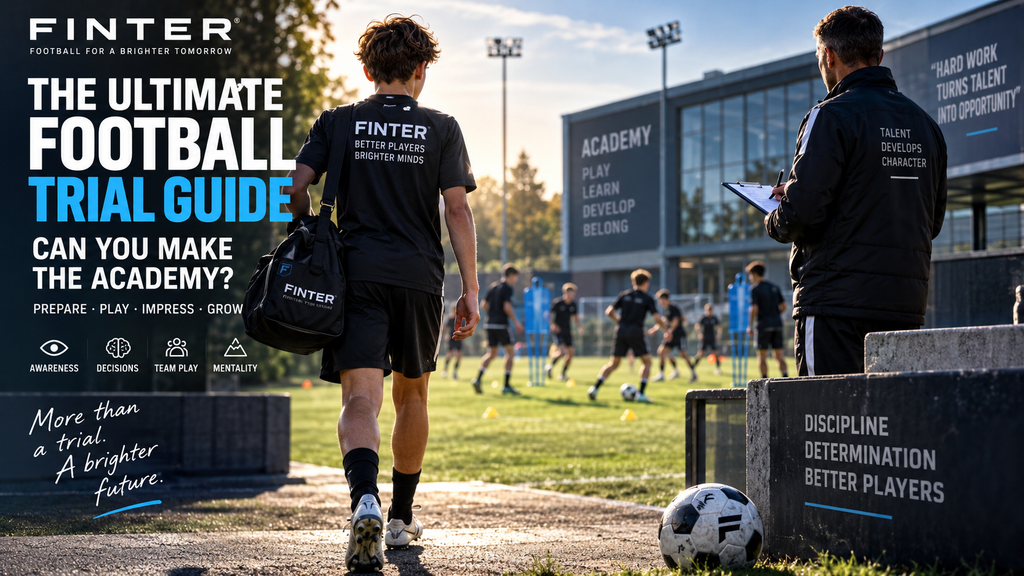
⚽ The Ultimate Football Trial Guide – Can You Make the Academy? Interactive Trial Simulator, Coach Test & Preparation Plan
Getting invited to a football trial can be one of the most exciting moments in a young player’s development.
It can also be one of the most stressful.
You may be thinking:
- What are the coaches looking for?
- Should I play safely?
- Should I try to dribble?
- What if I make a mistake?
- What if the other players are better than me?
- How do I make a strong impression?
A football trial is not simply a competition to produce the most spectacular action.
Coaches may notice much more than goals, assists and tricks. They may look at awareness, decision-making, movement, communication, mentality, tactical understanding, technical quality and how you respond when something goes wrong.
🔥 FINTER Football Trial MAX
Take the interactive trial test and discover:
- 👀 Your Awareness Score
- 🧠 Your Decision-Making Score
- 🤝 Your Team Play Score
- 🔥 Your Mentality Score
- 📊 Your Trial Profile
- 🎮 Trial Simulator
- ⚽ Position-specific recommendations
- 📋 Preparation checklist
- ⚡ Personal training plan
Important: The FINTER tool does not predict whether an academy or club will select you. It is designed to help you prepare, reflect and improve.
Interactive Trial Simulator & Coach Impression Test
Test your awareness, decisions, team play and mentality — then build a personal football trial preparation session.
⚽ Can You Make the Academy?
Getting invited to a football trial can be one of the most exciting moments in a young player's development. It can also be one of the most stressful.
You may be wondering what coaches are looking for, whether you should play safely, whether you should dribble, what happens if you make a mistake, or how to stand out when other players look stronger or faster.
A football trial is not simply a competition to produce the most spectacular action. Coaches may notice awareness, decision-making, movement, communication, mentality, tactical understanding, technical quality, physical qualities, coachability and how you respond when something goes wrong.
Get a quick coach-focused tip for that part of your game.
Do not try to show everything. Show that you can help the team.
The FINTER tools on this page are for preparation and self-reflection. They do not predict academy or club selection.
👀 What Might Coaches Look for at a Football Trial?
There is no universal academy checklist. Different clubs, age groups, coaches and playing styles can value different qualities. One team may prioritise aggressive pressing, another may focus on possession, and another may be looking for development potential in a particular position.
⚽ On the ball
- First touch
- Passing quality
- 1v1 decisions
- Finishing or final action
- Composure under pressure
🏃 Without the ball
- Scanning
- Movement and support
- Pressing and recovery
- Communication
- Reaction in transitions
The strongest action is often not the most difficult action. It is the action the game needs.
🧪 Coach Impression Test
Rate yourself from 1 = major weakness to 5 = strong.
📊 Your Trial Profile
This is a development tool, not a prediction of academy selection.
🎮 Trial Simulator
🎯 Position-Specific Trial Guide
📋 Trial Preparation Checklist
0 / 10 ready
⚡ Build My Trial Session
👀 1. Scan Before You Receive
Scanning is one of the simplest ways to give yourself more time. Before the ball arrives, check the pressure, space, teammates, opponents and possible next actions.
A player who scans well can appear faster because the decision starts before the first touch. If you wait until the ball reaches you before looking, the game can suddenly feel much quicker.
⚽ 2. First Touch: Prepare the Next Action
A good first touch is not only about keeping the ball close. It should help solve the next football problem. If space is available, move into it. If pressure is tight, protect the ball. If a teammate is free, prepare the pass.
At a trial, clean and purposeful football actions can be more valuable than trying to make every touch spectacular.
🧠 3. Decision-Making: Simple Does Not Mean Passive
Players sometimes force difficult actions because they want to impress. A simple pass can still show awareness, timing, technical quality, speed of thought and team understanding.
Do not hide, but do not force a highlight either. Ask one question:
🔥 4. What Happens After a Mistake?
You will make mistakes. Everyone does. You may lose possession, miscontrol a pass, miss a chance or make the wrong decision. The trial does not stop.
MISTAKE → ACCEPT → REACT → REJOIN THE GAME
Avoid standing still, complaining, looking towards the coach or allowing one mistake to create several more. Return your attention to the next action.
🏃 5. Movement Without the Ball
A coach may learn a lot about you when you do not have possession. Do you create passing angles? Support teammates? Track runners? React in transition? Press intelligently? Offer yourself again after passing?
You can influence a trial without constantly touching the ball.
🗣️ 6. Communication
Useful communication helps teammates. It does not mean shouting for the sake of looking like a leader.
Examples: “Man on”, “Turn”, “Time”, “Set”, “Left”, “Right”, “Drop”, “Press”, “Hold”.
Do not try to sound like a leader. Help your teammates play better.
⚔️ Should You Dribble at a Football Trial?
Yes, when the situation is right. If 1v1 is one of your strengths, do not remove it because you are nervous. But ask whether there is space behind the defender, whether beating the player creates an advantage, whether a teammate is in a stronger position and what your next action will be.
🔥 Your First Five Minutes
Do not enter thinking you must score immediately. Enter the football. A clean pass, good scan, useful support run, strong duel, sensible press or quick reaction after losing possession can settle you into the game.
🎯 Position-Specific Trial Priorities
🧤 Goalkeeper
Communication, starting position, handling, distribution, command, decisions and reactions after mistakes.
🛡️ Centre-back
Scanning, positioning, composure, communication, clean passing, defending space and sensible duel selection.
🏃 Full-back / Wing-back
Defensive awareness, support movement, recovery effort, combinations, receiving quality and timing going forward.
⚙️ Central Midfielder
Scanning, passing angles, tempo, receiving under pressure, transitions and movement after releasing the ball.
🎨 Attacking Midfielder
Creativity without forcing every action, movement between lines, combinations, final-pass awareness and shooting opportunities.
⚡ Winger
Width, 1v1 courage, acceleration, runs behind, pressing, combinations and end product.
🥅 Striker
Movement, pressing, link play, timing, box movement, protecting the ball and finishing. Do not judge the trial only by goals.
📅 FINTER 7-Day Football Trial Preparation Plan
Day 7 — Assess
Identify your two biggest strengths and one priority. Do not try to rebuild your entire game.
Day 6 — Technical Quality
Work on first touch, passing, receiving, both feet and scanning.
Day 5 — Position Work
Train actions that are realistic for your role: midfielder scan-receive-play, winger 1v1-end product, striker movement-finish, defender receive-play forward.
Day 4 — Game Speed
Add pressure, limited touches, opponent cues and directional decisions.
Day 3 — Short & Sharp
Keep quality high without exhausting yourself.
Day 2 — Light Day
Light football, mobility and recovery.
Day 1 — Prepare
Check boots, kit, water, location, arrival time and transport.
🌙 The Night Before & 🌅 Trial Morning
Prepare what you can control. Check your equipment, travel and timing. Avoid last-minute extreme training because nerves make you feel you should “do more”.
You cannot control how good the other players are, every bounce or every decision. You can control your preparation, effort, communication, reaction and willingness to learn.
👂 Coachability: Can You Listen and Adapt?
If a coach says “play quicker”, do not ignore the instruction and do not panic into playing every ball first time. Try to understand what the coach wants and adapt intelligently.
😬 What If Everybody Else Looks Better?
One player may look faster, another stronger and another may perform impressive skills in the warm-up. Stop ranking everyone. Their performance does not change your task.
Do not ask “Am I the best player here?” Ask “What does this moment need from me?”
🚨 12 Common Football Trial Mistakes
- Trying to impress with every touch.
- Refusing simple passes.
- Hiding after a mistake.
- Looking at the coach constantly.
- Ignoring defensive work.
- Dribbling when a better pass is available.
- Never communicating.
- Complaining at teammates.
- Giving up after losing possession.
- Trying unfamiliar tricks.
- Training too hard immediately before the trial.
- Judging the whole trial by one action.
⚡ 45-Minute Trial Preparation Session
10 min — Ball Activation
Both feet, turns, receiving and movement. Increase intensity gradually.
10 min — First Touch + Passing
Body position, direction of first touch, accuracy and scanning.
10 min — Position Actions
Choose realistic actions for your role.
10 min — Pressure + Decisions
Add limited touches, visual cues, direction, speed or an opponent.
5 min — Sharp Finish
Finish with quality rather than fatigue.
🎥 Football Trial Video Zone
Use video to understand principles, then practise them.
📋 After Your Football Trial
Do not immediately judge every touch emotionally. Give yourself time, then review the performance.
- What did I do well?
- Where did I struggle?
- Did I scan?
- Did I communicate?
- How did I react after mistakes?
- Did I follow instructions?
- Did I use my strengths?
- What should I improve next?
❌ What If You Are Not Selected?
Not being selected can be disappointing, but one trial is not a complete measurement of your potential. Squad needs, position availability, timing, playing style, physical development, competition and performance on the day can all matter.
If constructive feedback is available, use it. Then return to development.
❓ Football Trial FAQ
What do coaches look for at football trials?
There is no universal list. Coaches may consider technical ability, awareness, decisions, movement, mentality, communication, physical qualities, tactical understanding and fit with the team's needs.
How can I impress at a football trial?
Do not try to impress with every touch. Play with awareness, help teammates, use your strengths, compete, communicate and react constructively when things go wrong.
Should I play safe?
Simple football can be intelligent. Hiding because you are afraid to make a mistake is different. Get involved and take responsibility when the situation calls for it.
Should I dribble?
Yes, if it creates a genuine advantage. Use your 1v1 ability when the football situation supports it.
What if I make a mistake?
React to the next situation. One mistake does not need to become several more.
What should I do the day before?
Follow the club's instructions, organise equipment and travel, avoid unnecessary extreme training and arrive prepared rather than exhausted.
What if I do not score?
A performance is wider than goals. Movement, pressing, link play, decisions, communication and other contributions can matter.
Can this FINTER test tell me if I will be selected?
No. It is a preparation and reflection tool, not a selection predictor.
Do Not Try to Be Perfect
Prepare. Scan. Communicate. Compete. React. Listen. Use your strengths. Help the team.
⚽ What Do Coaches Look for at a Football Trial?
There is no universal checklist.
Different academies, clubs and coaches may want different things. One team may want aggressive pressing. Another may prioritise possession football. One coach may value physical qualities heavily, while another may focus more on technical ability, awareness or development potential.
Instead of trying to guess everything a coach wants, focus on qualities that can help almost any team:
- Good first touch
- Scanning
- Intelligent decisions
- Movement without the ball
- Communication
- Work rate
- Competitive mentality
- Ability to follow instructions
- Teamwork
- Position-specific understanding
- Reaction after mistakes
⭐ The FINTER Trial Principle
DO NOT TRY TO SHOW EVERYTHING.
SHOW THAT YOU CAN HELP THE TEAM.
A trial is not a highlights competition. You do not need a nutmeg every two minutes. You do not need to shoot every time you receive the ball. You do not need to prove that you are the most technical player on the pitch.
The strongest action is often simply the action the game requires.
👀 Scanning Before You Receive
One of the easiest ways to make football feel slower is to collect information before the ball arrives.
Ask yourself:
- Where is the pressure?
- Where is the space?
- Where are my teammates?
- Can I turn?
- Do I need to play first time?
- Is there space behind the defender?
SCAN → RECEIVE → DECIDE → EXECUTE
A player who scans well can sometimes appear faster without physically moving faster because the decision has already started before the ball arrives.
🧠 Read The Complete Guide to Football Intelligence →
⚽ Your First Touch
A brilliant first touch does not always mean doing something spectacular.
A good first touch prepares the next action.
If space is available, move into it. If you are under pressure, protect the ball. If a teammate is free, prepare the pass.
FIRST TOUCH → NEXT ACTION
🧠 Decision-Making
Players sometimes force difficult actions during trials because they want to impress.
This can have the opposite effect.
A simple pass can demonstrate awareness, timing, technical quality, understanding, teamwork and speed of thought.
Simple football is not frightened football.
WHAT DOES THIS MOMENT NEED?
🔥 What Happens After a Mistake?
You will make mistakes. Everyone does.
You may lose the ball, miss a chance, miscontrol a pass or make the wrong decision.
The trial does not stop.
MISTAKE → ACCEPT → REACT → REJOIN THE GAME
Your next action matters more than your previous one.
🏃 Movement Without the Ball
Football is not only what happens when the ball is at your feet.
A coach may notice:
- How you create passing angles
- How you support teammates
- Whether you create space
- Whether you track runners
- How quickly you react in transition
- Whether you offer yourself again after passing
- Whether you press intelligently
You can strongly influence a game without constantly touching the ball.
🗣️ Communication
Communication does not mean shouting for the entire trial.
Useful communication helps teammates.
“Man on.” · “Turn.” · “Time.” · “Set.” · “Left.” · “Right.” · “Drop.” · “Press.”
DO NOT TRY TO SOUND LIKE A LEADER. HELP YOUR TEAMMATES PLAY BETTER.
⚔️ Should You Dribble at a Football Trial?
Yes — if the situation is right.
If 1v1 ability is one of your strengths, do not hide it because you are nervous. But do not force it either.
FEINT → DEFENDER REACTS → SPACE → ACCELERATE → NEXT ACTION
The purpose of a dribble is not simply to perform a skill. The purpose is to create an advantage.
🔥 Your First Five Minutes
Do not enter the trial thinking: “I need to score immediately.”
Instead, enter the football.
- Play a clean pass
- Scan before receiving
- Communicate
- Support teammates
- Compete
- React immediately when possession changes
START SIMPLE → ENTER THE GAME → EXPRESS YOURSELF
🎯 Position-Specific Trial Advice
🧤 Goalkeeper
Show communication, positioning, handling, distribution, decision-making and the ability to recover after mistakes.
🛡️ Centre-Back
Show scanning, composure, communication, clean passing, positioning and intelligent defending.
🏃 Full-Back / Wing-Back
Show defensive awareness, recovery effort, support movement, combinations and intelligent attacking timing.
⚙️ Central Midfielder
Scan constantly. Create passing angles, control tempo and know where pressure is coming from.
🎨 Attacking Midfielder
Show creativity without forcing every action. Find spaces between the lines and combine with teammates.
⚡ Winger
Show movement, speed, 1v1 quality, runs behind and end product — but do not dribble automatically every time.
🥅 Striker
Show movement, pressing, link play, timing and finishing. Do not judge the entire trial only by whether you score.
📅 FINTER 7-Day Football Trial Preparation Plan
Day 7 – Assess
Identify your two biggest strengths and one development priority.
Day 6 – Technical Quality
Work on first touch, receiving, passing, both feet and scanning.
Day 5 – Position Work
Train actions that are directly relevant to your position.
Day 4 – Game Speed
Add pressure, limited touches, opponents, decisions and direction.
Day 3 – Short & Sharp
Keep quality high without creating unnecessary fatigue.
Day 2 – Light Day
Light football, mobility and recovery.
Day 1 – Prepare
Check your boots, kit, water, location, arrival time and transport.
ARRIVE READY — NOT EXHAUSTED.
🌙 The Night Before the Trial
Preparation reduces unnecessary stress.
You cannot control:
- How good the other players are
- Which team you are placed on
- Every referee decision
- Every bounce
- Another player’s performance
You can control:
- Your preparation
- Your attitude
- Your effort
- Your communication
- Your reactions
- Your willingness to learn
👂 Coachability
Imagine the coach tells you: “Play quicker.”
Do you ignore it? Do you panic? Or do you understand the instruction and adapt?
LISTEN → UNDERSTAND → ADAPT
🚨 12 Common Football Trial Mistakes
- Trying to impress with every touch.
- Refusing simple passes.
- Hiding after making a mistake.
- Looking constantly at the coach.
- Ignoring defensive work.
- Dribbling when a better pass is available.
- Never communicating.
- Complaining at teammates.
- Giving up after losing possession.
- Trying unfamiliar tricks.
- Training too hard immediately before the trial.
- Judging the entire trial from one failed action.
⚡ 45-Minute Football Trial Preparation Session
10 Minutes – Ball Activation
Use both feet, turns, touches and movement. Gradually increase intensity.
10 Minutes – First Touch + Passing
Focus on body position, first-touch direction, passing accuracy and scanning.
10 Minutes – Position-Specific Actions
Choose situations that reflect your role.
10 Minutes – Pressure + Decision-Making
Add limited touches, timer, opponent, visual signal, direction and decisions.
5 Minutes – Sharp Finish
Finish with quality. Do not train until you become exhausted.
⚽ Build Your Session with FINTER Football Training Tool MAX →
🎥 Football Trial Video Zone
Unisport – Do This to Impress Scouts at a Football Trial
Unisport – Do This to Impress Scouts and Coaches at Trials
WATCH → UNDERSTAND → TRAIN → APPLY
📋 After Your Football Trial
Do not immediately judge everything emotionally.
Ask yourself:
- What did I do well?
- Where did I struggle?
- Did I communicate?
- Did I keep moving without the ball?
- Did I scan?
- How did I react after mistakes?
- Did I follow instructions?
- Did I use my strengths?
- What should I improve next?
❌ What If You Are Not Selected?
Not being selected can be disappointing.
But one trial does not provide a complete measurement of your potential.
There may be many factors involved:
- Squad needs
- Position availability
- Playing style
- Age group
- Physical development
- Competition
- Timing
- Performance on the day
WHAT CAN I LEARN FROM THIS?
TEST → TRAIN → PLAY → REVIEW → IMPROVE
❓ Football Trial FAQ
What do coaches look for at football trials?
Coaches may evaluate technical ability, awareness, decision-making, movement, mentality, physical qualities, communication, tactical understanding and how well a player fits the team’s needs.
How can I impress at a football trial?
Do not try to impress with every touch. Show that you understand the game, help teammates, compete, communicate and use your strengths when the situation is right.
Should I play safe?
Playing simple football can be intelligent. Hiding because you are afraid to make a mistake is different.
Should I dribble?
Yes, when the situation creates a genuine opportunity. Use your dribbling to create an advantage.
What if I make a mistake?
React to the next situation. Do not allow one error to create several more.
Should I train hard the day before?
The objective should normally be to arrive prepared, sharp and fresh rather than exhausted.
What if I do not score?
A strong performance cannot always be reduced to goals. Movement, decisions, pressing, link play and teamwork may also matter.
Can the FINTER test tell me if I will get into an academy?
No. It is a preparation and self-reflection tool, not an academy-selection predictor.
🏆 The FINTER Final Trial Challenge
You do not need to play perfect football.
Prepare.
Scan.
Communicate.
Compete.
React.
Listen.
Use your strengths.
Help your teammates.
NEXT ACTION.
⚽ FINTER.DK