
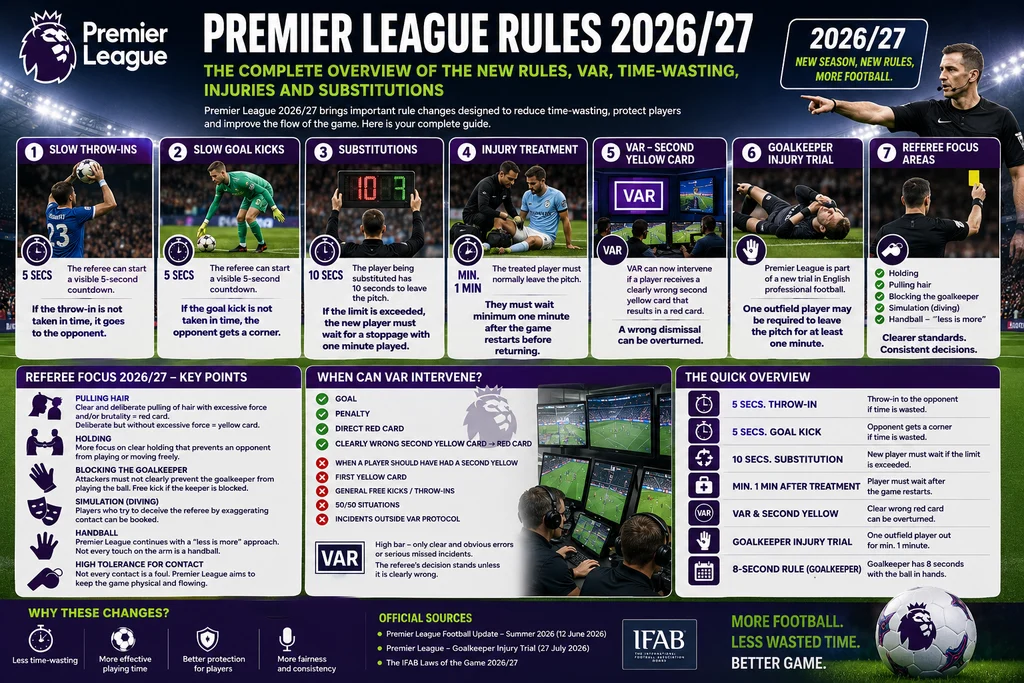
The Premier League 2026/27 season brings some of the most noticeable rule changes in years.
Players deliberately delaying throw-ins and goal kicks can now lose possession. A substituted player has only 10 seconds to leave the pitch. Players receiving on-field injury treatment will normally have to remain off the field for at least one minute after play restarts.
VAR is also changing. For the first time, a clearly incorrect second yellow card that results in a red card can be reviewed.
And English professional football is introducing a fascinating goalkeeper-injury trial designed to stop teams from using apparent goalkeeper injuries as tactical timeouts.
At the same time, Premier League referees have been given specific areas of focus involving holding, hair-pulling, goalkeeper interference, simulation and handball.
The overall message is simple:
More football. Less time-wasting. Faster restarts.
Here is the complete Finter.dk guide to the Premier League rules for 2026/27.
Explore more English football content on Finter.dk
Finter.dk English front page:
Most goals ever – Denmark, the Nordic countries, Europe and the world:
Top 50 greatest assists in football history:
Top 20 most-watched Liverpool videos:
Premier League 2026/27 Rules – The Quick Overview
| Change | What happens? | Possible consequence |
|---|---|---|
| ⏱️ Delayed throw-in | Referee can start a visible five-second countdown | Throw-in goes to the opponent |
| ⚽ Delayed goal kick | Five-second countdown | Opponent receives a corner |
| 🔄 Slow substitution | Player has 10 seconds to leave | Substitute must wait |
| 🩹 Injury treatment | Treated player normally leaves | At least one minute off after restart |
| 🟨🟥 VAR & second yellow | Clearly wrong second yellow can be reviewed | Incorrect dismissal can be overturned |
| 🧤 Goalkeeper injury | New English trial | An outfield player may have to leave |
| 👱 Hair-pulling | Clearer sanction guidance | Yellow or red depending on severity |
| 🤼 Holding | Increased referee focus | More obvious holding may be punished |
| 🧤 Blocking goalkeeper | Increased scrutiny | Foul if goalkeeper is unfairly impeded |
| 🎭 Simulation | Tough approach continues | Yellow card possible |
| ✋ Handball | “Less is more” approach continues | Not every arm contact is punished |
| 🧤 Goalkeeper holding ball | Eight-second rule continues | Opponent can receive a corner |
The five-second restart countdowns, 10-second substitution limit, one-minute injury requirement and VAR review of clearly incorrect second-yellow dismissals are official 2026/27 Laws of the Game changes being implemented in the Premier League.
1. Five Seconds for a Delayed Throw-In – Or You Lose the Ball
This could become one of the most visible new rules.
It does not mean that every throw-in must automatically be taken within five seconds.
The countdown is used when the referee believes that the team taking the throw-in is unfairly or deliberately delaying the restart.
The referee will whistle, signal and begin a visible five-second countdown.
If the ball has still not been put back into play when the countdown ends:
The throw-in is awarded to the opposing team.
Example
Liverpool are leading 2-1 in the 90th minute.
A player collects the ball slowly.
He walks towards the touchline.
Then another teammate comes across to take the throw.
More seconds disappear.
The referee decides that Liverpool are deliberately delaying the restart and begins the countdown:
5… 4… 3… 2… 1…
If the throw is still not taken:
The opposition gets the throw-in.
That creates a much stronger deterrent than simply adding a few seconds of stoppage time.
2. Delay a Goal Kick and the Opposition Can Get a Corner
The same principle applies to goal kicks.
If a team is deliberately delaying the taking of a goal kick, the referee can begin a visible five-second countdown.
If the goal kick is not taken before the countdown expires:
A corner kick is awarded to the opposing team.
That is potentially an enormous punishment.
Before and after
| Situation | Result |
|---|---|
| Defending team has a goal kick | Safe restart from inside its own goal area |
| Team deliberately delays | Referee starts five-second countdown |
| Countdown expires | Opposition gets a corner |
| Tactical consequence | Safe possession becomes an attacking set piece |
Imagine that happening in the 96th minute of a title-deciding match.
A team could go from trying to waste five seconds to defending a corner that decides the championship.
3. Important: The Goalkeeper Eight-Second Rule Still Applies
Another time-wasting rule remains in force.
Since 2025/26, goalkeepers have been restricted to eight seconds when controlling the ball with their hands or arms.
The referee visibly counts down the final five seconds.
If the goalkeeper keeps control beyond the permitted period:
The opposition receives a corner kick.
That rule remains in place for 2026/27.
So there are now several separate measures aimed at preventing time-wasting.
| Situation | Time-management rule |
|---|---|
| Goalkeeper controlling ball in hands | Eight seconds |
| Deliberately delayed throw-in | Five-second countdown |
| Deliberately delayed goal kick | Five-second countdown |
| Player being substituted | 10 seconds to leave |
The direction football is moving in is obvious.
Keep the game moving.
4. Substitutions: Only 10 Seconds to Leave the Pitch
Every football fan knows the scene.
A team is leading late.
The substitution board goes up.
The player suddenly walks extremely slowly towards the touchline.
He applauds the supporters.
He adjusts his socks.
He shakes hands with two teammates.
He eventually leaves.
That tactic is now much more dangerous.
Once the substitution has been signalled, the player being replaced is expected to leave the field within 10 seconds.
If the player fails to leave in time, the substitution still goes ahead – but the substitute cannot immediately enter.
The replacement must wait until the first stoppage after one minute has elapsed following the restart.
5. A Slow Substitution Could Leave a Team Temporarily With 10 Players
This is what makes the new rule interesting tactically.
Imagine Manchester City are leading 2-1.
A City player is substituted.
Instead of leaving quickly, he deliberately walks slowly and exceeds the 10-second limit.
He still has to leave.
But his replacement cannot immediately enter.
The game restarts.
City therefore have only 10 players on the field.
And the substitute must wait until the first stoppage after the one-minute period has elapsed.
Depending on when the next stoppage comes, the team could effectively be short-handed for longer than one minute.
Suddenly, wasting time through a substitution could actually hurt the team trying to protect the result.
6. Injured Players Normally Have to Stay Off for at Least One Minute
The rules around injury treatment are also becoming stricter.
If an outfield player causes play to be stopped because of an actual or suspected injury, or receives assessment or treatment on the pitch, the player will normally be required to leave.
Once play restarts, the player must remain off the field for at least one minute of running match time.
The Premier League had previously used a 30-second period.
For 2026/27, that becomes at least one minute.
7. Why Has the Injury Rule Changed?
The purpose is not to discourage players from receiving treatment.
Player safety remains the priority.
The aim is to reduce situations in which minor or tactical “injuries” become a way of:
- stopping the opposition’s momentum
- giving teammates a rest
- receiving tactical instructions
- slowing the game
- wasting time
- breaking up a period of pressure
The new rule creates a sporting cost.
A player who requires the game to be stopped may have to sit out at least one minute after the restart.
8. There Are Important Injury Exceptions
The rule is not intended to punish a player who has genuinely been injured by a serious foul.
There are exceptions within the Laws and competition protocols.
One important example is when an opponent receives a yellow or red card for the offence that caused the injury. In those circumstances, the injured player may be allowed to remain on the field following treatment.
Other safety-related exceptions also exist.
The basic principle is:
Treat real injuries properly – but make tactical injury delays less attractive.
9. VAR Can Review a Clearly Wrong Second Yellow Card
This is potentially one of the most important VAR developments since video refereeing was introduced.
Traditionally, ordinary yellow cards were outside the normal VAR intervention process.
That created a strange situation.
A referee could show a player a clearly incorrect second yellow card.
Because it was technically a yellow card rather than a straight red, VAR had limited ability to correct the mistake – even though the second yellow automatically meant the player was sent off.
That changes in 2026/27.
VAR may now assist where a player has been shown a clearly incorrect second yellow card resulting in a red card.
10. VAR Does Not Suddenly Review Every Yellow Card
This distinction is extremely important.
VAR is not now checking every yellow-card decision.
And VAR is not automatically allowed to intervene whenever a player might have deserved a second yellow.
The new power applies when:
- the referee actually awards the player a second yellow card;
- that second yellow results in dismissal;
- video evidence shows that the decision was clearly wrong.
Premier League guidance specifically distinguishes a wrongly awarded second yellow from a situation where a player perhaps should have received a second yellow but did not.
VAR 2026/27 – Quick Guide
| Incident | VAR intervention? |
|---|---|
| Goal | ✅ |
| Penalty incident | ✅ |
| Straight red card | ✅ |
| Clearly wrong second yellow resulting in red | ✅ |
| Player maybe deserved a second yellow but did not receive one | ❌ normally no |
| Ordinary first yellow card | ❌ normally no |
| Ordinary midfield free kick | ❌ |
| Incorrect throw-in | ❌ |
That could prevent one incorrect caution from completely destroying a match.
Playing 10 against 11 for 40 minutes because of an obvious refereeing error is a huge competitive disadvantage.
11. New Goalkeeper Injury Trial – The End of Tactical Goalkeeper Timeouts?
This may be the most fascinating experiment of the season.
English professional football has received IFAB approval to trial a new system designed to discourage tactical goalkeeper injury stoppages.
The trial applies across the professional game in England, including the Premier League.
The problem is familiar.
A team is under heavy pressure.
The opposition has created three chances in two minutes.
Suddenly the goalkeeper sits down.
The physio comes onto the pitch.
The other players walk towards the technical area.
They drink water.
The manager gives tactical instructions.
A minute later, the goalkeeper gets up and continues.
Whether every such situation is tactical is impossible to know.
But football authorities want to remove the potential advantage.
12. How the Goalkeeper Injury Trial Works
If the game is stopped for a goalkeeper injury under the trial:
The manager or head coach must nominate an outfield player to leave the pitch immediately.
That outfield player must remain off the pitch for at least one minute after play restarts.
Example
Arsenal are applying massive pressure.
The defending goalkeeper suddenly needs treatment.
The match is stopped.
Under the trial:
- The goalkeeper receives the necessary treatment.
- The manager selects one outfield teammate.
- That outfield player leaves the pitch.
- The game restarts.
- The outfield player must remain off for at least one minute.
The defending team may therefore have to play with only 10 outfield participants including the goalkeeper – effectively 10 players in total – during that period.
A tactical goalkeeper timeout suddenly carries a significant sporting disadvantage.
13. Goalkeeper Injury Trial – Important Exceptions
Player welfare remains more important than stopping tactical delays.
The trial therefore includes exceptions.
An outfield player does not have to leave in certain situations, including when:
- the goalkeeper requires immediate treatment after being fouled and a free kick is awarded;
- the goalkeeper and an outfield player collide and both need attention;
- the goalkeeper is bleeding.
The detailed IFAB trial protocol also contains safety provisions for severe injuries and other medical emergencies.
The objective is not:
“Goalkeepers are not allowed to be injured.”
The objective is:
“A goalkeeper injury should not provide an unfair tactical timeout.”
14. Hair-Pulling – Clearer Sanctions
Hair-pulling has also been specifically addressed in the Premier League’s refereeing guidance for 2026/27.
A clear and deliberate action to pull an opponent’s hair with excessive force and/or brutality should result in a red card.
If the action is deliberate but does not involve excessive force or brutality, a yellow card can be issued.
Simple Guide
| Action | Likely sanction |
|---|---|
| Accidental/minor contact | Depends on situation |
| Clear deliberate hair-pulling | Yellow may be appropriate |
| Deliberate hair-pulling with excessive force or brutality | Red card |
This should produce more consistent decisions in situations that previously caused major controversy.
15. Greater Focus on Holding
Holding is not a new football offence.
But it is one of the Premier League’s major refereeing focus areas for 2026/27.
Officials have been asked to improve recognition of obvious holding offences, particularly where a player is not genuinely trying to play the ball.
That becomes especially relevant at:
- corner kicks
- attacking free kicks
- crosses
- near-post runs
- back-post runs
- blocks inside the penalty area
Defenders wrapping both arms around an attacker while completely ignoring the ball may find themselves taking a greater risk.
16. Blocking the Goalkeeper – What Is Allowed?
Set pieces have become increasingly sophisticated.
Attacking teams often position players close to the goalkeeper and deliberately create traffic around the six-yard box.
But where is the line between legal positioning and an illegal block?
Premier League guidance says attackers should be penalised when they make a clear action with no genuine intention of playing or challenging for the ball, and the resulting contact impacts the goalkeeper’s ability to play or challenge for it.
However, goalkeepers are not untouchable.
Players are still entitled to:
- occupy legitimate positions
- challenge for the ball
- compete physically
- stand their ground
The key distinction is between being in the goalkeeper’s way and deliberately moving into the goalkeeper’s way to prevent them playing the ball.
17. Simulation and Embellishment Remain a Major Focus
Diving remains one of the actions Premier League referees are instructed to deal with strongly.
But there is also increased awareness of embellishment.
That is when genuine contact occurs, but the player dramatically exaggerates the effect in an attempt to convince the referee that the challenge was much worse.
Examples include:
- throwing both legs into the air after minimal contact
- holding the face when contact was elsewhere
- dramatically changing direction after light contact
- pretending to be seriously injured to influence a card decision
A player attempting to deceive the referee can still receive a yellow card.
18. Handball – Premier League Continues Its “Less Is More” Approach
Handball remains one of football’s most controversial laws.
But Premier League referees are again being encouraged to use a “less is more” approach.
In other words:
Ball touches arm does not automatically equal handball.
Officials still have to consider factors such as:
- whether the arm moved towards the ball
- whether the arm made the player’s body unnaturally bigger
- the player’s movement
- the position of the arm
- the nature of the action
Fans will still disagree.
That is probably unavoidable.
But the Premier League does not want every accidental contact between ball and arm to produce a whistle.
19. Premier League Wants a High Threshold for Ordinary Contact
One of the Premier League’s strengths has traditionally been its physical intensity.
Officials therefore continue to be encouraged not to punish every small piece of contact.
Football is a contact sport.
Shoulder-to-shoulder battles, legal challenges and ordinary physical pressure should still be allowed.
At the same time, referees must protect players from reckless and dangerous challenges.
The objective is to find the balance:
Physical football without allowing unfair or dangerous football.
20. VAR Should Still Have a High Intervention Threshold
The expansion involving second yellow cards does not mean VAR is supposed to referee the entire match.
The philosophy remains that the on-field referee’s decision should stand unless there is a sufficiently clear error within the VAR protocol.
This matters when fans see a situation replayed 20 times in ultra-slow motion.
The question is not simply:
“What decision would the VAR personally have made?”
The more relevant question is:
“Was the referee’s original decision clearly wrong?”
That distinction remains central to VAR.
21. Semi-Automated Offside Technology Continues
Semi-Automated Offside Technology has already become part of Premier League officiating.
It is therefore important to distinguish it from the genuinely new 2026/27 law changes.
SAOT is designed to:
- speed up offside decisions
- reduce lengthy line-drawing
- improve consistency
- reduce delays
- provide clearer visual explanations
So semi-automated offside is part of the modern Premier League VAR system, but it should not be presented as a brand-new 2026/27 rule.
22. Can VAR Correct a Clearly Wrong Corner?
This is where things become slightly more complicated.
IFAB’s 2026/27 changes allow competitions the option of permitting VAR to correct a clearly wrongly awarded corner kick when the correction can be made immediately and without delaying the restart.
The key words are:
Competition option.
That means the rule does not automatically operate in every competition simply because IFAB permits it.
By contrast, Premier League’s own official presentation specifically lists the review of a clearly wrong second yellow leading to dismissal among the mandatory changes it is implementing.
Important distinction
| VAR situation | Status |
|---|---|
| Clearly incorrect second yellow resulting in red | New reviewable situation |
| Every yellow card | No |
| Clearly wrongly awarded corner | IFAB competition option |
| Incorrect throw-in | Not a normal VAR review |
| Every ordinary free kick | No |
This distinction is important when reading headlines claiming that “VAR can now review corners”.
IFAB has created the option.
That does not mean every competition has to use it.
23. What About an Accidental Double Touch at a Penalty?
The Laws have also clarified what happens when a penalty taker accidentally touches the ball twice.
The classic example is a player slipping while taking the penalty.
The ball is kicked with one foot but immediately makes accidental contact with the player’s other foot.
The important distinction is whether the second touch was accidental or deliberate.
For an accidental double touch, the outcome depends on whether the ball enters the goal and on whether the penalty occurs during normal play or a shootout.
The clarification prevents a player from automatically suffering the same consequence for an accidental slip as for deliberately playing the ball twice.
This issue has already influenced elite football before 2026/27, so it should be viewed as a clarified law rather than one of the Premier League’s biggest brand-new changes this season.
24. What Do the New Rules Mean Tactically?
This is where the changes become really interesting.
Rules do not only affect referees.
They affect coaches.
Teams protecting a late lead have traditionally used several methods to reduce the amount of football played.
Traditional late-game tactics
- slow throw-ins
- slow goal kicks
- slow substitutions
- minor injury stoppages
- goalkeeper treatment
- players standing over the ball
- delaying restarts
Several of those strategies now come with potentially serious consequences.
25. Teams Need Better Restart Organisation
Five seconds can disappear incredibly quickly.
Players therefore need to know in advance:
- who takes the throw-in?
- who provides the short option?
- where is the safe pass?
- who takes the goal kick?
- where should the centre-backs move?
- where is the goalkeeper’s second option?
The rule could actually improve tactical organisation.
Teams that are well coached in restart situations may gain an advantage over teams that spend several seconds deciding what to do.
26. Substitutions Need to Be Practised Differently
Managers now have a very simple message for players:
When your number goes up, leave the pitch.
There is little advantage in spending 20 seconds pretending not to notice the substitution.
The potential consequence is too great.
If the replacement cannot enter immediately, the team may have to defend with 10 players.
That is particularly dangerous late in matches.
27. The Goalkeeper Trick Becomes Much Riskier
The goalkeeper injury trial may completely change the calculation around tactical stoppages.
Previously, a goalkeeper going down could potentially provide:
- 30-90 seconds of rest
- tactical instructions
- water
- a chance to reorganise
- a break in the opponent’s momentum
Under the new trial, the same stoppage can result in an outfield teammate being forced to leave temporarily.
If a team is already under heavy pressure, playing a player down is exactly what it does not want.
That creates a strong deterrent.
28. Which Rule Changes Will Fans Notice Most?
Finter.dk Rating
| Rank | Change | Potential impact |
|---|---|---|
| 1 | Five-second goal-kick countdown | ⭐⭐⭐⭐⭐ |
| 2 | Goalkeeper injury trial | ⭐⭐⭐⭐⭐ |
| 3 | VAR review of clearly wrong second yellow | ⭐⭐⭐⭐⭐ |
| 4 | 10-second substitution rule | ⭐⭐⭐⭐ |
| 5 | One-minute injury period | ⭐⭐⭐⭐ |
| 6 | Five-second throw-in countdown | ⭐⭐⭐⭐ |
| 7 | Increased focus on holding | ⭐⭐⭐ |
| 8 | Hair-pulling guidance | ⭐⭐ |
The goal-kick rule could produce the most dramatic individual moment.
Imagine this:
90+7 minutes.
A team leads 1-0.
They deliberately delay a goal kick.
The referee starts counting.
5… 4… 3… 2… 1…
Time expires.
The opposition gets a corner.
They score.
1-1.
One attempt to waste a few seconds could change an entire season.
29. New Laws vs Trials vs Referee Focus Areas
This is perhaps the most important table in the entire article.
Not everything being discussed for Premier League 2026/27 is technically a “new rule”.
| Topic | New Law? | Trial? | Referee emphasis/guidance? |
|---|---|---|---|
| Five-second delayed throw-in countdown | ✅ | ||
| Five-second delayed goal-kick countdown | ✅ | ||
| 10-second substitution limit | ✅ | ||
| One minute off after injury treatment | ✅ | ||
| VAR on clearly wrong second yellow resulting in red | ✅ | ||
| Goalkeeper injury system | ✅ | ||
| Hair-pulling sanctions | ✅ | ||
| Greater recognition of holding | ✅ | ||
| Goalkeeper blocking/interference | ✅ | ||
| Simulation/embellishment | ✅ | ||
| “Less is more” handball philosophy | ✅ | ||
| Goalkeeper eight-second rule | Introduced 2025/26 | Continues |
That distinction prevents confusion.
30. Why Are Football Authorities Making These Changes?
Almost every major change has the same objective:
Protect effective playing time.
Football authorities want less time lost to:
- unnecessary delays
- tactical injuries
- goalkeeper time-wasting
- substitution tricks
- slow restarts
The aim is not necessarily to make matches longer.
The aim is to make more of the existing match time contain actual football.
31. Could We See More Goals Because of the New Rules?
Possibly.
There are several ways the changes could indirectly increase goal chances.
1. Delayed goal kick → corner
An attempt to waste time can immediately create an attacking set piece.
2. Slow substitution → temporary numerical advantage
The opposition may attack against 10 players.
3. Goalkeeper injury → outfield player temporarily leaves
Again, the attacking team could gain a temporary numerical advantage.
4. Faster restarts
Teams will have less time to reorganise defensively.
5. Less momentum-breaking
Attacking teams may be able to sustain pressure for longer.
The effect may be small across an entire season.
But individual matches could absolutely be decided by these rules.
32. Will Referees Actually Enforce the Five-Second Rule?
That may become one of the biggest questions of the season.
A rule is only effective if it is enforced consistently.
Fans will immediately notice if one referee starts a countdown after eight seconds while another allows a player to delay for 20 seconds.
Consistency will therefore be crucial.
Expect early-season debates about:
- when the referee should begin the countdown
- what counts as deliberate delay
- whether the player was genuinely trying to restart quickly
- how strictly the rule is applied late in matches
The rule itself is relatively simple.
Its interpretation may not always be.
33. Bonus: Premier League Financial Rules Also Change in 2026/27
The changes are not limited to what happens on the pitch.
Premier League clubs have also moved into a new financial regulatory system.
The previous Profitability and Sustainability Rules are being replaced for ongoing 2026/27 regulation by a framework built around Squad Cost Ratio – SCR and Sustainability and Systemic Resilience – SSR.
The headline SCR figure is 85%.
Broadly, the system regulates spending on a club’s playing squad relative to football-related revenue and net profit or loss from player sales.
Clubs also begin with a multi-year allowance that can provide additional headroom above the 85% green threshold, although using that allowance affects future flexibility.
Simplified overview
| Financial rule | Main purpose |
|---|---|
| Squad Cost Ratio – SCR | Control spending directly related to the playing squad |
| Main green threshold | 85% |
| Sustainability and Systemic Resilience – SSR | Protect clubs against excessive financial risk |
| Previous PSR system | Replaced for the new ongoing framework |
Premier League clubs competing in UEFA competitions must also continue to comply with UEFA’s separate financial regulations.
So 2026/27 is unusual.
There are major changes:
on the pitch and in the accounts.
34. The 10 Rules Every Premier League Fan Should Remember
If you do not want to remember the entire article, remember these:
1.
A deliberately delayed throw-in can be reversed to the opposition after the referee’s five-second countdown.
2.
A deliberately delayed goal kick can become an opposition corner.
3.
The referee visibly counts the five seconds.
4.
A substituted player has 10 seconds to leave the field.
5.
If the player is too slow, the substitute may have to wait.
6.
A treated outfield player will normally have to remain off for at least one minute after the restart.
7.
VAR can correct a clearly wrong second yellow card that results in dismissal.
8.
English football is trialling a new system designed to stop tactical goalkeeper injuries.
9.
Holding, goalkeeper interference, hair-pulling and simulation are important referee focus areas.
10.
The goalkeeper eight-second rule introduced for 2025/26 remains in force.
35. The Ultimate Quick-Reference Table
| Situation | 2026/27 consequence |
|---|---|
| Deliberately delay throw-in | Five-second countdown → opposition throw |
| Deliberately delay goal kick | Five-second countdown → opposition corner |
| Goalkeeper holds ball too long | Eight-second rule → opposition corner |
| Player takes too long to leave during substitution | Replacement must wait |
| Player treated on field | Normally at least one minute off after restart |
| Clearly wrong second yellow | VAR can intervene |
| Goalkeeper treatment under trial | Outfield teammate may have to leave |
| Violent deliberate hair-pulling | Red card |
| Deliberate hair-pulling without excessive force/brutality | Yellow possible |
| Clear holding | Increased referee focus |
| Attacker deliberately blocks goalkeeper | Foul possible |
| Player exaggerates contact to deceive referee | Yellow possible |
| Ball simply touches arm | Not automatically handball |
36. Finter.dk Verdict: A Good Direction for Football?
Most of the changes have one major advantage:
They attack the cause of time-wasting rather than simply adding more stoppage time.
Adding eight minutes at the end of a match does not necessarily stop players from wasting time.
A direct sporting punishment might.
If a slow goal kick gives the opponent a corner, teams will restart faster.
If a slow substitution leaves the team short-handed, players will leave faster.
If a goalkeeper injury means an outfield teammate must temporarily leave, tactical goalkeeper timeouts become much less attractive.
That is potentially far more effective than simply asking referees to add more minutes.
The challenge will be consistency.
The rules need to be applied:
- in the first minute
- in the 95th minute
- to home teams
- to away teams
- to title challengers
- to promoted clubs
If they are applied consistently, they could improve the flow of Premier League football.
More English Football Guides on Finter.dk
Most Goals Ever
Who has scored the most official goals in football history?
Cristiano Ronaldo, Lionel Messi, Pelé, Romário, Puskás and the greatest goalscorers from Denmark, the Nordic region, Europe and the world.
Top 50 Greatest Assists in Football History
Messi, Maradona, Modrić, De Bruyne, Ronaldinho and some of football’s greatest passes ever.
The Most-Watched Liverpool Videos on YouTube
Salah, Barcelona, Manchester United, Anfield comebacks and Liverpool history.
Brian Madjo – Aston Villa’s 17-Year-Old Wonderkid
Stats, playing style, analysis and videos.
Find More Football Content
Training.
Football history.
Premier League.
Statistics.
Skills.
Wonderkids.
Goals.
Assists.
Dribbling.
Tactics.
Player development.
FAQ – Premier League Rules 2026/27
Is there now a five-second rule for every Premier League throw-in?
No.
The five-second countdown is designed for situations where the referee believes the team is unfairly delaying the throw-in.
Once the referee initiates the countdown, the restart must be taken before the five seconds expire.
Otherwise, the throw-in goes to the opposition.
What happens if a team wastes time at a goal kick?
The referee can begin a visible five-second countdown.
If the ball is not put into play before the countdown expires, the opposition receives a corner kick.
Does the goalkeeper still have eight seconds with the ball?
Yes.
The goalkeeper’s eight-second restriction when controlling the ball in the hands remains in place for 2026/27.
Exceeding the limit can result in a corner for the opposition.
How long does a substituted player have to leave the pitch?
The player has 10 seconds after the substitution has been signalled.
If the player exceeds the limit, the substitute cannot immediately enter the match.
Does a treated player have to wait one minute?
Normally, yes.
An outfield player whose injury causes play to stop or who receives on-field treatment or assessment must generally leave and remain off for at least one minute after play restarts.
There are important exceptions.
Can VAR review a second yellow card?
Yes – but only in a specific situation.
VAR can intervene when a clearly incorrect second yellow card has actually been awarded and results in a red card.
VAR is not simply reviewing every situation where a player might have deserved a second yellow.
Can VAR review every yellow card now?
No.
Ordinary yellow-card decisions remain outside normal VAR intervention.
The significant new provision concerns a clearly incorrect second yellow resulting in dismissal.
What is the goalkeeper injury trial?
If play is stopped for certain goalkeeper injuries, the goalkeeper’s team may have to nominate an outfield player to leave the field.
That player must remain off for at least one minute after the restart.
Why introduce the goalkeeper rule?
The aim is to discourage situations where goalkeeper injuries are used to:
- stop an opponent’s momentum
- waste time
- create a tactical timeout
- allow players to receive coaching
Genuine goalkeeper injuries can still receive appropriate treatment.
Is hair-pulling automatically a red card?
Not necessarily.
Premier League guidance distinguishes between deliberate hair-pulling without excessive force and deliberate hair-pulling involving excessive force and/or brutality.
The latter should result in a red card.
Is every contact with the goalkeeper a foul?
No.
Normal football contact and genuine challenges for the ball remain permitted.
Referees will focus on attackers who clearly interfere with or impede a goalkeeper without genuinely challenging for the ball.
Is every ball-to-arm contact handball?
No.
Premier League officials continue with a “less is more” philosophy towards handball.
The referee still has to judge the position and movement of the arm and the nature of the action.
Conclusion – Premier League 2026/27 Wants More Football and Less Waiting
The Premier League’s 2026/27 changes are not about reinventing football.
They are largely about something much simpler:
Making sure football is actually being played.
Slow throw-ins can cost possession.
Slow goal kicks can give away a corner.
Slow substitutions can temporarily leave a team with fewer players.
On-field injury treatment can mean a player must wait at least one minute before returning.
Tactical goalkeeper stoppages now carry a potential sporting disadvantage.
And a clearly incorrect second yellow no longer has to destroy a match without VAR having the possibility of correcting it.
The common theme is clear:
More effective playing time.
Fewer tactical delays.
Faster restarts.
Better protection against major refereeing mistakes.
Now the biggest question is not what the rules say.
It is how consistently they will be enforced.
Because sooner or later this season, a Premier League referee will raise his hand late in a huge match and begin counting:
5…
4…
3…
2…
1…
And suddenly an attempt to waste time could become the moment that decides the match.