
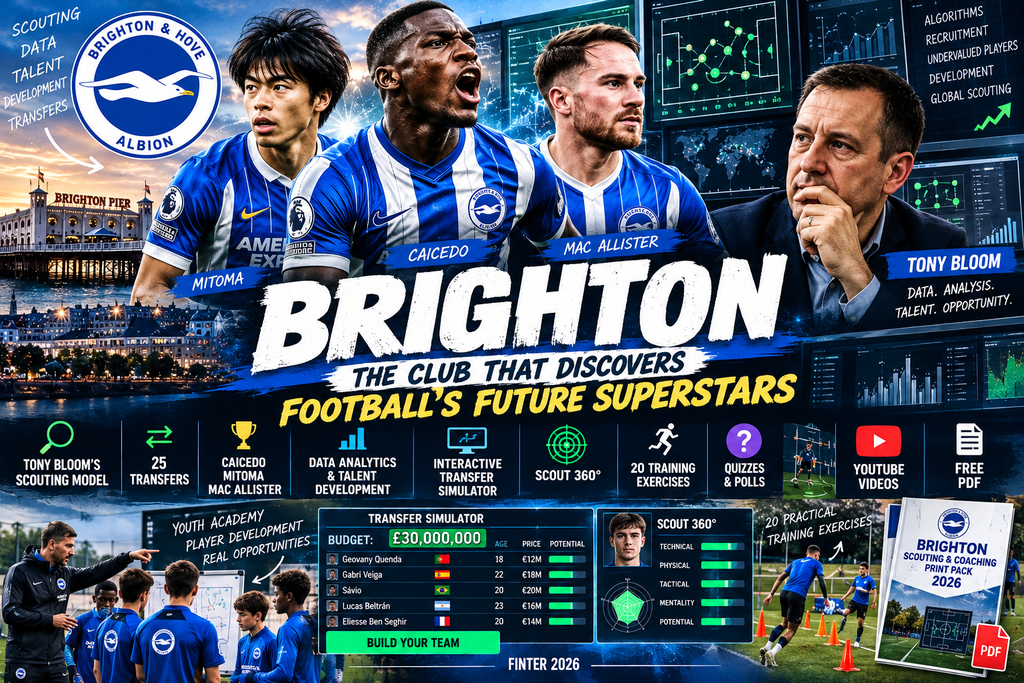
Brighton: The Club That Finds Football’s Future Stars
How Tony Bloom’s data-informed recruitment strategy helped Brighton challenge richer rivals — and what every football coach, scout and sporting director can learn.
25 transfer case studies · Brighton vs Brentford vs Benfica · Interactive transfer simulator · Scout 360° · 20 training exercises · Quiz · Reader polls · YouTube · Free PDF
Updated 18 October 2026
25 transfers Try the simulator Free PDF1. How did Brighton challenge football’s wealthiest clubs?
Brighton & Hove Albion have become a case study in how intelligent recruitment can close some of football’s financial gaps. Rather than relying only on famous names, the club has identified players in markets including Ecuador, Japan, Argentina and continental Europe, offered development opportunities and, in many cases, sold them for substantial fees.
This is not simply a story about algorithms. It is about good decisions under uncertainty: identifying the correct role, evaluating players in context, building a development pathway and knowing when the price is right. Owner Tony Bloom is associated with quantitative sports analysis, but Brighton’s precise internal formulas are not public.
Find overlooked value
Search beyond the obvious leagues and established stars.
Match the role
Ask whether the player’s abilities fit the team’s playing model.
Develop talent
Playing time, coaching and loans can change a career.
Manage uncertainty
Even outstanding scouting cannot guarantee outcomes.
Brighton reached the Premier League in 2017 and qualified for European competition after finishing sixth in 2022/23. A high transfer fee is not equivalent to net profit: wages, fees, bonuses, accounting and operating costs matter too.
2. Inside a modern, data-informed scouting model
This is FINTER’s educational framework inspired by Brighton, not a disclosure of Brighton’s confidential processes.
Ten questions every scout should ask
- Does the player fit a specific position and role?
- How secure is the first touch under pressure?
- Does the player scan and decide quickly?
- Can they break defensive lines through passing or carrying?
- How well do they move without the ball?
- Are defensive actions effective in context?
- How quickly do they learn from coaching?
- What are the demands, physical profile and injury considerations?
- How could character and adaptability influence the move?
- Does the transfer make sense financially?
A 95% pass completion rate may describe conservative passing. Many tackles might reflect poor positioning. Expected goals (xG) and expected assists (xA) become meaningful only with information about role, possession, opponents and minutes played. For young players, early physical maturity is not the same as long-term ability.
Who leads the football operation in 2026?
Jason Ayto joined Brighton as sporting director in September 2025 but left on 3 June 2026. Brighton said technical director Mike Cave would oversee sporting operations, reporting to chief executive Paul Barber. Organisational context matters because a club’s recruitment approach should not be attributed to one individual alone.
3. Twenty-five Brighton transfers and talent case studies
These are 25 selected cases, not a ranking of the 25 biggest profits. They include major successes, investments still developing and deals with mixed results. That is a better way to learn than displaying only the winners.
| # | Player | Country | Arrived from | Moved to | Joined | Left | Reported cost | Reported sale | Scouting lesson |
|---|---|---|---|---|---|---|---|---|---|
| 1 | Moisés Caicedo | Ecuador | Independiente del Valle | Chelsea | 2021 | 2023 | 4.5 m £ | 100–115 m £ | Elite midfield potential, mobility and ball recoveries |
| 2 | Carlos Baleba | Cameroun | Lille | Manchester United | 2023 | 2026 | 23–27 m £ | 65–70 m £ | Mobility, interceptions and long-term development |
| 3 | Marc Cucurella | Spanien | Getafe | Chelsea | 2021 | 2022 | 15–16 m £ | 55–62 m £ | High-energy full-back and quick transitions |
| 4 | João Pedro | Brasilien | Watford | Chelsea | 2023 | 2025 | 30 m £ | 55–60 m £ | Versatile attacking roles |
| 5 | Jan Paul van Hecke | Nederlandene | NAC Breda | Tottenham | 2020 | 2026 | 2–3 m £ | approx. 52 m £ | Build-up passing and defensive positioning |
| 6 | Ben White | England | Southampton U18 | Arsenal | 2014 | 2021 | Youth | approx. 50 m £ | Loans as an important development pathway |
| 7 | Alexis Mac Allister | Argentina | Argentinos Juniors | Liverpool | 2019 | 2023 | 7–8 m £ | approx. 35 m £ | Scanning, ball security under pressure |
| 8 | Yves Bissouma | Mali | Lille | Tottenham | 2018 | 2022 | approx. 15 m £ | approx. 25 m £ | Aggressive ball-winning |
| 9 | Deniz Undav | Tyskland | Union SG | Stuttgart | 2022 | 2024 | approx. 6 m £ | approx. 23 m £ | Established finisher from a less prominent league |
| 10 | Robert Sánchez | Spanien | Levante ungdom | Chelsea | 2013 | 2023 | Youth | approx. 25 m £ | Goalkeeper developed within the club |
| 11 | Leandro Trossard | Belgien | Genk | Arsenal | 2019 | 2023 | approx. 15 m £ | approx. 21 m £ | Technical quality and multiple attacking roles |
| 12 | Dan Burn | England | Wigan | Newcastle | 2018 | 2022 | approx. 3 m £ | approx. 13 m £ | Practical contribution rather than glamour |
| 13 | Neal Maupay | Frankrig | Brentford | Everton | 2019 | 2022 | approx. 20 m £ | approx. 10 m £ | Reminder that not every transfer makes a profit |
| 14 | Simon Adingra | Elfenbenskysten | FC Nordsjælland | Sunderland | 2022 | 2025 | approx. 6 m £ | approx. 21 m £ | Development pathway including loans |
| 15 | Pervis Estupiñán | Ecuador | Villarreal | AC Milan | 2022 | 2025 | approx. 15 m £ | approx. 15 m £ | Role-specific left-back profile |
| 16 | Julio Enciso | Paraguay | Libertad | Strasbourg | 2022 | 2025 | approx. 9.5 m £ | approx. 8 m £ | Young talent involves significant uncertainty |
| 17 | Valentín Barco | Argentina | Boca Juniors | Strasbourg | 2024 | 2025 | approx. 8 m £ | approx. 9 m £ | Adapting to a new position is difficult |
| 18 | Abdallah Sima | Senegal | Slavia Prag | Lens | 2021 | 2025 | approx. 7 m £ | approx. 4 m £ | Loans can influence final market value |
| 19 | Kaoru Mitoma | Japan | Kawasaki Frontale | — | 2021 | — | approx. 2.5 m £ | — | 1v1 dribbling, changes of pace and a Union SG loan |
| 20 | Facundo Buonanotte | Argentina | Rosario Central | — | 2023 | — | approx. 6 m £ | — | Technique and choices in tight spaces |
| 21 | Bart Verbruggen | Nederlandene | Anderlecht | — | 2023 | — | approx. 16 m £ | — | First touch and passing from the goalkeeper |
| 22 | Joël Veltman | Nederlandene | Ajax | — | 2020 | — | approx. 0.9 m £ | — | Experience and tactical discipline |
| 23 | Charalampos Kostoulas | Grækenland | Olympiacos | — | 2025 | — | approx. 30 m £ | — | Significant investment in potential |
| 24 | Brajan Gruda | Tyskland | Mainz | — | 2024 | — | approx. 25 m £ | — | Technical qualities in a competitive market |
| 25 | Georginio Rutter | Frankrig | Leeds United | — | 2024 | — | approx. 40 m £ | — | Brighton also spend large amounts |
Six stories worth studying closely
Moisés Caicedo: Recruited from Independiente del Valle, he developed into an elite Premier League midfielder before moving to Chelsea in 2023. His case shows the value of recognising mobility, ball-winning and the ability to adapt to higher levels.
Kaoru Mitoma: Signed from Kawasaki Frontale and developed further on loan at Union Saint-Gilloise. His timing, feints and changes of pace show why a winger’s value cannot be reduced to goals and assists.
Alexis Mac Allister: Signed from Argentinos Juniors; became a World Cup winner with Argentina and later joined Liverpool. Scanning, composure and positional intelligence were central strengths.
Ben White: A pathway through academy development and a productive loan at Leeds United shows how well-chosen minutes can accelerate growth.
Carlos Baleba: Signed from Lille in 2023 and joined Manchester United in August 2026. Brighton confirmed the move without publishing the fee; reports put the package at up to around £70m.
João Pedro: The Watford signing illustrates that Brighton will also commit large fees if they identify the right attacking profile. His later Chelsea move illustrates how development and resale value can coexist.
4. Brighton vs Brentford vs Benfica
These clubs operate in different markets and under different financial constraints. The comparison below describes observable tendencies, not unpublished internal recruitment systems.
| Factor | Brighton | Brentford | Benfica |
|---|---|---|---|
| Recognised strength | Global recruitment and development | Data-supported decisions and role clarity | Academy development and talent sales |
| Competitive setting | Premier League | Premier League | Portuguese league and Europe |
| Development tools | Loans and tactical fit | Clear player requirements and efficient resources | Academy pathways and first-team integration |
| Main challenge | Replacing important departures | Competing with larger budgets | Keeping talent from richer leagues |
| FINTER coaching lesson | Identify the next level | Define the role precisely | Build a consistent youth pathway |
Brighton: Pick three overlooked players and assess future development, not just recent goals and assists.
5. Interactive transfer simulator: become Brighton’s sporting director
You have £30 million to recruit exactly three fictional players. Study their current ability, potential, price and risk, then choose a three-season development approach. This is an educational exercise using invented players, not a genuine Brighton model or financial forecast.
The simulator uses a transparent, simplified, deterministic rule set. The values are illustrative and do not predict real transfers.
6. FINTER Scout 360° — create a player assessment
Rate eight areas from 1 to 10. The tool calculates a simple score out of 100 and suggests two development priorities. It is not Brighton’s actual scouting tool and must never be the sole basis for selecting or rejecting children.
What to scout by position
| Position | What to look for |
|---|---|
| Goalkeeper | Positioning, communication, decisions, distribution and shot-stopping |
| Centre-back | Defending space, duels, scanning, first pass and recovery speed |
| Full-back | 1v1 defending, support runs, defensive cover, crossing and timing |
| Number 6 / 8 | Awareness, press resistance, forward passing and positioning |
| Number 10 / winger | Creating chances, 1v1 actions and off-ball movement |
| Forward | Finishing, penalty-area movement, runs behind and pressing |
7. Twenty practical scouting and training exercises
These are FINTER-designed activities inspired by modern talent development, not verified exercises from Brighton’s academy. Adapt area size, intensity and pressure to age and ability.
1. First touch under pressure (U9–adult)
Set-up: 4v2 rondo in 12 × 12 m, four 2-minute rounds.
Observe: First touch away from pressure; scan before receiving.
2. Scan before receiving (U10–adult)
Set-up: Players pass in triangles while the coach signals a colour behind the receiver.
Observe: Head movement and choice after the first touch.
3. Break the lines (U12–adult)
Set-up: 5v5 across three zones; reward passes into the middle zone.
Observe: Passing angle, timing and body shape.
4. 3v2 decision-making (U9–adult)
Set-up: Repeated 3v2 attacks towards goal.
Observe: Whether to pass, carry or shoot, and when.
5. Keep possession under pressure (U11–adult)
Set-up: 4v4 with two neutral players in a small grid.
Observe: Support angles, protection of the ball and risk.
6. Win it, then use it (U11–adult)
Set-up: 4v4 with a bonus for a clean pass following a ball recovery.
Observe: Timing of challenges and the next action.
7. The intelligent number six (U13–adult)
Set-up: 6v6 with a neutral holding midfielder.
Observe: Scanning, defensive cover and connecting the units.
8. Defend on the front foot (U12–adult)
Set-up: 3v3 with goalkeepers; launch a counterattack after an interception.
Observe: Anticipation, positioning and transition play.
9. Read the passing lane (U10–adult)
Set-up: Two attackers pass across a channel defended by one player.
Observe: Recognition of cues and interception timing.
10. React after losing the ball (U12–adult)
Set-up: 5v5 to small goals; reward coordinated counter-pressing.
Observe: Immediate reaction and team structure.
11. Mitoma-inspired 1v1 (U8–adult)
Set-up: Wide player attacks a defender with space to accelerate.
Observe: Feints, balance, direction changes and pace.
12. Time the run behind (U11–adult)
Set-up: Forward attacks space as a midfielder prepares a through ball.
Observe: Starting position and timing.
13. Create between the lines (U12–adult)
Set-up: 5v5 plus an attacking neutral player between zones.
Observe: Receiving on the half-turn and final passes.
14. Finish after movement (U10–adult)
Set-up: Attacker separates from a defender to receive and shoot.
Observe: Movement before the final touch.
15. The run that creates space (U13–adult)
Set-up: 4v4 with an attacker rewarded for opening lanes for teammates.
Observe: Value of off-ball actions.
16. 15-minute player observation (U12–adult)
Set-up: Watch one player for 15 minutes in two separate matches.
Observe: Choices, body shape, reactions to mistakes.
17. One player, two positions (U10–U19)
Set-up: Give the same player two roles during small-sided games.
Observe: Which attributes transfer to new roles.
18. Scout without watching the ball (U11–adult)
Set-up: Track one off-ball player throughout a phase of play.
Observe: Scanning, positioning, communication and running.
19. Blind scouting challenge (U13–adult)
Set-up: Compare full-match video clips without player names or clubs.
Observe: Ability to separate evidence from reputation.
20. Six-week development curve (U10–U19)
Set-up: Repeat three agreed skill observations over six weeks.
Observe: Real improvement, not merely peak performance.
A four-week coaching plan
| Week | Focus | Exercises | Observe |
|---|---|---|---|
| 1 | First touch and scanning | 1, 2, 3, 5 | Awareness before receiving |
| 2 | Decisions and attacking | 4, 7, 12, 13 | Choices under pressure |
| 3 | Defensive understanding | 6, 8, 9, 10 | Positioning and counter-pressing |
| 4 | Development and review | 16, 17, 18, 20 | Individual development trajectory |
8. YouTube: study Brighton on the pitch
Pause the videos before key decisions: what does the player see, which passing lane opens, and what other decision could work?
Brighton showboat: Mitoma, Mac Allister and more
Brighton goals and attacking sequences
More videos about Brighton recruitment · Mitoma tactical analysis · Brighton tactical breakdowns
YouTube videos may become unavailable or restricted. The search links provide alternatives.
9. Interactive scouting quiz — ten questions
10. Interactive reader polls
Cast your vote and see your selection. Important: this HTML stores only the votes on your device. It cannot display genuine percentages from all FINTER readers without a WordPress backend or plugin.
11. Five coaching dilemmas
An U12 player matures later than teammates. Should they be excluded?
Not because of height or strength alone. Look at technique, understanding, enjoyment and improvement across time.
A striker scores often but barely presses.
Define the requirements of the role. Goals alone do not explain a player’s contribution to team performance.
A midfielder loses possession frequently.
Are those losses the result of difficult, line-breaking attempts? Compare risk with the value created.
Data recommends a player but the coach disagrees.
Identify the specific point of disagreement. Review more full matches and reconsider how the criteria were weighted.
A young talent cannot get minutes.
A development pathway needs suitable training and realistic opportunities, not just a famous club name.
12. Free FINTER scouting and coaching PDF
Brighton Scouting & Coaching Print Pack 2026 (English)
Download the free English-language FINTER print pack with 20 scouting and training exercises, player observation sheets, a four-week coaching plan and a knowledge quiz.
Download free PDF (English)13. More scouting and coaching resources from FINTER
14. Sources, limitations and methodology
- Brighton: Jason Ayto club statement, 3 June 2026
- Brighton: Carlos Baleba joins Manchester United, 25 August 2026
- Premier League: summer 2026 transfer watch
- Transfermarkt: Brighton transfer overview
- BBC Sport: Brighton’s leadership after Ayto’s departure
Public reports help explain Brighton’s transfer track record, but the club’s algorithms, private forecasts and complete contractual terms are not public. This guide therefore distinguishes confirmed moves, approximately reported amounts, and FINTER-created training tools and simulations.
Conclusion: Brighton’s biggest lesson
The lesson is not simply “buy low, sell high.” Assess the player, position, price, risk and pathway together. Use data to sharpen questions, full-match scouting to provide context and excellent coaching to turn potential into performance. The best recruitment process is one that continues learning from both successes and mistakes.