
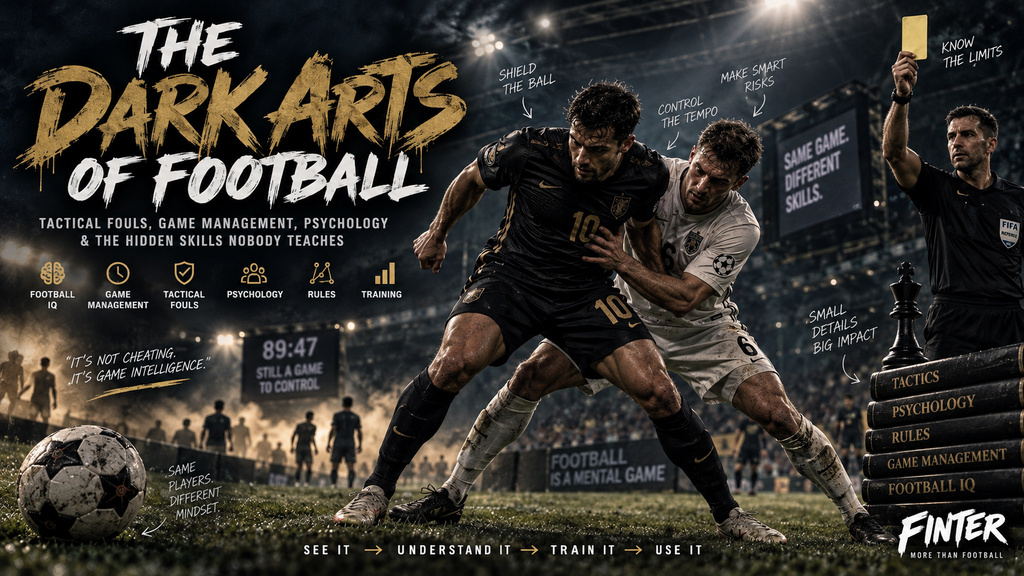
⚽🧠 The Dark Arts of Football
Tactical Fouls, Game Management, Psychology & the Hidden Skills Nobody Teaches
Football is not only about passing, dribbling, shooting and formations. At the highest level, players also manipulate space, time, risk, rhythm and pressure.
Some of those actions are completely legal. Some sit close to the limit. Others cross the line and become punishable.
This interactive FINTER guide teaches you how to recognise the difference.
🌍 Welcome to FINTER in English
FINTER combines football development, tactics, training, stories, history, interactive tools and Football IQ.
🕶 What Are the Dark Arts of Football?
“Dark arts” is an informal football expression. It describes small actions that influence matches but rarely appear in ordinary statistics.
A player may not score, assist or complete a spectacular dribble. Instead, the player may:
- stop an opponent building momentum
- protect possession near the corner flag
- slow down a dangerous transition
- recognise when a foul may be tactically costly but useful
- draw genuine contact through clever body positioning
- change the tempo of possession
- force an opponent toward the touchline
- recognise when risk should increase or decrease
Football intelligence is not the same as cheating.
Legal shielding, smart positioning and tempo control are football skills. Simulation, deliberate illegal delay and dangerous challenges are different.
🧠 Why the Best Players Understand Match State
A football decision cannot be judged without context.
How long remains?
What result does your team need?
Where will danger appear if possession is lost?
Who has numerical superiority?
Which team controls the emotional rhythm?
What happens if the next action fails?
Great game management begins before receiving the ball. Scanning allows players to understand pressure, space and passing options before making the next decision.
🔥 12 Hidden Football Skills Behind the Dark Arts
1. Shielding the Ball
A player does not always need to beat the defender. Sometimes the best solution is simply to keep the defender away from the ball.
Effective shielding uses:
- a low centre of gravity
- the body between opponent and ball
- small touches
- awareness of the touchline
- an arm for balance rather than pushing
Watch the final five minutes of a close match. How often does the leading team choose possession instead of progression?
2. Taking the Ball to the Corner
A winger normally wants to beat the defender and cross.
But if the team leads 1–0 in stoppage time, the objective may change completely.
Keeping the ball near the corner can be more valuable than producing a low-percentage cross.
That is match intelligence.
3. The Tactical Foul
Your team loses possession with several players ahead of the ball. The opponent suddenly has space to counter.
A midfielder deliberately stops the move with a foul.
The tactical calculation is:
Is conceding a free kick — and potentially a card — less dangerous than allowing the counterattack?
This does not make dangerous tackling intelligent. A reckless challenge can create a much larger problem than the counterattack.
4. Winning a Free Kick
There is a difference between winning genuine contact and inventing contact.
A smart attacker can move between defender and ball, forcing the defender to stop challenging or risk committing a foul.
That is body positioning.
Pretending contact occurred when it did not is simulation.
5. Changing Tempo
Strong teams rarely play at one speed.
When chasing a goal they may:
- restart faster
- play forward earlier
- push full-backs higher
- take more positional risks
When protecting a lead they may:
- value possession more
- circulate the ball
- reduce unnecessary risk
- make the opponent run
6. Quick Restarts
A clever free kick or throw-in can attack an opponent before they organise.
The fastest decision is not always the best one, but players who scan before the restart can recognise when the opportunity exists.
7. Standing Near the Ball
Players often move close to the ball after conceding a free kick to give teammates time to recover.
But required restart distances must be respected.
The intelligent skill is recovering position without deliberately committing an offence.
8. Using the Touchline as a Defender
The pitch can defend for you.
A defender can angle the body to guide an attacker toward the sideline.
The attacker suddenly has fewer directions, fewer passing lanes and less usable space.
No slide tackle required.
9. Breaking Rhythm
When the opponent builds momentum, the defending team may need to disrupt their rhythm.
This can happen through:
- longer possession spells
- a different pressing height
- formation changes
- substitutions
- forcing play wide
10. Drawing Pressure Before Releasing the Ball
Some players deliberately wait for an opponent to approach.
Why?
Because the defender’s movement creates space somewhere else.
The player then releases the ball into the newly opened space.
Move the opponent before moving the ball.
11. Staying Calm While the Opponent Loses Control
Frustrated players often begin making worse decisions.
They may leave position, commit unnecessary fouls, argue with officials or attempt low-percentage actions.
The smartest psychological response is often simple: do not join the chaos.
12. Understanding When the Risk Changes
A difficult dribble at 0–0 in midfield may be unnecessary.
The same dribble while losing 0–1 in the final minute may be exactly the risk the match requires.
Football intelligence is not just knowing what you can do.
It is knowing when to do it.
⚖ Clever, Risky or Illegal?
| Action | Status | Key point |
|---|---|---|
| Shielding the ball | ✅ Legal | Use position rather than illegal holding or pushing |
| Taking possession toward the corner | ✅ Legal | Normal football action |
| Slowing the match through possession | ✅ Legal | Different from illegally delaying a restart |
| Tactical foul | ⚠ Foul | May also lead to disciplinary action depending on the situation |
| Drawing genuine contact | ✅ Can be legal | Different from inventing contact |
| Simulation | ❌ Illegal | Attempting to deceive the referee |
| Quick free kick | ✅ Legal | Provided restart requirements are met |
| Ignoring required distance | ⚠ Punishable | Can result in disciplinary action |
| Excessively delaying a restart | ❌ Punishable | Can result in a caution |
| Goalkeeper controlling ball for more than 8 seconds | ❌ Offence | Opponents receive a corner kick |
🧤 The Goalkeeper 8-Second Rule
A goalkeeper controlling the ball with the hands or arms inside the penalty area has eight seconds to release it.
The referee visually counts down the final five seconds.
If the goalkeeper continues beyond the limit, the opposition receives a corner kick.
⚖ Interactive: Legal, Clever or Illegal?
Eight situations. How well do you know the difference?
Score: 0/8
🎮 What Would You Do?
Scenario 1 · Protecting a Lead
90+2 minutes. Your team leads 1–0. You receive the ball near the opponent’s corner flag. Only one teammate is in the box.
Scenario 2 · Counterattack Emergency
Your team loses possession. The opponent has three attackers against two defenders. You are close enough to confront the ball carrier.
Scenario 3 · You Need a Goal
You are losing 0–1. Two minutes remain. Your team wins a throw-in near halfway.
🎥 Watch, Pause, Predict
Use football videos actively. Do not only follow the ball. Pause before the action and predict what the player should do.
🧠 Tactical Fouls & Match Control
Look for the reason behind the intervention, not just the foul itself.
▶ Watch tactical-foul analysisObservation task
- Where is the ball lost?
- How many defenders remain?
- What happens if nobody intervenes?
- Was the risk worthwhile?
🛡 Shielding & Protecting Possession
Focus on body position rather than strength.
▶ Watch shielding techniqueObservation task
- Where is the ball relative to the defender?
- How low is the player’s body position?
- When does the player scan?
- When is the ball released?
⚽ Avoid Losing the Ball
Study how players protect possession without immediately dribbling forward.
▶ Watch possession-protection techniquesPlayer challenge
Try each action first against passive pressure, then repeat against an active defender.
⚽ Train Game Management Without Teaching Cheating
The best way to develop Football IQ is to create problems players must solve themselves.
🔥 Game 1 · Protect the Lead
Format: 5v5 or 6v6.
One team starts 2–1 ahead. Six minutes remain.
Do not tell them how to protect the lead. Observe what they choose.
Coach watches for:- possession decisions
- risk level
- use of wide areas
- communication
- reaction after losing the ball
⚡ Game 2 · Delay the Counter
Start with 4 attackers against 3 defenders.
The defenders score a point if they delay the attack long enough for a recovering defender to enter.
Focus on: body angle, distance, cover, communication and patience.
🛡 Game 3 · Corner Control
Mark a small zone near each corner.
A player scores a bonus point by keeping possession inside the zone for five seconds.
Players learn how to protect the ball legally under pressure.
🧠 Game 4 · Match-State Switch
Play normal 5v5 football. Every four minutes the coach changes the match situation.
- You lead 1–0.
- You are losing 0–1.
- One minute remains.
- A draw is enough.
- You must score twice.
Observe whether player decisions actually change.
⚡ Game 5 · Tempo Control
Award:
- 1 point for six consecutive passes
- 2 points for a goal
- 1 bonus point for scoring within 10 seconds of winning possession
Players must recognise when to slow the game and when to accelerate.
📋 60-Minute Football IQ Session
| Time | Activity | Focus |
|---|---|---|
| 10 min | Ball warm-up | Scanning & movement |
| 10 min | Shielding game | Body positioning |
| 15 min | Transition delay game | Risk & defensive decisions |
| 20 min | Match-state game | Game management |
| 5 min | Reflection | Player learning |
⚽ Want more game-based training?
Small-sided games create more touches, more decisions and more repeated match situations.