
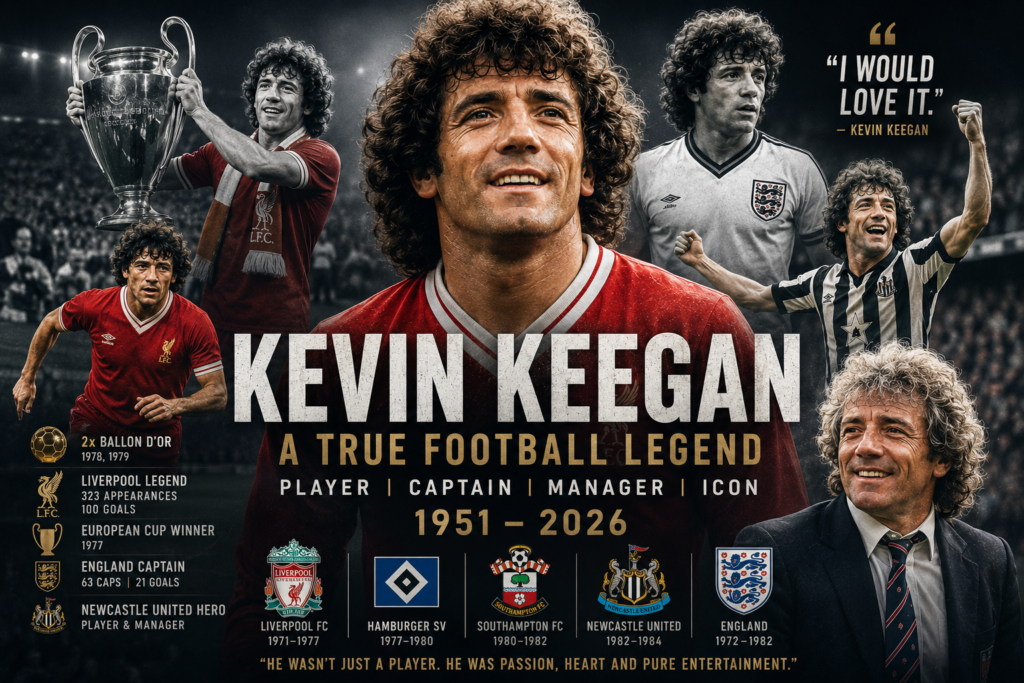
English football legend Kevin Keegan has died at the age of 75.
The former Liverpool superstar, Newcastle United icon, England captain and national-team manager had been battling cancer.
According to the announcement made on behalf of his family, Keegan died surrounded by his wife and daughters.
Keegan was much more than a successful goalscorer.
He was one of the most charismatic and influential personalities in English football history, a European Cup winner, a German champion and one of the few footballers ever to win the Ballon d’Or in consecutive years.
Liverpool described Keegan’s contribution as an unforgettable part of the club’s history. Newcastle United remembered him as one of the most iconic, influential and deeply loved figures ever associated with the club.
Read more English football stories, player biographies, coaching articles and legendary moments on the English Finter.dk front page.
Kevin Keegan: Quick Facts
| Kevin Keegan fact | Information |
|---|---|
| Full name | Joseph Kevin Keegan |
| Born | February 14, 1951 |
| Birthplace | Armthorpe, Doncaster, England |
| Died | July 20, 2026 |
| Age | 75 |
| Position | Forward and attacking midfielder |
| Famous nicknames | King Kev and Mighty Mouse |
| England appearances | 63 |
| England goals | 21 |
| Matches as England captain | 31 |
| Ballon d’Or awards | 1978 and 1979 |
| Liverpool record | 323 appearances and 100 goals |
| Major clubs | Liverpool, Hamburger SV, Southampton and Newcastle United |
| Clubs managed | Newcastle United, Fulham and Manchester City |
| National team managed | England |
Keegan became the only British footballer to win the Ballon d’Or twice.
He represented England 63 times, scored 21 international goals and captained the national team on 31 occasions.
What Was Kevin Keegan’s Cause of Death?
Kevin Keegan’s family announced in January 2026 that he had been admitted to hospital after experiencing ongoing abdominal symptoms.
Medical examinations revealed that he had cancer, and treatment began shortly afterwards.
It was later reported that Keegan was suffering from stage-four cancer. The exact type of cancer was not publicly disclosed.
On July 20, 2026, his family announced that he had died at the age of 75. His wife and daughters were reportedly with him during his final moments.
The family thanked the medical professionals who had cared for him and requested privacy.
Read the official Newcastle United family statement.
From Scunthorpe United to Liverpool
Kevin Keegan began his professional career with Scunthorpe United.
He was not the tallest or most physically imposing player, but his energy, courage, movement and extraordinary work rate made him impossible to ignore.
Liverpool manager Bill Shankly brought Keegan to Anfield in 1971.
Keegan was initially considered a possible midfielder. However, Liverpool quickly discovered that his greatest qualities could be used closer to the opposition goal.
Together with powerful Welsh striker John Toshack, Keegan formed one of the most famous attacking partnerships of the 1970s.
Toshack challenged for headers, occupied central defenders and brought the ball down.
Keegan moved around him, attacked the spaces, collected second balls and created chances.
Their partnership was sometimes compared to Batman and Robin.
They were completely different footballers, but their qualities fitted together almost perfectly.
Read the story of another legendary Liverpool captain in Steven Gerrard – The Liverpool Legend Who Never Gave Up.
Kevin Keegan’s Liverpool Statistics
Kevin Keegan played six seasons for Liverpool between 1971 and 1977.
| Liverpool statistic | Total |
|---|---|
| Appearances in all competitions | 323 |
| Goals in all competitions | 100 |
| English league titles | 3 |
| UEFA Cup titles | 2 |
| FA Cup titles | 1 |
| European Cups | 1 |
Keegan won the English league championship with Liverpool in 1973, 1976 and 1977.
He also won the UEFA Cup in 1973 and 1976, the FA Cup in 1974 and the European Cup in 1977.
His final Liverpool total was exactly 100 goals in 323 appearances.
That record alone would have made him a club legend.
The trophies, major-match performances and connection with the supporters made his legacy even greater.
See Keegan’s complete record on the official Liverpool FC profile.
Two Goals in the 1974 FA Cup Final
One of Keegan’s greatest Liverpool performances came in the 1974 FA Cup final.
Liverpool’s opponents were Newcastle United, the club that would later become one of the most important parts of Keegan’s life.
Liverpool won the final 3-0.
Keegan scored twice.
The performance demonstrated many of the qualities that made him so dangerous:
- Relentless movement
- Fast combinations
- Intelligent runs
- Courage inside the penalty area
- The ability to perform under pressure
Keegan was not simply a player who collected goals against weaker opponents.
He delivered on the biggest stages.
The Perfect Liverpool Farewell
Keegan had already announced that he intended to leave Liverpool after the 1976/77 season.
His final match for the club was therefore the European Cup final against Borussia Mönchengladbach.
It could hardly have been a bigger occasion.
Keegan did not score, but he was Liverpool’s most dangerous attacking player. His movement and direct play caused constant problems for the German defence.
He eventually won the penalty that Phil Neal converted to complete Liverpool’s 3-1 victory.
Liverpool had become European champions for the first time.
Keegan left the club at the highest possible point: as an English champion and European champion.
His Liverpool career ended with:
- 323 appearances
- 100 goals
- Three league titles
- Two UEFA Cups
- One FA Cup
- One European Cup
Explore more historic matches and turning points in The 50 Football Moments That Changed the World Forever.
Hamburger SV and Two Ballon d’Or Awards
In the summer of 1977, Kevin Keegan joined Hamburger SV.
The transfer was a brave decision.
It was still unusual for leading English footballers to leave the English league and move abroad. Keegan was also leaving Liverpool immediately after helping the club become European champions.
His first months in Hamburg were challenging.
Keegan had to adapt to:
- A new country
- A different language
- New teammates
- A more tactical football culture
- Enormous expectations
He overcame those challenges and produced the most successful individual period of his career.
Keegan won the Ballon d’Or in both 1978 and 1979.
He also helped Hamburg win the Bundesliga title in the 1978/79 season and reach the 1980 European Cup final.
Hamburg lost that final 1-0 to Nottingham Forest, but Keegan’s three years in Germany had already transformed his reputation.
For Hamburg, Keegan made 90 Bundesliga appearances and scored 32 league goals.
In the 1978/79 championship season, he scored 17 league goals while starting every league match.
Read Hamburg’s official tribute, Kevin Keegan – A HSV Legend.
For more German football history, read FC Bayern Munich – The Ultimate History, Records, Legends and Mia San Mia Guide.
Kevin Keegan’s Greatest Individual Achievement
Winning the Ballon d’Or once is enough to guarantee a place in football history.
Kevin Keegan won it twice in consecutive years.
He became European Footballer of the Year in 1978 and successfully defended the award in 1979.
The achievement placed him among a very small group of footballers recognised as the finest player in Europe in back-to-back years.
Keegan remains the only British footballer to have won the award twice.
Read about the greatest Ballon d’Or record of all in Lionel Messi Records – The Complete List of Messi’s Greatest Football Records.
The Sensational Move to Southampton
Keegan returned to English football in 1980 and joined Southampton.
The transfer was a major surprise.
Southampton were not considered one of England’s traditional superpowers, yet they had managed to sign the reigning two-time Ballon d’Or winner.
Keegan continued to score goals and entertain supporters.
During the 1981/82 season, he produced one of the finest campaigns of his career and was named PFA Players’ Player of the Year.
Southampton even led the English league during part of the season.
Although they could not maintain their championship challenge, Keegan had demonstrated that he remained one of the most dangerous attacking players in the country.
Newcastle United: The Arrival of King Kev
In 1982, Keegan completed another surprising transfer.
He left the top division to join Newcastle United in the second tier of English football.
Newcastle were a huge club with passionate supporters and a proud history, but the team desperately needed hope.
Keegan gave them exactly that.
More than 35,000 supporters attended his debut against Queens Park Rangers.
Keegan scored the only goal of the match.
The connection between the player, the city and the supporters was immediate.
Keegan helped Newcastle win promotion in 1984 alongside attacking talents such as Peter Beardsley and Chris Waddle.
He made 85 appearances for Newcastle and scored nearly 50 goals.
Newcastle supporters called him King Kev.
The nickname was not simply about his ability.
It reflected the emotional importance he held for an entire city.
Read Newcastle United’s official Kevin Keegan Hall of Fame profile.
The Helicopter Farewell
Keegan’s final season as a player ended in almost cinematic fashion.
He scored in his final competitive league match as Newcastle defeated Brighton 3-1 and celebrated promotion.
A testimonial match against Liverpool followed at St James’ Park.
After the match, Keegan left the stadium wearing his full football kit.
He departed in a helicopter.
It was a dramatic goodbye that perfectly suited a player who had always combined football, emotion, entertainment and a special relationship with the crowd.
Kevin Keegan’s England Career
Keegan made his England debut in 1972 and played his final international match during the 1982 World Cup.
| England statistic | Total |
|---|---|
| International appearances | 63 |
| International goals | 21 |
| Matches as captain | 31 |
| International career | 1972–1982 |
Keegan was one of England’s biggest stars throughout the 1970s.
Unfortunately, much of his international career coincided with a difficult period for the national team.
England failed to qualify for the World Cup in both 1974 and 1978.
At the 1982 World Cup, Keegan was restricted by a serious back injury.
He eventually appeared as a substitute against Spain, but England were eliminated following a 0-0 draw.
Explore the history and future of the national team in England at the 2026 FIFA World Cup.
Read about another famous England striker in Gary Lineker – England’s Goal Machine, World Cup Hero and Football Gentleman.
You can also read Harry Kane – The Incredible Story of England’s Greatest Goalscorer.
Why Was Kevin Keegan So Good?
Kevin Keegan was approximately 1.73 metres tall.
He did not possess the traditional physical profile of a powerful centre-forward, but he was brave, athletic and extremely difficult to control.
Movement Without the Ball
Keegan rarely stood still.
He attacked empty spaces, pulled defenders out of position and continually gave his teammates passing options.
Work Rate
He ran, pressed and competed throughout the match.
His work rate became one of the defining characteristics of his career.
Timing
Keegan had an outstanding ability to arrive inside the penalty area at exactly the right moment.
Heading Ability
Despite his height, he was surprisingly dangerous in the air.
His timing, courage and jumping ability allowed him to challenge much taller defenders.
Finishing
Keegan could score with both feet and was particularly dangerous when reacting quickly inside the penalty area.
Mentality
He refused to allow his size, early rejections or difficult periods to define his career.
Charisma
Supporters could feel that every match mattered to him.
He played with visible passion and rarely attempted to hide his emotions.
Learn more about awareness, movement and intelligent decisions in The Complete Guide to Improving Football IQ.
Develop leadership qualities inspired by players such as Keegan in How to Become a Football Captain.
The Manager Who Saved Newcastle United
After retiring as a player, Keegan initially suggested that he did not want to become a football manager.
That changed in February 1992.
Newcastle United were in serious danger of being relegated to the third tier of English football.
Keegan returned to St James’ Park and immediately gave the club energy, belief and direction.
He kept Newcastle in the division and then built one of the most exciting teams in English football.
In his first full season, Newcastle won the second-tier championship and earned promotion to the Premier League.
During their first season back in the top division, Newcastle finished third.
The team played brave, attacking and entertaining football.
They became known as The Entertainers.
Newcastle’s Entertainers
Keegan’s Newcastle squads included attacking stars such as:
- Peter Beardsley
- Andy Cole
- David Ginola
- Les Ferdinand
- Faustino Asprilla
- Alan Shearer
Keegan did not build teams simply to avoid defeat.
He wanted them to attack, score goals and give the supporters memorable experiences.
Newcastle became one of the most exciting teams in Europe.
Their matches were often unpredictable because the team accepted significant defensive risks in order to attack with numbers.
Keegan’s philosophy was simple:
Football should inspire people.
The Premier League Title That Disappeared
During the 1995/96 season, Newcastle appeared to be heading towards the Premier League title.
At one point, they held a 12-point lead over Manchester United.
However, Sir Alex Ferguson’s team gradually reduced the advantage while Newcastle dropped points during several dramatic matches.
One of the decisive moments was Liverpool’s famous 4-3 victory over Newcastle at Anfield.
The match is still regularly described as one of the greatest games in Premier League history.
Manchester United eventually won the title, finishing four points ahead of Newcastle.
Keegan’s team finished second again the following season.
Newcastle never won the Premier League under Keegan, but the Entertainers remain more fondly remembered than many championship-winning teams.
Explore more alternative football history in The 100 Greatest Football “What If?” Stories Ever.
The Famous “I Would Love It” Interview
During the intense 1995/96 title race, Sir Alex Ferguson attempted to increase the pressure on Newcastle through his media interviews.
After Newcastle defeated Leeds United, Keegan responded during an emotional live television interview.
The interview included the famous line:
“I would love it.”
It became one of the most replayed interviews in Premier League history.
Some observers believed Ferguson had won the psychological battle.
Others saw Keegan’s reaction as evidence of how deeply he cared about Newcastle and the championship race.
Keegan rarely hid behind prepared media answers.
His emotions were genuine, and that authenticity was one of the reasons supporters connected so strongly with him.
Fulham, England and Manchester City
After leaving Newcastle, Keegan continued his managerial career.
| Team | Major achievement |
|---|---|
| Fulham | Won the third-tier championship in 1998/99 |
| England | National-team manager from 1999 to 2000 |
| Manchester City | Won the second-tier championship in 2001/02 |
| Newcastle United | Returned as manager in 2008 |
Keegan created promotion-winning teams at both Fulham and Manchester City.
His teams were typically adventurous, positive and attack-minded.
His period as England manager proved more difficult.
England qualified for UEFA Euro 2000 but were eliminated during the group stage.
Keegan resigned after a 1-0 defeat against Germany in the final match played at the old Wembley Stadium.
He managed England in 18 matches and won seven.
Kevin Keegan’s Major Trophies
As a Player
| Club | Trophy | Total |
|---|---|---|
| Liverpool | English league championship | 3 |
| Liverpool | UEFA Cup | 2 |
| Liverpool | FA Cup | 1 |
| Liverpool | European Cup | 1 |
| Hamburger SV | Bundesliga | 1 |
| Individual | Ballon d’Or | 2 |
As a Manager
| Club | Achievement |
|---|---|
| Newcastle United | First Division champions, 1992/93 |
| Fulham | Second Division champions, 1998/99 |
| Manchester City | First Division champions, 2001/02 |
Tributes Following Kevin Keegan’s Death
Tributes arrived from across the football world following the announcement of Keegan’s death.
Newcastle United described him as one of the most iconic, influential and deeply loved figures in the club’s history.
Liverpool remembered the former number seven whose performances helped lay the foundations for one of the greatest periods in the club’s history.
Former Newcastle striker Alan Shearer described Keegan as a hero, manager and friend.
Other former players, clubs and supporters remembered his passion, generosity, personality and extraordinary connection with football fans.
Keegan’s influence stretched far beyond the clubs he represented.
He was a pioneer for English players moving abroad, a superstar before football became a global commercial industry and a manager who believed entertainment mattered.
Read the official Liverpool tribute to Kevin Keegan.
12 Incredible Kevin Keegan Facts
- Liverpool initially considered using Keegan as a midfielder before moving him into attack.
- He scored exactly 100 goals for Liverpool.
- His final Liverpool appearance was the 1977 European Cup final victory.
- He won the Ballon d’Or in two consecutive years.
- He remains the only British footballer to win the Ballon d’Or twice.
- He represented Newcastle United as both a player and manager.
- He won promotion with Newcastle in both roles.
- He was named PFA Players’ Player of the Year while playing for Southampton.
- He captained England 31 times.
- He scored 21 goals in 63 England appearances.
- He left the pitch in a helicopter following his Newcastle testimonial.
- He recorded music, and his song “Head Over Heels in Love” became a hit in Germany.
Watch Kevin Keegan’s Greatest Moments
Where possible, videos from official clubs, competitions and established broadcasters are the best choices for embedding in an article.
▶️ Kevin Keegan’s Top Five Bundesliga Goals
▶️ Kevin Keegan Discusses the Passion of Newcastle Supporters
▶️ Kevin Keegan Looks Back at the “I Would Love It” Interview
▶️ Kevin Keegan at 70 – The Keegan Years
▶️ Kevin Keegan’s Best Liverpool Goals and Highlights
▶️ Liverpool vs Borussia Mönchengladbach – 1977 European Cup Final
▶️ Kevin Keegan at Hamburger SV
▶️ Kevin Keegan and Newcastle’s Entertainers
▶️ Kevin Keegan’s Goals for England
Find hundreds of historic football videos in The Ultimate Football YouTube Encyclopedia – 300 Greatest Football Videos Ever Made.
Frequently Asked Questions About Kevin Keegan
Is Kevin Keegan dead?
Yes. Kevin Keegan died on July 20, 2026, at the age of 75.
What was Kevin Keegan’s cause of death?
Kevin Keegan had been battling cancer. His diagnosis was announced by his family in January 2026. The exact form of cancer was not publicly disclosed.
How many times did Kevin Keegan win the Ballon d’Or?
Kevin Keegan won the Ballon d’Or twice.
He received the award in 1978 and 1979 while playing for Hamburger SV.
How many goals did Kevin Keegan score for Liverpool?
Kevin Keegan scored exactly 100 goals in 323 official Liverpool appearances.
How many times did Kevin Keegan play for England?
Keegan made 63 senior appearances for England and scored 21 international goals.
He captained England 31 times.
Did Kevin Keegan win the Champions League?
Keegan won the European Cup with Liverpool in 1977.
The European Cup was the competition that later became known as the UEFA Champions League.
Which clubs did Kevin Keegan play for?
During his professional career, Keegan represented:
- Scunthorpe United
- Liverpool
- Hamburger SV
- Southampton
- Newcastle United
He also briefly appeared for Blacktown City in Australia after his main English playing career had ended.
Why was Kevin Keegan called King Kev?
The nickname became particularly famous among Newcastle United supporters.
It reflected Keegan’s enormous importance to the club as both a player and manager.
Why was Kevin Keegan called Mighty Mouse?
Keegan was smaller than many traditional centre-forwards but played with remarkable energy, courage and physical commitment.
The Mighty Mouse nickname reflected his combination of limited height and extraordinary determination.
Did Kevin Keegan win the Premier League as a manager?
No.
His Newcastle team finished second behind Manchester United in both 1995/96 and 1996/97.
Despite not winning the title, the Entertainers remain one of the most celebrated teams in Premier League history.
Kevin Keegan’s Legacy Will Live On
Kevin Keegan leaves behind a career unlike almost any other in English football.
He progressed from Scunthorpe United to become a European champion with Liverpool.
He moved abroad when very few leading English players were prepared to take that risk.
He conquered German football with Hamburg and won the Ballon d’Or twice.
He captained England.
He gave Southampton one of the biggest transfers in the club’s history.
He transformed Newcastle first as a player and later as a manager.
Keegan never won the Premier League as a manager.
However, his Newcastle teams are remembered more vividly than many teams that lifted trophies.
That is because Keegan offered supporters more than results.
He gave them hope.
He gave them attacking football.
He gave them drama.
He gave them the feeling that almost anything was possible.
Kevin Keegan was 75 years old. King Kev will be remembered as one of English football’s greatest players, personalities, pioneers and dreamers.
Read More English Football Articles on Finter.dk
- English Finter.dk Front Page
- Steven Gerrard – The Liverpool Legend Who Never Gave Up
- Gary Lineker – England’s Goal Machine and World Cup Hero
- Harry Kane – The Incredible Story of England’s Greatest Goalscorer
- Jude Bellingham – The Ultimate Guide to England’s Midfield Superstar
- England at the 2026 FIFA World Cup
- England Finish Third at World Cup 2026 After a 6-4 France Thriller
- England vs Argentina – World Cup 2026 Semi-Final
- England 2-1 DR Congo – Harry Kane Double Completes the Comeback
- The 50 Football Moments That Changed the World Forever
- The 100 Greatest Football “What If?” Stories Ever
- The Ultimate Football YouTube Encyclopedia
- Lionel Messi Records – The Complete List
- FC Bayern Munich – History, Records and Legends
- Florian Wirtz vs Jamal Musiala
- The 25 Biggest Breakout Stars of FIFA World Cup 2026
- The Players With the Most FIFA World Cup Appearances
- Why the World’s Best Footballers Play Multiple Sports as Kids
- Why Footballers Lose Their Confidence
- Parents in Youth Football – When Support Turns Into Pressure
- Sporting CP – Academy, Legends, Trophies and Football Culture