
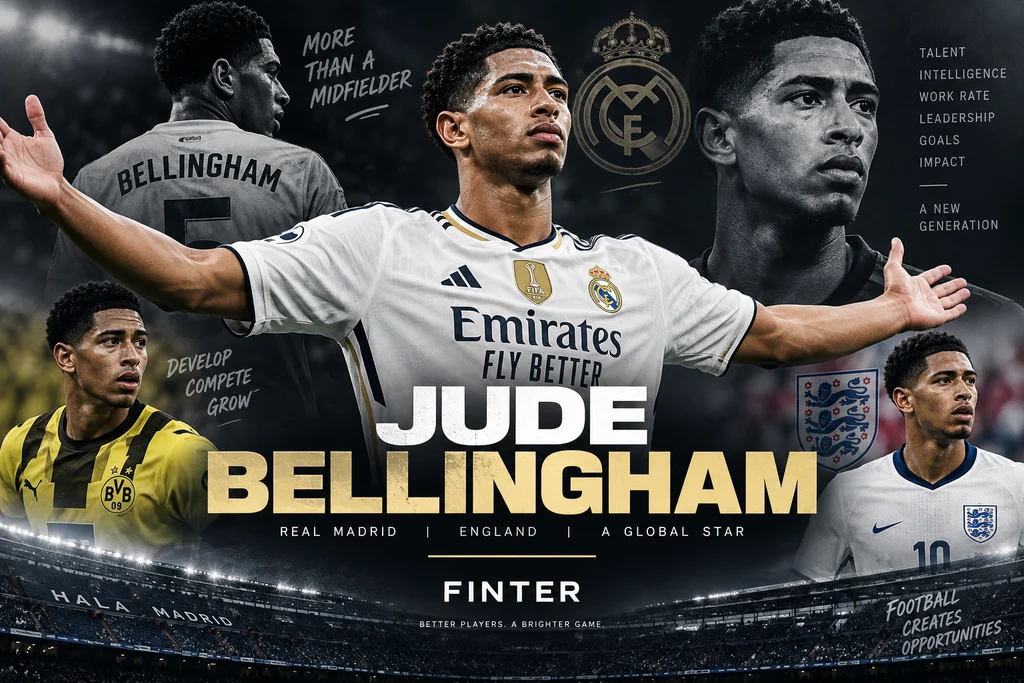
⚽ FINTER.DK · FOOTBALL SUPERSTARS · 2026/27
Jude Bellingham – The Complete Guide to Real Madrid’s Midfield Superstar!
FINTER’s Ultimate Interactive Football IQ & Box-to-Box Training Guide
From Birmingham City and Borussia Dortmund to Real Madrid and the England national team.
Discover the story behind one of modern football’s most exciting midfielders.
Learn about scanning, movement, leadership, late runs into the penalty area, passing, decision-making and tactical intelligence.
Includes 20 training drills from U5 to senior, interactive tools, 15 quiz questions, 10 coaching dilemmas, three training sessions, a four-week development plan, 14-day challenge and printable worksheets.
🏆 Champions League 🏴 England ⚽ Real Madrid 🧠 Football IQ 👀 Scanning 🎮 Interactive Training🌟 How did Jude Bellingham become a world-class midfielder?
Some footballers become famous because of their incredible speed.
Others are known for their dribbling, passing or goalscoring.
Jude Bellingham combines several different qualities.
He can win possession, carry the ball forward, find teammates, arrive in the penalty area and score important goals.
He is also known for his intensity, confidence and willingness to take responsibility.
But perhaps his most interesting quality is his understanding of the game.
Bellingham often recognises where space will appear before he makes his next movement.
This guide explores his career and shows how young players, coaches and football fans can learn from his playing style.
📊 Jude Bellingham – Quick Facts
| Category | Information |
|---|---|
| Full name | Jude Victor William Bellingham |
| Date of birth | 29 June 2003 |
| Birthplace | Stourbridge, England |
| Nationality | English |
| Position | Central / attacking midfielder |
| Youth academy | Birmingham City |
| Birmingham City first team | 2019–2020 |
| Borussia Dortmund | 2020–2023 |
| Real Madrid | From 2023 |
| Senior England debut | 2020 |
| Champions League winner | 2024 |
| La Liga champion | 2023/24 |
| Golden Boy | 2023 |
| Kopa Trophy | 2023 |
Sources: Real Madrid and The Football Association. Career dates and historical achievements are different from live season statistics.
1. 🏡 Early Life in England
Jude Bellingham was born on 29 June 2003 in Stourbridge, England.
He grew up in a family with a strong interest in football.
His younger brother, Jobe Bellingham, also became a professional footballer.
From an early age, Jude displayed enthusiasm for the game and a desire to develop his abilities.
He joined Birmingham City’s academy and progressed through the club’s youth system.
What can young players learn?
Development involves more than natural talent.
Enjoyment, practice, good coaching, supportive relationships and opportunities to play are all important.
2. ⚽ Birmingham City – An Extraordinary Breakthrough
Bellingham made his senior debut for Birmingham City in August 2019.
He was just 16 years old.
His performances attracted attention from clubs across Europe.
He demonstrated maturity, technical quality and an ability to compete against experienced professionals.
Why was Birmingham important?
Because he gained experience in competitive senior football at a young age.
He learned to operate under pressure, adapt to different opponents and understand the demands of professional football.
Coaching lesson
Young players develop at different speeds.
Early success does not guarantee future success, and later development should never be seen as failure.
3. 🇩🇪 Borussia Dortmund – Becoming a European Star
In 2020, Bellingham joined Borussia Dortmund.
Germany offered him a new football environment and the opportunity to compete in the Bundesliga and Champions League.
At Dortmund, his game developed in several important areas.
- Ball carrying.
- Defensive positioning.
- Pressing and counter-pressing.
- Passing under pressure.
- Attacking movements.
- Decision-making.
DFB-Pokal 2021
Bellingham was part of Dortmund’s team that won the German Cup in 2021.
Leadership
Despite his young age, he regularly demonstrated responsibility and intensity on the pitch.
His performances established him as one of Europe’s most exciting midfield talents.
4. 👑 Real Madrid – A New Level
In 2023, Bellingham joined Real Madrid.
He entered a club with an extraordinary history and high expectations.
His impact during the 2023/24 season was immediate.
He contributed important goals, attacking movements and midfield performances.
Why did Bellingham fit Real Madrid?
His versatility made him valuable in different situations.
He could support midfield, carry the ball forward, press opponents and attack the penalty area.
The importance of movement
Bellingham frequently used well-timed forward runs to arrive in scoring positions.
These movements demonstrate that creating a goal is not always about receiving the ball early.
Sometimes the decisive action is arriving in the right space at the right moment.
5. 🏆 Champions League Glory in 2024
Real Madrid won the 2023/24 Champions League.
The final took place at Wembley Stadium on 1 June 2024.
Real Madrid defeated Borussia Dortmund 2–0.
Bellingham played against his former club.
He provided the assist for Vinícius Júnior’s goal.
Winning the Champions League in his first season at Real Madrid was a major achievement.
A lesson in teamwork
Football success depends on more than individual performances.
Great teams need players who understand their roles and cooperate under pressure.
6. 🏴 England and EURO 2024
Bellingham made his senior England debut in November 2020.
He later represented England at major international tournaments.
EURO 2024
England reached the European Championship final in Germany.
Bellingham produced one of the tournament’s most dramatic moments.
The bicycle kick against Slovakia
On 30 June 2024, England faced Slovakia in the round of 16.
England were losing 1–0 late in the match.
In stoppage time, Bellingham scored with an acrobatic overhead kick.
The goal made it 1–1 and forced extra time.
Harry Kane later scored, and England won 2–1.
England eventually finished as runners-up at EURO 2024 after losing the final to Spain.
What can young players learn?
Concentration and persistence matter throughout a match.
However, spectacular moments are built on many skills, including technique, positioning and awareness.
7. ⭐ Awards and Achievements
| Award / Trophy | Year | Team |
|---|---|---|
| DFB-Pokal | 2021 | Borussia Dortmund |
| Golden Boy | 2023 | Individual award |
| Kopa Trophy | 2023 | Individual award |
| La Liga | 2023/24 | Real Madrid |
| Spanish Super Cup | 2024 | Real Madrid |
| Champions League | 2024 | Real Madrid |
| UEFA Super Cup | 2024 | Real Madrid |
| Intercontinental Cup | 2024 | Real Madrid |
These achievements illustrate his early success, but they do not define every aspect of his career.
The development of a footballer also involves learning, adapting and handling challenges.
8. 🏃 What Is a Box-to-Box Midfielder?
A box-to-box midfielder contributes in both defensive and attacking areas.
The player may help recover possession, support passing combinations and move forward to create chances.
Important qualities
🛡️ Defending
Positioning, tackling and supporting teammates.
⚽ Passing
Connecting different parts of the team.
🏃 Movement
Creating passing options and attacking space.
👀 Scanning
Collecting information before receiving.
🎯 Attacking
Timing runs and arriving in dangerous areas.
🧠 Decisions
Choosing the appropriate action for each situation.
Bellingham has demonstrated many of these characteristics throughout his career.
9. 👀 Scanning and Football IQ
Scanning means observing the surrounding football environment.
Players can look for:
- Teammates.
- Opponents.
- Available spaces.
- Passing opportunities.
- Pressure from behind.
- Potential forward runs.
The FINTER decision model
👀 SCAN → 🧠 UNDERSTAND → ⚽ RECEIVE → 🎯 ACT
Scan: Look for useful information.
Understand: Recognise the current situation.
Receive: Prepare your first touch.
Act: Choose a pass, dribble or movement.
Scanning is not simply about turning your head as often as possible.
The important question is: Did the player use the information effectively?
10. 🎯 Late Runs into the Penalty Area
One of Bellingham’s recognisable attacking qualities is the ability to arrive in dangerous areas.
A late run can be difficult for defenders to follow.
Example
Why does timing matter?
Running too early may allow defenders to track the movement.
Running too late may mean the opportunity has already disappeared.
Young players should learn to recognise situations, not simply repeat the same movement.
11. ⚽ Passing, First Touch and Ball Carrying
Bellingham’s midfield role requires technical quality in different areas.
Passing
A good pass needs appropriate direction, speed and timing.
First touch
A controlled first touch can prepare the next movement.
Ball carrying
Carrying the ball can help a midfielder move into open space and attract defenders.
Playing under pressure
The player must decide whether to turn, protect possession, pass or dribble.
Coaching principle: The best technique is the one that suits the situation.
12. ❤️ Leadership and Teamwork
Bellingham has become known for displaying confidence and responsibility on the football pitch.
Leadership can take many different forms.
- Helping teammates.
- Communicating positively.
- Working hard for the team.
- Responding constructively to mistakes.
- Supporting younger players.
- Respecting coaches and opponents.
Does every child need to be a leader?
No.
Players have different personalities.
Some communicate loudly, while others lead through their actions.
A good coach creates an environment where different personalities can contribute.
13. ⚔️ Bellingham Compared with Other Midfielders
| Player | Notable Strengths | Training Inspiration |
|---|---|---|
| Jude Bellingham | Box-to-box play, movement, ball carrying | Attacking runs and transitions |
| Luka Modrić | Turning, passing, scanning | Playing out of pressure |
| Xavi Hernández | Passing rhythm, positioning | Scanning and passing angles |
| Kevin De Bruyne | Through balls, assists, crosses | Timing and final passes |
| Andrés Iniesta | First touch, dribbling, creativity | Small-space technique |
Different midfielders contribute in different ways.
There is no single perfect playing style.
Youth development should encourage individual strengths rather than forcing every player to be identical.
14. ⚽ 20 Bellingham-Inspired Football Training Drills
These original FINTER drills are inspired by Bellingham’s playing characteristics.
They are not presented as documented exercises used by Bellingham himself.
Pitch sizes and timings are suggestions. Adapt every drill to age, ability and available space.
🟢 U5–U8: Movement and Ball Control
1. Find the Colour
Players: 4–12.
Area: 12 × 12 metres.
Duration: 8 minutes.
Setup: Place different coloured cones around a small pitch.
Instructions: Players dribble freely. The coach calls a colour, and players move towards the corresponding cone.
Coaching: Look up and maintain control.
Progression: Use two consecutive colours.
2. Pass and Move
Players: 4–12.
Area: 12 × 12 metres.
Duration: 8 minutes.
Setup: Create passing triangles.
Instructions: Pass to a teammate, then move into a new supporting position.
Coaching: Passing accuracy and movement.
Progression: Introduce a passive defender.
3. Dribble and Turn
Players: 4–12.
Area: 15 × 15 metres.
Duration: 8 minutes.
Instructions: Players dribble towards cones and change direction.
Coaching: Balance and close ball control.
Progression: Encourage turns with both feet.
4. The Passing Gate
Players: 4–12.
Area: 15 × 12 metres.
Duration: 10 minutes.
Instructions: Players pass through small cone gates towards teammates.
Coaching: Passing direction and weight.
Progression: Move the gates.
5. Small-Sided 3v3
Players: 6–12.
Area: 20 × 15 metres.
Duration: 12 minutes.
Instructions: Play 3v3 with small goals.
Coaching: Encourage teamwork, dribbling and creativity.
Progression: Introduce a neutral player.
🟡 U9–U12: Scanning and Passing
6. Rondo 3v1
Players: 4–12.
Area: 8 × 8 metres.
Duration: 10 minutes.
Instructions: Three players keep possession against one defender.
Coaching: Passing angles and first touch.
Progression: Adjust the playing area.
7. Scan Before Receiving
Players: 4–12.
Area: 15 × 12 metres.
Duration: 12 minutes.
Instructions: A player receives a pass while the coach displays a visual signal behind them.
Coaching: Observe before receiving.
Progression: Add an active opponent.
8. Forward First Touch
Players: 4–12.
Area: 15 × 15 metres.
Duration: 12 minutes.
Instructions: Receive a pass and take the first touch towards an open gate.
Coaching: Body position and direction.
Progression: Add passive pressure.
9. Timed Forward Run
Players: 4–12.
Area: 25 × 20 metres.
Duration: 12 minutes.
Instructions: One player prepares a pass while another times a run into space.
Coaching: Timing and communication.
Progression: Introduce defenders.
10. Rondo 4v2
Players: 6–12.
Area: 12 × 12 metres.
Duration: 12 minutes.
Instructions: Four players keep possession against two defenders.
Coaching: Awareness and passing decisions.
Progression: Adjust space and pressure.
🟠 U13–U16: Midfield Intelligence
11. Late Runs into the Box
Players: 6–14.
Area: 30 × 25 metres.
Duration: 15 minutes.
Instructions: A midfielder times a forward run as a teammate prepares to cross.
Coaching: Arrive at the right moment.
Progression: Introduce active defenders.
12. Carry the Ball Forward
Players: 6–12.
Area: 25 × 20 metres.
Duration: 15 minutes.
Instructions: A midfielder receives, recognises available space and drives forward.
Coaching: Awareness and controlled acceleration.
Progression: Add pressure and passing options.
13. Third-Man Movement
Players: 6–12.
Area: 25 × 20 metres.
Duration: 15 minutes.
Instructions: Player A passes to B, who releases C into space.
Coaching: Timing and passing combinations.
Progression: Introduce defenders.
14. Transition Decision Game
Players: 8–16.
Area: 30 × 25 metres.
Duration: 15 minutes.
Instructions: After winning possession, players decide whether to counterattack or retain the ball.
Coaching: Recognise available space.
Progression: Change defensive numbers.
15. Positional Play 5v3
Players: 8–16.
Area: 22 × 18 metres.
Duration: 15 minutes.
Instructions: Five players retain possession against three defenders.
Coaching: Body shape, spacing and decisions.
Progression: Add an attacking target.
🔴 U17–Senior: Advanced Midfield Play
16. Midfield Pressing Triggers
Players: 10–18.
Area: 35 × 30 metres.
Duration: 20 minutes.
Instructions: Players recognise pressing opportunities and work as a coordinated unit.
Coaching: Pressing angles and communication.
Progression: Introduce counterattacks.
17. Box-to-Box Transition
Players: 10–18.
Area: 45 × 35 metres.
Duration: 20 minutes.
Instructions: Players move from a defensive transition into a coordinated attack.
Coaching: Movement and decision-making.
Progression: Add different transition scenarios.
18. Midfield Under Pressure
Players: 10–18.
Area: 35 × 25 metres.
Duration: 20 minutes.
Instructions: Midfielders receive between defensive lines and choose whether to turn or combine.
Coaching: Scanning and first touch.
Progression: Increase defensive pressure.
19. Attack the Penalty Area
Players: 10–18.
Area: 40 × 30 metres.
Duration: 20 minutes.
Instructions: Midfield players coordinate runs into the box with wide attacking actions.
Coaching: Timing, spacing and finishing.
Progression: Introduce active defending.
20. The Bellingham Match
Players: 14–22.
Area: Adapt to 7v7, 8v8 or 11v11.
Duration: 25 minutes.
Instructions: Play a realistic match with attention to midfield movement, pressing, scanning and forward runs.
Coaching: Apply training decisions in realistic situations.
Progression: Adjust tactical constraints.
❤️ Important: Child Development
Children should not copy professional training workloads.
Young players need enjoyment, creativity, positive relationships and opportunities to explore the game.
Adapt all drills to individual needs and developmental stages.
15. 🎮 Interactive Training Generator
Choose an age group and a training focus.
The generator will suggest a Bellingham-inspired drill.
16. 📊 Interactive Passing Accuracy Calculator
Calculate the percentage of successful passes during a match or training session.
Does a high passing percentage mean better football?
Not necessarily.
A midfielder may complete many safe passes without creating opportunities.
It is also important to evaluate the quality, purpose and difficulty of each decision.
17. 📅 Three Complete Training Sessions
Session 1 – U5–U9
| Time | Activity | Focus |
|---|---|---|
| 10 min | Find the Colour | Awareness |
| 10 min | Pass and Move | Technique |
| 10 min | Dribble and Turn | Ball control |
| 15 min | 3v3 Football | Decision-making |
Total: 45 minutes.
Session 2 – U10–U14
| Time | Activity | Focus |
|---|---|---|
| 10 min | Technical Warm-Up | Ball control |
| 15 min | Rondo 4v2 | Passing |
| 15 min | Timed Forward Runs | Movement |
| 20 min | Small-Sided Match | Football IQ |
Total: 60 minutes.
Session 3 – U15–Senior
| Time | Activity | Focus |
|---|---|---|
| 15 min | Passing Warm-Up | Technique |
| 15 min | Midfield Pressing | Defending |
| 20 min | Box-to-Box Transition | Movement |
| 25 min | Match-Based Training | Football IQ |
Total: 75 minutes.
18. 🗓️ Four-Week Development Plan
| Week | Focus | Exercises | Development Goal |
|---|---|---|---|
| 1 | Scanning | Awareness and first touch | Recognise space earlier |
| 2 | Passing | Rondos and combinations | Improve passing choices |
| 3 | Movement | Forward runs and transitions | Improve timing |
| 4 | Football IQ | Match-based exercises | Transfer learning into games |
How should coaches evaluate progress?
After each training week, ask the player:
- What improved?
- Which situations remain difficult?
- What should we practise next?
Use these answers to adapt the next session.
19. 🤔 Ten Realistic Coaching Dilemmas
1. The midfielder always runs forward
How do you develop defensive awareness?
FINTER: Use transition games that require players to recognise when to attack and when to provide defensive cover.
2. A player rarely scans before receiving
How can awareness improve?
FINTER: Combine scanning cues with passing and first-touch decisions.
3. The player wants to score every goal
How do you encourage teamwork?
FINTER: Reward good passes, supporting runs and opportunities created for teammates.
4. The midfielder loses possession under pressure
What should the coach focus on?
FINTER: First touch, body position, awareness and passing options.
5. The player makes forward runs too early
How can timing improve?
FINTER: Practise recognising the passer’s preparation and the defenders’ movement.
6. The team presses without coordination
Should every player simply chase the ball?
FINTER: No. Pressing requires roles, communication and protection of important spaces.
7. The player is technically strong but makes slow decisions
How can Football IQ develop?
FINTER: Use small-sided games with active opposition and multiple passing options.
8. One player dominates every training exercise
How can everyone develop?
FINTER: Rotate roles and organise small-sided games with frequent involvement.
9. A player loses confidence after mistakes
What should the coach do?
FINTER: Support experimentation and recognise positive decisions, even when execution fails.
10. Parents focus only on goals and assists
How do you communicate development?
FINTER: Discuss teamwork, defending, movement, decision-making and enjoyment.
20. 🧠 Interactive Jude Bellingham Quiz
Test your knowledge with 15 questions about Bellingham, Real Madrid, England and football intelligence.
21. 🏆 FINTER’s 14-Day Bellingham Challenge
Complete 14 short activities inspired by Bellingham’s midfield playing style.
Adapt activities to age, fitness and training commitments. Allow appropriate rest and recovery.
22. 📝 Printable Coaching Worksheets
Worksheet 1 – Midfield Observation
Player: __________________________
Date: ____________________________
| Observation | Yes | Sometimes | Not Yet |
|---|---|---|---|
| Scans before receiving | ☐ | ☐ | ☐ |
| Creates passing angles | ☐ | ☐ | ☐ |
| Uses an effective first touch | ☐ | ☐ | ☐ |
| Times forward runs well | ☐ | ☐ | ☐ |
| Supports defensive transitions | ☐ | ☐ | ☐ |
What went well?
What can improve?
Worksheet 2 – Passing Statistics
Player: __________________________
Date: ____________________________
| Measurement | Result |
|---|---|
| Passes attempted | ________ |
| Successful passes | ________ |
| Forward passes | ________ |
| Successful turns | ________ |
| Well-timed forward runs | ________ |
Worksheet 3 – Training Session Plan
Team: ____________________________
Date: ____________________________
Focus: ___________________________
| Time | Activity | Coaching Point |
|---|---|---|
| 10 min | ________ | ________ |
| 15 min | ________ | ________ |
| 15 min | ________ | ________ |
| 20 min | ________ | ________ |
📘 Save Your Training Sheets as a PDF
Use the print button at the top of this guide.
Choose “Save as PDF” in your browser’s print settings.
You can also print the worksheets for training.
23. 🎥 Video Inspiration – Learn from Bellingham
FINTER links to third-party video platforms. Videos are not reproduced or hosted by FINTER.
24. 🔗 Explore More FINTER Football Guides
25. ❓ Frequently Asked Questions
Who is Jude Bellingham?
Jude Bellingham is an English professional footballer who plays in midfield for Real Madrid and England.
When was Jude Bellingham born?
29 June 2003.
Where was Bellingham born?
Stourbridge, England.
Which clubs has Bellingham played for?
Birmingham City, Borussia Dortmund and Real Madrid.
When did Bellingham join Real Madrid?
In 2023.
Has Bellingham won the Champions League?
Yes. He won the competition with Real Madrid in 2024.
What is a box-to-box midfielder?
A player who contributes in both defensive and attacking areas of the pitch.
What is scanning in football?
Observing teammates, opponents and space to prepare better decisions.
What is Football IQ?
An informal term describing football understanding and decision-making.
Can children learn from Bellingham?
Yes. His playing style can inspire exercises involving movement, passing, awareness and teamwork.
Are these Bellingham’s actual training drills?
No. They are original FINTER coaching suggestions inspired by his playing characteristics.
Can the guide be printed?
Yes. Use the print button or choose Save as PDF.
📚 Official Sources
❤️ FINTER’s Final Thoughts
Jude Bellingham’s career demonstrates the importance of combining different football qualities.
Technical skills matter.
Physical development matters.
But awareness, movement, teamwork and decision-making are equally important.
A great midfielder does not simply chase the ball.
The player understands when to move, when to support, when to defend and when to attack.
If you want to learn from Bellingham, start by improving your awareness and movement without the ball.
Then work on passing, first touch, ball carrying and recognising attacking opportunities.
Most importantly, enjoy the process of becoming a better footballer.