
⚽ FINTER WORLD | INTERNATIONAL COACHING GUIDE 2026/27
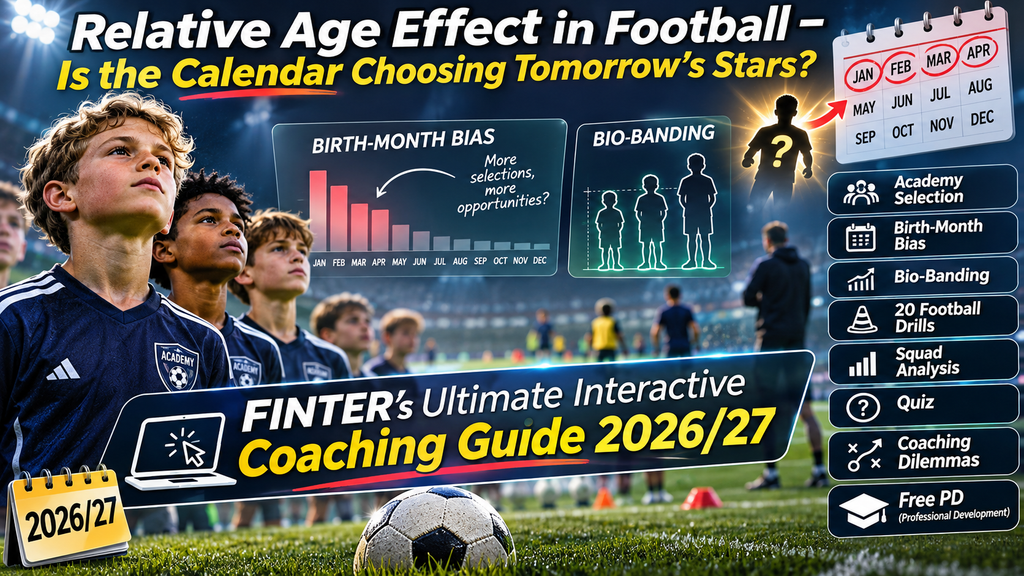
Relative Age Effect in Football – Is the Calendar Choosing Tomorrow’s Stars?
Birth-month bias, academy selection, biological maturity and the overlooked footballers who deserve another chance.
Why are some young players selected for elite academies while others never receive the same opportunities?
Could the month a child was born influence their chances of becoming a professional footballer?
Discover the science, explore international football systems and learn how to create fairer opportunities for young players.
📊 Interactive Analysis | ⚽ 20 Football Drills | 🧠 15-Question Quiz | ⚖️ 10 Coaching Dilemmas | 📥 Free PDF
🎯 The 30-Second Takeaway
The Relative Age Effect (RAE) describes a pattern where athletes born earlier within a selection year can be overrepresented in competitive sport.
In youth football, two players in the same age category may be almost 12 months apart.
This difference can influence physical development, performance and selection.
However, birth month does not determine footballing potential.
The challenge is not simply identifying the strongest players today. It is recognising who could become the strongest players tomorrow.
📘 FREE FINTER COACHING PACK
Relative Age Effect in Football
Download our 11-page coaching resource.
✅ 20 Football Drills
✅ Squad Analysis
✅ Player Observation Sheets
✅ Training Programmes
✅ Coaching Reflections
✅ 10 Coaching Dilemmas
✅ Printable A4 Resources
Language note: The downloadable coaching PDF is currently in Danish. The complete English learning activities are included in this article.
🌍 Explore FINTER in English and Danish
FINTER provides interactive football education for coaches, players, parents and football enthusiasts.
🇬🇧 English Guide 🇩🇰 Danish Article⚽ 1. Two Players, One Selection
Imagine two talented 11-year-old footballers.
One was born on January 3. The other was born on December 28.
They play in the same age category.
Both love football. Both train regularly. Both dream of becoming professionals.
But the January-born player is almost one year older.
During childhood, this difference can influence physical development, coordination and accumulated experience.
Now imagine an academy trial.
The older player wins more physical duels, runs faster and scores three goals.
The younger player demonstrates excellent awareness, creativity and intelligent passing.
Who receives the academy invitation?
🧠 The Question Every Scout Should Ask
Are we evaluating today’s performance or tomorrow’s potential?
Could the player who looks less physically impressive today become the better footballer later?
📊 2. What Does the Research Actually Show?
Research from different countries has repeatedly identified relative-age patterns in selected youth football populations.
Players born earlier in the relevant eligibility period are often overrepresented at certain academy and elite levels.
However, the size and direction of these patterns vary.
🔬 A Scottish Academy Example
A study published in 2025 examined players in Club Academy Scotland.
The reported birth-quarter distribution was approximately:
| Birth Quarter | Percentage |
|---|---|
| Q1 – January to March | 34.90% |
| Q2 – April to June | 23.64% |
| Q3 – July to September | 20.78% |
| Q4 – October to December | 20.68% |
In this sample, players born during the first calendar quarter were overrepresented.
These figures describe the specific study population.
They should not be presented as universal figures for every football academy.
Read the Scottish Academy Research
🌍 What About Other Countries?
International studies have examined relative-age patterns in European and global football environments.
Research from Spain, Germany and other football nations demonstrates the importance of considering selection systems, age groups and biological development.
Differences between boys’ and girls’ football must also be considered.
FINTER’s Research Conclusion
A disproportionate number of relatively older players can indicate a relative-age pattern.
But the distribution alone cannot prove that individual coaches are discriminating.
The underlying player population, selection procedures and competition rules must also be examined.
🌍 3. Why January Is Not Always the Important Month
Many discussions about Relative Age Effect focus on January-born and December-born players.
But football eligibility periods do not always begin in January.
Different competitions and age-group systems may use different cut-off dates.
For example, a September-to-August eligibility year creates a different relative-age order from a January-to-December system.
This is particularly important when comparing international research.
Always verify the actual eligibility rules of the relevant football association, competition and season.
A player’s relative age depends on those rules, not simply on the calendar month.
🎮 4. Interactive Birth-Month Calculator
Explore how a player’s birth month relates to the beginning of an eligibility year.
This simplified tool assumes an eligibility year beginning on the first day of the selected month. It does not determine biological maturity or individual talent.
📊 5. Interactive Squad Analysis
Does your football squad contain more relatively older players than relatively younger players?
Enter the number of players in each quarter of the relevant eligibility year.
Q1 represents the first three months after the cut-off. Q4 represents the final three months.
How Should Coaches Interpret the Results?
A birth-quarter distribution does not prove selection bias.
Small squads can produce uneven distributions by chance.
A meaningful analysis should compare the squad with the relevant player population and selection process.
Only enter aggregate counts. No children’s names or personal birth dates are needed.
🧬 6. Relative Age, Biological Maturity and Bio-Banding
Relative age and biological maturity are related considerations, but they are not the same.
Relative Age
Relative age describes a player’s position within the eligibility year.
Biological Maturity
Biological maturity describes the development of the body.
Two players of the same chronological age can be at different stages of physical maturation.
A relatively older player can mature late.
A relatively younger player can mature early.
What Is Bio-Banding?
Bio-banding is an approach that groups players in certain development activities according to biological maturity rather than chronological age alone.
It can provide alternative physical challenges and opportunities for observation.
However, bio-banding is not a universal solution.
It should complement, rather than automatically replace, traditional age-group football.
🇩🇰 Denmark’s DBU Future
The Danish Football Association has developed initiatives supporting talented players who mature later physically.
DBU Future is one example of an alternative talent-development pathway.
It focuses on biological development, not simply whether a player was born in December.
🚨 7. The Academy Opportunity Loop
A small initial advantage can sometimes grow into a much larger developmental advantage.
Stage 1 – Early Physical Advantage
A player performs well because of temporary physical advantages.
Stage 2 – Positive Evaluation
The player receives greater recognition from coaches.
Stage 3 – Additional Opportunities
The player gains access to additional training and competition.
Stage 4 – Accelerated Development
More high-quality practice can contribute to further improvement.
Stage 5 – Other Players Lose Opportunities
Players who were not selected may receive fewer development opportunities.
This is a possible developmental feedback loop, not a guaranteed outcome for every footballer.
Football academies should regularly review whether selection systems are identifying potential or primarily rewarding immediate physical performance.
⚽ 8. Does Relative Age Effect Apply to Girls’ Football?
Research has also examined relative-age patterns in girls’ and women’s football.
However, results from boys’ academies should not automatically be applied to girls.
Participation patterns, competition structures, biological development and talent pathways can differ.
The strength of the relative-age pattern may therefore vary.
Coaches should examine the specific population rather than assuming that all football environments produce identical effects.
🔍 9. Ten Actions Every Coach and Scout Can Take
- Understand the age-group eligibility cut-off.
- Observe players over several matches and training sessions.
- Evaluate technical and tactical qualities alongside physical performance.
- Provide meaningful playing opportunities.
- Rotate roles and positions during development.
- Avoid permanent labels based on early selections.
- Use small-sided games to observe decision-making.
- Give constructive feedback to every player.
- Create opportunities for previously overlooked players to return.
- Review talent-development decisions regularly.
FINTER’s Scouting Principle
Do not ask only: Who is the best player today?
Also ask: Who is learning quickly? Who sees the game? Who makes intelligent decisions? Who shows creativity and courage?
And most importantly: Who might develop further if given the right opportunities?
⚽ 10. Twenty Football Drills for Inclusive Talent Development
These exercises are designed to encourage technical development, decision-making, creativity and meaningful participation.
They are practical FINTER suggestions, not individually validated methods for eliminating Relative Age Effect.
🎮 11. Interactive Football Training Generator
Choose an age group and a training focus.
FINTER will suggest three suitable exercises.
📋 12. Three Complete Training Programmes
Programme 1 – U5 to U8
Duration: 45 minutes
- 10 minutes: Free Dribbling
- 10 minutes: 1v1 Games
- 10 minutes: Dribbling Gates
- 15 minutes: 2v2 and 3v3
Coaching Focus: Maximum participation, many ball contacts and positive encouragement.
Programme 2 – U9 to U12
Duration: 60 minutes
- 10 minutes: First Touch and Awareness
- 15 minutes: 2v1 Decisions
- 15 minutes: Multi-Goal Games
- 15 minutes: 4v4 Position Rotation
- 5 minutes: Player Reflection
Coaching Focus: Decision-making, technical confidence and intelligent movement.
Programme 3 – U13 to Adult
Duration: 75 minutes
- 15 minutes: Technical Warm-Up
- 15 minutes: Positional Rondo
- 20 minutes: Tactical Small-Sided Games
- 20 minutes: Match Situations
- 5 minutes: Reflection
Coaching Focus: Game intelligence, adaptability and problem-solving.
Four-Week Academy Development Plan
| Week | Focus | Coaching Task |
|---|---|---|
| 1 | Observation | Review squad birth quarters and playing opportunities. |
| 2 | Technical Development | Use varied small-sided games. |
| 3 | Position Rotation | Provide new roles and challenges. |
| 4 | Evaluation | Review player development and previous assumptions. |
🏆 13. FINTER’s 14-Day Talent Development Challenge
Can you improve your coaching and scouting habits in 14 steps?
Days 1–7
- Check the eligibility cut-off.
- Analyse aggregate birth quarters.
- Observe every player’s first touch.
- Review playing opportunities.
- Use 1v1 and 2v2 games.
- Rotate positions.
- Ask players about their learning goals.
Days 8–14
- Compare the feedback players receive.
- Observe decisions under pressure.
- Evaluate without focusing on goals scored.
- Give individual development feedback.
- Try alternative physical match-ups.
- Discuss selection decisions with colleagues.
- Create a follow-up development plan.
🧠 14. Interactive Relative Age Effect Quiz
Test your football knowledge with 15 questions.
⚖️ 15. Ten Interactive Coaching Dilemmas
What would you do in these academy situations?
❤️ 16. Advice for Parents
Not being selected for an academy at the age of 11 or 12 does not mean a child has no footballing potential.
Player development is not linear.
Children develop physically, technically and emotionally at different rates.
Five Important Principles
- Focus on enjoyment and learning.
- Avoid constant comparisons with other children.
- Ask coaches about development opportunities.
- Encourage children to make mistakes and experiment.
- Remember that early selection is not a final verdict.
A Better Question to Ask the Coach
Instead of asking: “Why wasn’t my child selected?”
Try asking: “What opportunities can help my child develop during the next three months?”
❓ 17. Frequently Asked Questions
What is Relative Age Effect in football?
It describes a pattern where players born earlier in an eligibility year can be overrepresented in selected football populations.
Are January-born footballers more talented?
Not necessarily. Being relatively older does not determine talent.
Are December-born players disadvantaged?
They may be relatively younger in calendar-year systems, but the actual effect depends on the selection environment.
Does the football year always begin in January?
No. Eligibility dates vary between competitions.
What is bio-banding?
A developmental approach that considers biological maturity when grouping players in certain activities.
Can late-developing players become professionals?
Yes. Development varies and early selection cannot reliably predict every player’s future level.
Can a squad analysis prove discrimination?
No. It provides a starting point for examining the distribution of birth dates.
🔗 18. Related FINTER Articles
Explore more football development topics on FINTER.dk.
📚 19. Research and Official Sources
The research discussed above includes the following publications.
🏆 FINTER’s Final Message
Do not confuse being ahead at the age of 12 with having the highest potential at the age of 22.
The best youth football environment does more than identify today’s strongest players.
It creates opportunities for tomorrow’s players to emerge.
Every player deserves the opportunity to learn, develop and enjoy football.
⚽ FINTER World – Better Coaching. More Opportunities. More Love for the Game.
📥 Download Free Coaching PDF