
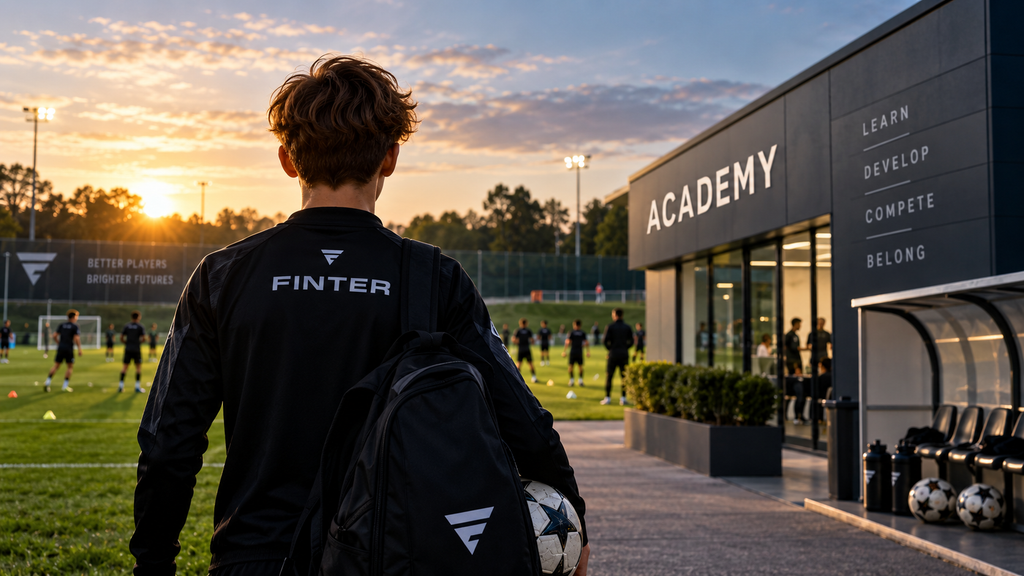
Academy Football Survival Guide – How to Stay, Develop & Win Your Place After a Successful Trial
You made the trial. You earned the opportunity. Now the real development begins.
This is the complete FINTER guide to surviving, learning and progressing inside a football academy or high-level youth environment.
🔥 You Made the Academy. What Happens Now?
For many young footballers, getting into an academy feels like reaching the finish line.
It is not.
It is the beginning of a different challenge.
The training may be faster. Decisions may need to be quicker. Competition for places may become stronger. Coaches may demand more responsibility.
Players who were previously among the strongest in their team can suddenly find themselves surrounded by players who are equally ambitious.
The question is no longer: “Can I get into an academy?”
It becomes: “Can I keep developing once I am there?”
⭐ FINTER Academy Principle
SHOW THAT YOU CAN KEEP DEVELOPING.
Academy football is not only about displaying your strengths.
It is also about responding to new demands.
Can you learn? Can you listen? Can you adapt? Can you recover from mistakes? Can you compete without becoming selfish? Can you keep improving when progress is slow?
🧪 Interactive Academy Survival Check
Tick the statements that currently describe you.
Do not use this as a talent score. Use your unchecked boxes to identify what you can work on next.
🏟️ The First 30 Days in an Academy
Week 1 – Observe
Learn names, routines and expectations. Listen carefully. Notice what coaches repeat.
Week 2 – Understand
Start recognising the principles behind the exercises. Why are you positioned there? Why does the coach want fewer touches? When should you press? Where should you move after passing?
Week 3 – Apply
Try to transfer coaching points into realistic football actions.
Week 4 – Review
- What have I learned?
- What feels easier now?
- Where am I still struggling?
- What does the coach repeatedly correct?
- What should my next development target be?
👀 Academy Football Happens Faster
At higher levels, players often feel that they have less time on the ball.
The solution is not always faster feet. Sometimes you need to see the game earlier.
Scanning helps you recognise:
- pressure
- space
- teammates
- opponents
- passing lanes
- possible turns
- the next action
🎮 Academy Situation #1 – You Are on the Bench
❌ Reaction A – Stop working because the coach clearly does not believe in you
This gives away control. You cannot control every selection decision, but you can control your response.
⚠️ Reaction B – Train twice as much immediately
More is not automatically better. Extra work should have a clear purpose and fit your overall training load.
✅ Reaction C – Ask what you can improve and keep training with quality
This gives you a development target and keeps your attention on what you can control.
🪑 What Should You Do If You Are Benched?
Being benched can feel personal, but selection is part of competitive football.
You may be outside the team because of:
- form
- tactics
- physical development
- position competition
- training performance
- rotation
- injury return
Instead of immediately thinking:
“The coach does not like me.”
Ask something useful:
“What are one or two things I should focus on to improve my chances?”
Feedback is only useful if you turn it into behaviour.
🧠 Coach Trust – How Do Players Earn It?
Coach trust is rarely created by one spectacular action. It often grows through consistent useful behaviour.
🎮 Academy Situation #2 – Another Player Is Ahead of You
❌ “I need them to play badly.”
This turns a teammate into an enemy and shifts attention away from your own development.
⚠️ “I will copy everything they do.”
Learn from strong players, but remember that your position, body and strengths may be different.
✅ “What can I learn from them while still improving my own game?”
This allows competition and learning to exist at the same time.
🤝 Compete Without Becoming Selfish
Academy teammates may also be competing for minutes, contracts or positions.
That creates a strange reality: you compete with them — and you need them.
🗣️ How to Ask a Coach for Feedback
Do not ask only:
“Was I good?”
Ask specific questions:
“What is one thing I could improve when receiving under pressure?”
“What do you want me to do differently when we lose the ball?”
⚽ Train Your Weaknesses Without Losing Your Strengths
Good development keeps your identity while expanding your options.
If your weak foot needs improvement, do not abandon your strong foot.
If your decision-making needs work, do not remove creativity.
If you need better defending, do not stop developing your attacking qualities.
⚽ Build a Personal Session with FINTER Football Training Tool MAX →🔥 Academy Training Standards
“Train harder” does not simply mean doing more.
Strong training includes:
- attention
- intensity
- good decisions
- purposeful repetitions
- realistic pressure
- appropriate recovery
- transfer into football situations
🔥 Warm Up Like Training Matters
The warm-up is not dead time.
It can prepare:
- movement
- coordination
- ball control
- scanning
- passing
- reaction
- intensity
😴 Recovery Is Part of Development
More training is not automatically better development.
Basic recovery includes:
- sleep
- food
- hydration
- appropriate training load
- reporting pain or injury concerns
- rest when needed
Do not hide an injury because you are afraid of losing your place. Speak to the relevant coach, parent or qualified medical professional.
📚 School + Academy Football
Football matters. So do school, family, friendships, recovery and life outside football.
A useful weekly structure can include:
- training
- matches
- travel
- school deadlines
- sleep
- recovery
- free time
Organisation reduces unnecessary stress.
📅 FINTER Weekly Academy Planner
🔄 What If the Coach Changes Your Position?
A position change can feel like criticism. Sometimes it is an opportunity to learn more about the game.
Instead of asking:
“Why am I not playing my normal position?”
Ask:
“What can this position teach me?”
A winger at full-back may learn defending and overlap timing.
A striker playing wide may learn more about 1v1 situations.
A midfielder at centre-back may learn more about build-up, space and communication.
🎯 Position-Specific Academy Development
🧤 Goalkeeper
Develop communication, positioning, distribution, decision-making and your reset after errors.
🛡️ Centre-Back
Develop scanning, body position, communication, defending space, first touch and playing forward under pressure.
🏃 Full-Back / Wing-Back
Develop 1v1 defending, receiving near the touchline, support angles, transitions and attacking timing.
⚙️ Central Midfielder
Develop scanning, body orientation, receiving under pressure, tempo control and awareness of what is behind you.
🎨 Attacking Midfielder
Develop space recognition, turning, combinations, final-third decisions and creativity under pressure.
⚡ Winger
Develop 1v1 quality, acceleration, movement behind defenders, pressing and end product.
🥅 Striker
Develop movement, finishing, pressing, link play, box positioning and the ability to stay involved when chances are limited.
🧠 Football Intelligence Can Separate Players
Technique matters.
But as the level rises, understanding situations becomes increasingly important.
Two players may have similar technical ability. The player who recognises pressure earlier may play faster. The player who sees the next pass earlier may lose the ball less.
🧠 FINTER – Complete Guide to Football Intelligence → 👀 FINTER – Football Scanning Explained →🗣️ Leadership Without the Captain’s Armband
Leadership can be:
- helping a teammate
- giving useful information
- reacting positively after mistakes
- setting standards in training
- being reliable
- taking responsibility
🚨 15 Academy Mistakes to Avoid
- Trying to impress with every touch.
- Comparing yourself with every teammate.
- Stopping your effort when benched.
- Ignoring feedback.
- Arguing with every correction.
- Training extra without considering recovery.
- Hiding injuries.
- Becoming selfish because places are competitive.
- Thinking one bad session means you are failing.
- Thinking one great session means you have made it.
- Only practising strengths.
- Copying another player instead of learning from them.
- Neglecting school or life outside football.
- Losing enjoyment completely.
- Thinking development must happen every week.
🎥 Academy Video Learning Zone
Use video with a purpose. Pick one theme, watch, then take one idea into training.
🎥 Unisport – Academy & Elite Training Videos → 🎥 Unisport – How to Become a Better Footballer → 🎥 Football Academy Training Day Videos → 🎥 Football Scanning & Awareness Training → 🎥 Football Decision-Making Training →❌ What If You Are Released From an Academy?
Being released can feel devastating.
But an academy decision is not a final definition of your ability or future.
Players develop at different speeds. Squad needs change. Physical maturation differs. Coaches and playing styles differ.
If you are released:
- allow yourself to be disappointed
- ask for useful feedback if available
- identify what you can improve
- explore appropriate new environments
- keep football in perspective
- continue only if football is still something you want
👨👩👧 Advice for Parents of Academy Players
Parents can have a huge influence on how a young player experiences academy football.
After training or matches, avoid turning the car journey into a second coaching session.
Useful questions include:
- Did you enjoy it?
- What did you learn?
- Was anything difficult today?
- Is there something you want help with?
The player already has coaches. A parent can provide something different: stability, perspective and support.
🏆 FINTER 30-Day Academy Challenge
Week 1 – Awareness
Focus on scanning and collecting information before receiving.
Week 2 – Decisions
Focus on choosing the strongest football action rather than the most impressive one.
Week 3 – Mentality
Focus on your response after mistakes, benching and difficult sessions.
Week 4 – Coachability
Choose one coaching point and deliberately apply it during training.
🔗 Continue Your Development on FINTER
🧠 The Complete Guide to Football Intelligence → 👀 Football Scanning Explained → ⚽ FINTER Football Training Tool MAX → 🔥 FINTER Football Warm-Up MAX → 🗣️ The Complete Guide to Football Leadership →❓ Academy Football FAQ
How do you stay in a football academy?
There is no guaranteed formula. Focus on development, coachability, consistency, team contribution, learning and responding well to setbacks.
What should I do if I am benched?
Keep training with quality and ask for specific feedback about what you can improve.
Should I do extra training after academy sessions?
Extra training can be useful when it has a clear purpose and fits your overall load. More is not automatically better.
What if another player is better than me?
Use strong teammates as information. Study what they do well, while continuing to develop your own strengths and weaknesses.
How should I react to criticism from a coach?
Listen for the useful information. Ask for clarification if needed, then try to apply the coaching point.
What if my position is changed?
Try to understand what the new role can teach you. Position changes can broaden your football understanding.
What if I am released?
Being released from one academy does not define your entire football future. Seek feedback where possible, identify the next development target and consider appropriate new environments.
How important is football intelligence in academy football?
As the level rises, players often have less time and space. Scanning, awareness, positioning and decision-making can therefore become increasingly important.
Should football be my entire life if I am in an academy?
No. School, family, friendships, recovery and life outside football remain important for young players.
Getting In Is One Achievement. Developing After You Get In Is the Bigger Challenge.
Listen.
Learn.
Compete.
Recover.
Help the team.
Keep your strengths.
Improve your weaknesses.