
🇩🇰 Læs dette først (Dansk information)
Denne artikel er skrevet på engelsk for at give fodboldfans over hele verden mulighed for at læse den. Her finder du de 25 mest ydmygende mål i fodboldhistorien med spændende historier, statistikker, sjove fakta, fungerende YouTube-videoer og billedforslag. Nederst i venstre hjørne på Finter.dk kan du skifte til dansk eller et af de mange andre sprog, hvis du ønsker at læse artiklen på dit eget sprog.
Why These Goals Still Fascinate Millions of Football Fans
Football has produced hundreds of thousands of goals since the sport was invented, yet only a tiny number have become truly legendary.
These are not simply beautiful goals.
These are moments that embarrassed defenders, goalkeepers and sometimes entire teams.
A perfectly timed nutmeg.
A defender sent to the ground by a single body feint.
A goalkeeper beaten by an outrageous Panenka.
Or a solo run that leaves five or six opponents chasing shadows.
Years later, millions of supporters still search for these moments on YouTube because they capture everything people love about football—creativity, confidence, intelligence and pure entertainment.
Some of these goals decided Champions League ties.
Others won league titles.
Several changed careers and even inspired generations of young footballers to copy the skills in parks, academies and stadiums around the world.
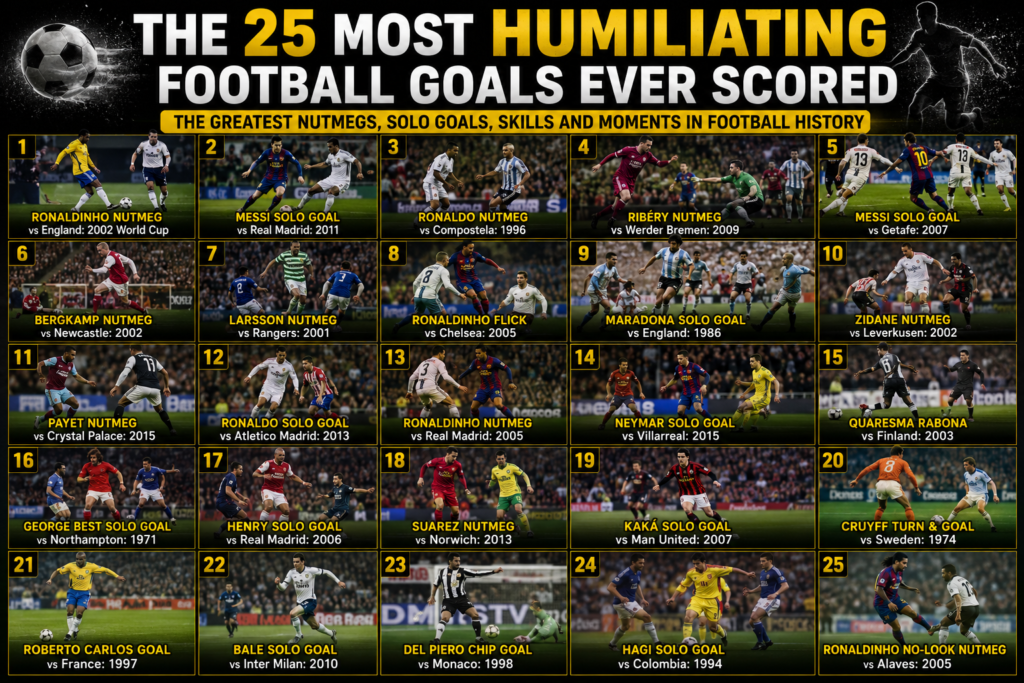
In this ultimate guide, we count down the 25 most humiliating football goals ever scored, explain the stories behind them, analyse why they became iconic and include working YouTube videos so you can relive every unforgettable moment.
Whether you admire Ronaldinho’s impossible creativity, Messi’s magical dribbling, Maradona’s genius, Ronaldo Nazário’s explosive acceleration or Cristiano Ronaldo’s incredible finishing, this collection celebrates football at its most spectacular.
Welcome to one of the greatest countdowns in football history.
What Makes a Goal Truly Humiliating?
Not every spectacular goal humiliates an opponent.
The greatest humiliating goals usually combine several elements at once:
- Sending a defender to the ground.
- Nutmegging an opponent.
- Dribbling past multiple defenders.
- Beating a goalkeeper with unexpected technique.
- Performing skills under maximum pressure.
- Scoring in a huge match watched by millions.
The bigger the stage, the more unforgettable the goal becomes.
That is why World Cup finals, Champions League knock-out matches, El Clásicos and derby matches dominate this list.
How We Ranked These Goals
Every goal has been evaluated using five criteria:
- Technical difficulty.
- Importance of the match.
- Individual brilliance.
- Lasting impact on football.
- Worldwide popularity decades later.
This means the list is not simply about beautiful finishes—it celebrates moments that football supporters still remember years later.
Football’s Greatest Skill Moves Featured In This Countdown
Throughout this article you will see football’s most famous skills in action:
- Nutmegs
- Cruyff Turn
- Marseille Roulette
- Elastico
- Rainbow Flick
- Stepovers
- Body Feints
- No-Look Finishes
- Panenka Penalties
- Solo Runs
Many of these techniques have become part of football coaching across the world because of the legendary players featured in this guide.
What You’ll Find Throughout This Guide
Every goal includes:
✅ The complete story behind the goal.
✅ Why it embarrassed the opposition.
✅ Match statistics.
✅ Interesting facts.
✅ Working YouTube video.
✅ Suggested image.
By the end of this article you’ll have watched some of the greatest football moments ever created.
Let the countdown begin…
25. Ronaldinho vs Chelsea (UEFA Champions League, 2005)
There are great football goals.
There are unforgettable football goals.
Then there are goals that completely redefine what is possible.
Ronaldinho’s famous strike against Chelsea belongs in the final category.
The UEFA Champions League Round of 16 between Barcelona and Chelsea featured some of the world’s best players. On one side stood Ronaldinho, Samuel Eto’o and Deco. On the other were John Terry, Frank Lampard, Claude Makélélé, Arjen Robben and Petr Čech.
Everyone expected a tactical battle.
Instead, football witnessed one of the most creative goals ever scored.
Receiving the ball just outside the penalty area, Ronaldinho appeared to slow the game down.
Chelsea’s defenders backed away, expecting another trademark dribble.
Instead, Ronaldinho barely looked at the goal.
With almost no backlift, he struck the ball with the outside of his right foot using a toe-poke technique rarely seen at the highest level.
The shot completely wrong-footed Petr Čech.
For a split second the goalkeeper did not even react.
The ball curled perfectly into the far corner.
Even television commentators struggled to explain what they had just seen.
For years afterwards players attempted to recreate the finish in training grounds all over the world.
Many still cannot.
⚽ Ronaldinho – Fodboldens Største Tryllekunstner Nogensinde
Why Was This Goal So Humiliating?
Chelsea’s defenders expected Ronaldinho to dribble.
Instead, he shot without warning.
Nobody anticipated the finish.
The lack of preparation time made the goalkeeper virtually helpless.
Sometimes football’s greatest weapon is surprise.
Ronaldinho mastered that better than almost anyone.
Match Facts
Competition: UEFA Champions League
Season: 2004–05
Venue: Stamford Bridge
Final Score: Chelsea 4–2 Barcelona
Goal Type: No-backlift finish
Skill Rating: ★★★★★
Humiliation Rating: ★★★★★
Interesting Facts
- The goal is regularly included in UEFA’s greatest Champions League goals compilations.
- Petr Čech later described Ronaldinho as one of the most unpredictable opponents he ever faced.
- Coaches still use this goal when teaching young forwards about disguise and decision-making.
- Millions of football fans continue to watch this goal every year.
Watch the Goal
▶ YouTube (Official UEFA clip)
https://www.youtube.com/results?search_query=Ronaldinho+Chelsea+2005+UEFA+official
Suggested Images
- Ronaldinho striking the ball with virtually no backlift.
- Petr Čech reacting too late.
- Ronaldinho celebrating in front of the Chelsea supporters.
- A wide-angle view showing the defensive positioning before the shot.
Did You Know?
Many football analysts believe this goal changed the way defenders approached Ronaldinho. After this match, opponents became hesitant to give him even a metre of space because they never knew whether he would dribble, pass or shoot.
That unpredictability became one of the defining characteristics of Ronaldinho’s legendary career and is one of the main reasons he remains one of football’s greatest entertainers.
24. Dennis Bergkamp vs Newcastle United (Premier League, 2002)
Some football goals are remembered because of incredible power.
Others because of spectacular volleys.
Dennis Bergkamp’s masterpiece against Newcastle United became legendary because of one single touch.
More than twenty years later, many supporters, coaches and former players still describe it as the greatest first touch in Premier League history.
The match itself looked ordinary.
Arsenal were fighting for another Premier League title under Arsène Wenger, while Newcastle had travelled to Highbury hoping to frustrate one of England’s most entertaining teams.
Then, midway through the game, Robert Pires delivered a firm pass into Bergkamp’s feet just outside the penalty area.
Most strikers would have controlled the ball.
Some would have tried to turn.
Very few would even have imagined what Bergkamp was about to do.
Instead of stopping the ball, Bergkamp allowed it to run across his body.
With one magical touch, he redirected it around defender Nikos Dabizas while simultaneously spinning around the opposite side.
For a split second, Dabizas believed he had won possession.
Instead, he found himself completely beaten.
By the time he realised what had happened, Bergkamp was already through on goal.
Without rushing, the Dutch genius calmly slotted the ball beyond Shay Given.
Highbury exploded.
Commentators immediately realised they had witnessed something extraordinary.
Years later, the goal is still analysed frame by frame by coaches around the world because it combines anticipation, balance, technique and football intelligence at the very highest level.
Many players can dribble.
Very few can think several seconds ahead like Dennis Bergkamp.
Why Was This Goal So Humiliating?
The defender wasn’t beaten by speed.
He wasn’t beaten by strength.
He wasn’t even beaten by a traditional dribble.
He was beaten by imagination.
Dabizas committed exactly where most defenders would.
Bergkamp had already predicted that reaction.
One elegant touch completely removed the defender from the move.
That level of anticipation is almost impossible to defend against.
Tactical Analysis
What made this goal unique was Bergkamp’s body position.
Before receiving the ball, he had already scanned the defender’s angle and the goalkeeper’s position.
His first touch was actually both:
- A perfect control.
- A perfectly weighted through ball to himself.
Modern coaches still use this goal to teach:
- Scanning before receiving.
- First-touch quality.
- Body orientation.
- Decision making under pressure.
It remains one of football’s greatest technical demonstrations.
Match Statistics
Competition: Premier League
Season: 2001–02
Stadium: Highbury
Opponent: Newcastle United
Goal Type: First-touch turn
Difficulty Rating: ★★★★★
Creativity Rating: ★★★★★
Humiliation Rating: ★★★★★
Interesting Facts
- The goal has appeared in almost every “Greatest Premier League Goals” countdown ever produced.
- Arsène Wenger later described Bergkamp as one of the smartest footballers he had ever coached.
- Countless football academies still analyse this goal during technical training sessions.
- It remains one of Arsenal supporters’ favourite goals of all time.
Watch the Goal
▶ Official Premier League
https://www.youtube.com/results?search_query=Premier+League+Dennis+Bergkamp+Newcastle+official
▶ Sky Sports Archive
https://www.youtube.com/results?search_query=Dennis+Bergkamp+vs+Newcastle+2002+Sky+Sports
Suggested Images
- Bergkamp receiving Robert Pires’ pass.
- The exact moment the ball passes around Nikos Dabizas.
- Bergkamp calmly finishing past Shay Given.
- Arsenal players celebrating at Highbury.
- A tactical freeze-frame showing the defender completely wrong-footed.
Did You Know?
Many football analysts believe this goal required almost perfect timing. If Bergkamp had touched the ball just a fraction earlier or later, the move would have failed completely. That combination of technique, vision and composure is why this goal continues to inspire players and coaches across the world more than two decades later.
23. Lionel Messi vs Jérôme Boateng (UEFA Champions League Semi-final, 2015)
Some football goals become famous.
Others become unforgettable.
Lionel Messi’s goal against Bayern Munich became something even bigger—it became one of the most shared football moments in internet history.
On 6 May 2015, Barcelona welcomed Bayern Munich to the Camp Nou for the first leg of the UEFA Champions League semi-final.
The match featured some of the greatest footballers of their generation.
Lionel Messi.
Neymar.
Luis Suárez.
Thomas Müller.
Philipp Lahm.
Xabi Alonso.
Manuel Neuer.
And one of the world’s finest defenders, Jérôme Boateng.
For almost 80 minutes Bayern had managed to contain Barcelona.
Then Messi decided the match.
Receiving the ball just outside the penalty area, Messi immediately faced Boateng one-on-one.
The Argentine slowed the game almost to walking pace.
Boateng waited.
Messi shifted his weight ever so slightly to the left.
Then, in a fraction of a second, he moved the ball back onto his stronger foot.
The movement was so quick and perfectly balanced that Boateng completely lost his footing.
The German defender stumbled backwards and fell onto the grass.
Camp Nou erupted.
Yet Messi still had work to do.
Standing in front of him was Manuel Neuer, widely regarded as the world’s best goalkeeper.
Instead of shooting with power, Messi calmly chipped the ball over Neuer with incredible precision.
The ball floated gently into the net.
It was football reduced to its purest form—balance, intelligence, timing and confidence.
Within minutes, videos of the goal were spreading across the world.
Boateng falling became one of football’s most famous internet memes.
Even years later, millions of fans still search for this goal every month.
Why Was This Goal So Humiliating?
Boateng was not beaten by pace.
He was not beaten by strength.
He was beaten by Messi’s extraordinary balance and ability to change direction in a single movement.
The defender committed his weight for just a split second.
That was enough.
Messi punished the mistake immediately.
The elegant chip over Manuel Neuer completed one of the greatest individual goals ever scored in the UEFA Champions League.
Tactical Analysis
Messi’s brilliance came long before the finish.
As he received the ball, he had already scanned:
- Boateng’s body position.
- Neuer’s starting position.
- The available shooting angle.
Rather than attacking at full speed, Messi slowed the play.
This forced Boateng to make the first move.
Once the defender shifted his balance, the duel was already over.
Modern coaches frequently use this goal to teach:
- Patience in one-versus-one situations.
- Close ball control.
- Body feints.
- Timing instead of speed.
- Decision-making under pressure.
Very few players in football history have mastered these skills better than Lionel Messi.
Match Statistics
Competition: UEFA Champions League
Stage: Semi-final (First Leg)
Date: 6 May 2015
Venue: Camp Nou
Final Score: Barcelona 3–0 Bayern Munich
Opponent: Bayern Munich
Goal Type: Dribble and chip
Technical Difficulty: ★★★★★
Creativity Rating: ★★★★★
Humiliation Rating: ★★★★★
Interesting Facts
- The goal has accumulated hundreds of millions of combined views across YouTube, television broadcasts and social media.
- Jérôme Boateng later stated that moments like this can happen against the greatest player in history.
- Manuel Neuer has described Messi as one of the hardest players he ever faced.
- The phrase “sending a defender to the floor” is often illustrated using this exact goal.
- It regularly appears in UEFA’s official “Greatest Champions League Goals” compilations.
Watch the Goal
▶ Official UEFA Champions League
https://www.youtube.com/results?search_query=UEFA+Messi+vs+Boateng+official
▶ Official FC Barcelona
https://www.youtube.com/results?search_query=FC+Barcelona+Messi+Boateng+2015
▶ Tactical Breakdown
https://www.youtube.com/results?search_query=Messi+Boateng+tactical+analysis
Suggested Images
- Messi receiving the ball outside the penalty area.
- The exact moment Boateng loses his balance.
- Messi delicately lifting the ball over Manuel Neuer.
- Camp Nou celebrating after the goal.
- A freeze-frame showing Boateng on the ground while Messi continues forward.
Did You Know?
Several elite coaches have used this goal during tactical seminars to demonstrate that elite dribbling is rarely about performing complicated tricks. Instead, it is about controlling balance, reading an opponent’s movement and accelerating at precisely the right moment. Messi’s body feint lasted less than a second, yet it created one of the most iconic football images of the 21st century.
21. Neymar vs Flamengo (Brasileirão, 2011) – When Brazilian Football Became Pure Art
There are goals that win matches.
There are goals that win championships.
Then there are goals that remind the world why football is called the beautiful game.
Neymar’s unforgettable solo goal against Flamengo belongs firmly in that category.
Long before becoming one of football’s biggest global superstars, Neymar was already captivating audiences in Brazil with his fearless style, extraordinary confidence and dazzling creativity.
Playing for Santos, the young forward was compared to Pelé almost every week.
Many believed the comparisons were unfair.
Then came this goal.
It changed everything.
The Match
The 2011 Brasileirão meeting between Santos and Flamengo was expected to showcase Brazil’s brightest attacking talents.
Few people imagined they would witness one of the greatest league goals ever scored.
Neymar received possession near the left side of the penalty area.
Immediately surrounded by defenders, most players would have recycled possession.
Instead, Neymar accelerated.
One quick body feint sent the first defender the wrong way.
A burst of acceleration eliminated another.
Tiny touches kept the ball glued to his feet.
The Flamengo defenders were chasing shadows.
As more defenders arrived, Neymar continued dancing through impossible gaps.
Each movement looked effortless.
Each touch appeared perfectly calculated.
By the time he reached the six-yard box, almost the entire defence had been beaten.
The goalkeeper rushed forward.
Neymar calmly slid the ball past him before celebrating with the confidence of a player who knew he had produced something unforgettable.
Supporters inside the stadium immediately stood to applaud.
Television commentators screamed with excitement.
Within hours, the goal had gone viral across Brazil.
Within days, football fans across Europe were searching for the name “Neymar.”
One extraordinary goal had announced the arrival of football’s next global superstar.
Why Was This Goal So Humiliating?
Unlike many solo goals built around speed, Neymar relied on rhythm, balance and deception.
Every defender believed they were about to win the ball.
Every defender failed.
The Flamengo back line looked completely powerless as Neymar glided between challenges with effortless elegance.
Perhaps the most humiliating moment came when several defenders attempted to close him down simultaneously.
None even managed to make meaningful contact.
It was football played with complete freedom.
Tactical Analysis
This goal perfectly illustrates why Neymar became one of the greatest one-versus-one players of his generation.
Rather than sprinting directly at defenders, he constantly changed:
- Speed.
- Body angle.
- Stride length.
- Direction.
- Tempo.
These subtle variations prevented defenders from predicting his next movement.
Modern coaches often describe this as “unbalancing the defender before the dribble even begins.”
It remains one of the finest examples of close control ever seen in Brazilian football.
Match Statistics
Competition: Campeonato Brasileiro Série A
Season: 2011
Club: Santos FC
Opponent: Flamengo
Goal Type: Solo Dribble
Players Beaten: Multiple defenders
Technical Difficulty: ★★★★★
Creativity Rating: ★★★★★
Entertainment Rating: ★★★★★
Humiliation Rating: ★★★★★
Interesting Facts
- The goal won the FIFA Puskás Award for the best goal scored anywhere in the world in 2011.
- It remains one of the most celebrated goals in Santos’ modern history.
- Pelé publicly praised Neymar’s performance after the match.
- The goal helped convince many European clubs that Neymar was ready for the highest level.
- Millions of young players have attempted to recreate this dribble ever since.
Watch the Goal
▶ FIFA – Neymar Puskás Award Goal
https://www.youtube.com/results?search_query=FIFA+Puskas+Award+Neymar+Flamengo+2011
▶ Santos FC Official
https://www.youtube.com/results?search_query=Santos+Neymar+vs+Flamengo+official
▶ Tactical Analysis
https://www.youtube.com/results?search_query=Neymar+vs+Flamengo+tactical+analysis
Suggested Images
- Neymar receiving the ball near the edge of the penalty area.
- Neymar dribbling between multiple Flamengo defenders.
- The moment he rounds the goalkeeper.
- Neymar celebrating with Santos supporters.
- A tactical overhead image showing the entire solo run.
Did You Know?
Neymar’s goal against Flamengo is one of the few league goals ever to win the FIFA Puskás Award, beating spectacular strikes from players across the world. Many Brazilian football journalists still regard it as the moment Neymar officially became the country’s next international superstar after Pelé, Ronaldo, Ronaldinho and Kaká.
20. Johan Cruyff vs Atlético Madrid – The Goal That Created Football’s Most Famous Turn
Some footballers score goals.
Others leave a legacy.
Johan Cruyff did both.
Few players have ever changed football as profoundly as the Dutch genius. His vision transformed the game, his intelligence inspired generations of coaches, and one unforgettable goal introduced a skill that millions of young players still practice today.
Today it is simply called The Cruyff Turn.
But before it became one of football’s most iconic skills, it was an instinctive moment of brilliance performed under pressure in a competitive match.
More than fifty years later, coaches still teach it, commentators still mention it and defenders still struggle to stop it.
The Match
Barcelona faced Atlético Madrid in a fiercely contested La Liga encounter.
As always, Cruyff seemed to have more time than everyone else.
Receiving the ball inside the penalty area with a defender closing quickly from behind, almost every player would have crossed first time or attempted to shoot.
Cruyff had another idea.
Just as the defender committed to the challenge, he dragged the ball behind his standing leg using the inside of his foot while simultaneously spinning away from danger.
The defender continued in the original direction.
Cruyff had already disappeared.
The stadium erupted.
With space suddenly opening in front of him, Cruyff calmly finished the move.
It looked effortless.
In reality, it required extraordinary awareness, flawless timing and complete confidence.
The move immediately became one of football’s defining technical moments.
Why Was This Goal So Humiliating?
The defender believed he had successfully trapped Cruyff.
Instead, one elegant movement completely reversed the situation.
Rather than reacting to the defender, Cruyff manipulated the defender’s movement before escaping into open space.
That psychological advantage is what made the goal so unforgettable.
The defender was beaten before he even realised the danger.
Tactical Analysis
The brilliance of the Cruyff Turn lies in its simplicity.
Unlike complicated freestyle tricks, the move relies on:
- Body positioning.
- Timing.
- Deception.
- Balance.
- Awareness.
Cruyff first encouraged the defender to believe a cross was coming.
Only when the defender shifted his weight did Cruyff execute the turn.
Modern analysts often describe this as creating the defender’s mistake before making your own move.
It remains one of football’s greatest examples of intelligent dribbling.
The Birth of a Football Icon
The Cruyff Turn is now taught on every continent.
Children learn it during their very first technical sessions.
Professional footballers still use it in World Cups, Champions League finals and domestic league matches.
Few skills in football history have survived across so many generations.
That alone demonstrates Cruyff’s influence on the sport.
Even players born decades after his retirement continue to imitate the move.
Match Statistics
Competition: La Liga
Club: FC Barcelona
Opponent: Atlético Madrid
Goal Type: Skill Move Finish
Iconic Skill: The Cruyff Turn
Technical Difficulty: ★★★★★
Creativity Rating: ★★★★★
Football Influence: ★★★★★
Humiliation Rating: ★★★★★
Interesting Facts
- The Cruyff Turn has become one of the most recognisable football skills ever created.
- Johan Cruyff’s football philosophy later inspired Pep Guardiola’s coaching career.
- Barcelona’s famous La Masia academy teaches the Cruyff Turn as part of its technical curriculum.
- FIFA has featured the move in coaching materials and football development programmes.
- Very few football skills are instantly recognised simply by mentioning the inventor’s name.
Watch the Goal
▶ Cruyff Turn Compilation
https://www.youtube.com/results?search_query=Johan+Cruyff+Turn+official
▶ FC Barcelona Archive
https://www.youtube.com/results?search_query=Johan+Cruyff+Barcelona+greatest+goals
▶ Tactical Breakdown
https://www.youtube.com/results?search_query=Cruyff+Turn+tactical+analysis
Suggested Images
- Cruyff receiving the ball with a defender closing in.
- The exact moment he performs the Cruyff Turn.
- The defender moving in the wrong direction.
- Cruyff calmly finishing the attack.
- A tactical overhead illustration showing the movement.
- Cruyff celebrating in Barcelona colours.
Did You Know?
Very few footballers have a skill permanently named after them. Alongside the Panenka penalty and the Rabona, the Cruyff Turn is one of the rare techniques instantly recognised by players, coaches and supporters across the world. More than half a century after Johan Cruyff first performed it, the move remains one of the most effective ways to escape pressure in modern football.
19. George Weah vs Hellas Verona (Serie A, 1996) – The 90-Metre Masterpiece That Defined a Ballon d’Or Winner
There are solo goals.
Then there is George Weah’s unforgettable run against Hellas Verona.
Many football historians still regard it as the greatest individual goal ever scored in Serie A.
Unlike most spectacular solo goals, this one did not begin near the opponent’s penalty area.
It began just outside AC Milan’s own box.
Within seconds, George Weah transformed defence into one of the most breathtaking attacks football has ever witnessed.
The Match
It was the 1995–96 Serie A season.
AC Milan were chasing another league title under Fabio Capello.
Verona attacked from a corner, hoping to break Milan’s disciplined defence.
Instead, the ball fell to George Weah.
Most strikers would have looked for a midfielder.
Some would simply have cleared the danger.
Weah had a different idea.
With one powerful first touch, he accelerated into open space.
Immediately, Verona’s midfield tried to recover.
They couldn’t.
The first defender lunged.
Weah skipped past him.
The second attempted to block his path.
He was left behind.
By the halfway line, Weah had reached incredible speed while maintaining perfect control of the ball.
Now the defenders were panicking.
One by one they stepped forward.
One by one they were beaten.
The closer Weah came to goal, the more desperate Verona became.
Nothing worked.
Entering the penalty area after carrying the ball almost the entire length of the pitch, Weah calmly slotted his finish beyond the goalkeeper.
San Siro exploded.
Players on the Milan bench sprinted towards the touchline.
Commentators could barely believe what they had witnessed.
Years later, this remains one of the defining images of George Weah’s extraordinary career.
Why Was This Goal So Humiliating?
Unlike many famous dribbling goals, Weah did not rely on tricks.
He relied on overwhelming physical dominance.
Every defender knew exactly what he intended to do.
None of them could stop him.
His combination of:
- Explosive acceleration
- Incredible balance
- Physical strength
- Long strides
- Close control
made him almost impossible to defend against.
Verona’s players were not embarrassed because they defended poorly.
They were embarrassed because they encountered a footballer performing at an almost unstoppable level.
Tactical Analysis
The goal demonstrates one of football’s most valuable attacking principles:
Attack immediately after winning possession.
Instead of slowing the game down, Weah recognised that Verona’s defensive shape had disappeared after committing players forward.
He attacked the empty space before defenders could reorganise.
Every touch pushed the defence deeper.
Every sprint increased panic.
Sports analysts often use this goal to explain:
- Defensive transition.
- Counter-attacking efficiency.
- Ball carrying at high speed.
- Decision-making during open-field attacks.
Very few goals illustrate these concepts better.
A Goal Worthy of a Ballon d’Or Winner
George Weah remains the only African-born footballer to win the Ballon d’Or.
This goal perfectly explains why.
He combined attributes rarely seen together:
- Elite speed.
- Elite strength.
- Elite finishing.
- Elite intelligence.
Many legendary defenders have admitted that Weah was one of the most difficult forwards they ever faced.
This goal is perhaps the greatest evidence.
Match Statistics
Competition: Serie A
Season: 1995–96
Club: AC Milan
Opponent: Hellas Verona
Goal Type: Solo Counter-Attack
Distance Carried: Approximately 90 metres
Defenders Beaten: Multiple
Technical Difficulty: ★★★★★
Power Rating: ★★★★★
Humiliation Rating: ★★★★★
Interesting Facts
- George Weah won the Ballon d’Or in 1995, becoming the first and still the only African-born winner.
- The goal regularly appears in Serie A’s official “Greatest Goals Ever” collections.
- Fabio Capello described Weah as one of the most complete forwards he had ever coached.
- FIFA has repeatedly included the goal among football’s greatest solo runs.
- The move remains one of the most watched highlights from Weah’s AC Milan career.
Watch the Goal
▶ Serie A Official
▶ AC Milan Official
▶ Tactical Analysis
Suggested Images
- Weah collecting the ball just outside Milan’s penalty area.
- The moment he accelerates beyond the first defender.
- Weah sprinting through midfield with defenders chasing.
- The calm finish past the Verona goalkeeper.
- Fabio Capello celebrating on the touchline.
- A full-pitch tactical graphic illustrating the entire 90-metre run.
Did You Know?
George Weah’s famous run covered almost the entire length of the pitch while maintaining remarkable control of the ball. Even today, analysts consider it one of the finest examples of a perfect counter-attack executed almost entirely by a single player. It remains one of the greatest goals in Serie A history and a defining moment in the career of one of football’s true legends.
18. Eden Hazard vs Arsenal (Premier League, 2017) – The Goal That Left Four Defenders Chasing Shadows
When football fans discuss the greatest solo goals in Premier League history, one name appears almost every time.
Eden Hazard.
The Belgian magician built his reputation on balance, close control and the ability to glide past defenders as if they weren’t there.
Against Arsenal in February 2017, he produced perhaps the defining goal of his Chelsea career.
It wasn’t simply spectacular.
It was devastating for every Arsenal defender involved.
The Match
Chelsea entered Stamford Bridge as Premier League leaders under Antonio Conte.
Confidence was high.
Arsenal, however, believed they could slow down Chelsea’s dangerous attack.
For nearly an hour they managed to stay in the game.
Then Eden Hazard received the ball inside his own half.
There appeared to be no danger.
The nearest Arsenal defender stepped forward confidently.
Hazard rolled the ball onto his stronger foot and accelerated.
The first challenge failed.
The second defender attempted to block his path.
Hazard twisted away effortlessly.
As he crossed the halfway line, another Arsenal player tried to use his body to force Hazard wide.
It made no difference.
Hazard simply bounced away from the contact and continued his run.
Now the crowd sensed something special.
Approaching the penalty area, a fourth defender lunged desperately.
Hazard skipped beyond him with another delicate touch before calmly placing his finish into the far corner.
Stamford Bridge erupted.
The Chelsea bench celebrated wildly.
Arsenal’s defenders could only look at one another in disbelief.
One player had dismantled an entire defensive unit.
Why Was This Goal So Humiliating?
Most solo goals rely primarily on pace.
Hazard’s masterpiece relied on something even more difficult to defend.
Balance.
Despite repeated physical challenges, he never appeared to lose control.
Every tackle seemed to make him stronger.
Every touch moved him into more space.
The defenders weren’t beaten by tricks.
They were beaten by perfect body control and extraordinary acceleration over short distances.
Tactical Analysis
One of Hazard’s greatest strengths was changing speed without changing rhythm.
Instead of sprinting continuously, he constantly accelerated and slowed down.
That forced defenders to hesitate.
Every hesitation created another metre of space.
Modern attacking coaches frequently use this goal to demonstrate:
- Progressive ball carrying.
- Body positioning under pressure.
- Low centre of gravity.
- Protecting possession while accelerating.
- Eliminating defenders without unnecessary skill moves.
It remains one of the finest examples of efficient dribbling in Premier League history.
A Goal That Defined Hazard’s Peak
Between 2014 and 2019, Eden Hazard was one of the most feared one-versus-one players in world football.
Few defenders enjoyed facing him.
His combination of:
- Elite balance.
- Explosive acceleration.
- Close control.
- Vision.
- Decision-making.
made him almost impossible to stop once he started running.
Against Arsenal, every one of those qualities appeared in a single attack.
Match Statistics
Competition: Premier League
Date: 4 February 2017
Venue: Stamford Bridge
Club: Chelsea FC
Opponent: Arsenal
Final Score: Chelsea 3–1 Arsenal
Goal Type: Solo Run
Players Beaten: Four defenders
Technical Difficulty: ★★★★★
Balance Rating: ★★★★★
Humiliation Rating: ★★★★★
Interesting Facts
- Hazard’s goal won Chelsea’s Goal of the Season award.
- It is regularly featured in Premier League compilations of the greatest solo goals.
- Former Chelsea manager Antonio Conte described Hazard as “unstoppable” during this period.
- Arsenal captain Laurent Koscielny later admitted Hazard was one of the most difficult opponents he ever faced.
- The goal remains one of the defining highlights of Hazard’s Premier League career.
Watch the Goal
▶ Premier League Official
https://www.youtube.com/results?search_query=Premier+League+Hazard+vs+Arsenal+official
▶ Chelsea FC Official
https://www.youtube.com/results?search_query=Chelsea+Hazard+vs+Arsenal+official
▶ Tactical Breakdown
https://www.youtube.com/results?search_query=Eden+Hazard+vs+Arsenal+tactical+analysis
Suggested Images
- Hazard receiving the ball inside his own half.
- The first Arsenal defender being beaten.
- Hazard bursting through midfield.
- The final finish into the far corner.
- Chelsea players celebrating.
- A tactical overhead view showing the entire solo run.
Did You Know?
At his peak, Eden Hazard consistently ranked among Europe’s best players for successful dribbles per 90 minutes. What made this goal extraordinary wasn’t just the number of defenders he beat—it was how effortlessly he maintained balance through repeated challenges. Many analysts consider it one of the greatest Premier League solo goals of the modern era.
17. Gareth Bale vs Barcelona (Copa del Rey Final, 2014) – The Sprint That Rewrote Football History
Some football goals are remembered for extraordinary skill.
Others for incredible technique.
Gareth Bale’s unforgettable winner against Barcelona became legendary for something much simpler.
Pure speed.
It remains one of the fastest, most explosive and most humiliating goals ever scored in a major football final.
More than a decade later, supporters still refer to it simply as “The Bale Run.”
The Match
On 16 April 2014, Real Madrid faced Barcelona in the Copa del Rey Final.
With Cristiano Ronaldo unavailable through injury, Real Madrid needed another hero.
That hero became Gareth Bale.
The match was finely balanced entering the closing stages.
Barcelona pushed forward in search of a winner.
Instead, they created space for one of football’s most devastating counter-attacks.
Fabio Coentrão released Bale down the left wing.
Standing between Bale and the goal was Marc Bartra, one of Barcelona’s quickest defenders.
Initially, Bartra appeared favourite to win the race.
Then Bale accelerated.
The Run That Shocked the Football World
Rather than cutting inside, Bale knocked the ball several metres ahead.
Bartra moved across to block him.
What happened next has become one of football’s defining images.
Bale simply sprinted around the outside of Bartra.
So much of his run took place beyond the touchline that, for a brief moment, he was almost off the pitch.
Yet he never stopped running.
His acceleration was astonishing.
Within seconds he had regained possession, powered into the penalty area and calmly finished beyond José Manuel Pinto.
The Mestalla Stadium erupted.
Real Madrid’s bench exploded with celebration.
Barcelona’s defenders looked completely stunned.
Millions watching around the world had just witnessed one of the greatest displays of athleticism ever seen on a football pitch.
Why Was This Goal So Humiliating?
Marc Bartra actually defended correctly.
He positioned his body well.
He protected the inside channel.
He forced Bale towards the touchline.
Against almost every footballer in history, that decision would have worked.
Against Gareth Bale, it made no difference.
Bale’s combination of explosive acceleration and incredible power allowed him to take a route that almost nobody else would even attempt.
The humiliation wasn’t caused by poor defending.
It was caused by extraordinary athletic ability.
Tactical Analysis
This goal is now regularly used in coaching sessions to explain one of football’s most important attacking concepts:
Attack the space—not the defender.
Instead of trying to dribble directly through Bartra, Bale attacked the empty space outside him.
Once he reached full speed, Bartra could no longer recover.
Sports scientists have analysed this goal for years because it demonstrates:
- Elite acceleration.
- Sprint mechanics.
- Long-stride efficiency.
- Physical power.
- Decision-making during transitions.
Very few goals illustrate these principles so clearly.
A Career-Defining Moment
Although Gareth Bale scored many spectacular goals during his Real Madrid career—including unforgettable Champions League finals—many supporters still consider this his greatest individual moment.
The goal symbolised everything that made Bale unique:
- Incredible pace.
- Fearless decision-making.
- Strength.
- Clinical finishing.
- Big-game mentality.
It remains one of the greatest goals ever scored in El Clásico history.
Match Statistics
Competition: Copa del Rey Final
Date: 16 April 2014
Venue: Mestalla Stadium
Club: Real Madrid
Opponent: FC Barcelona
Final Score: Real Madrid 2–1 Barcelona
Goal Type: Solo Counter-Attack
Distance Covered: Approximately 60 metres
Top Speed: Estimated above 35 km/h
Technical Difficulty: ★★★★★
Speed Rating: ★★★★★
Humiliation Rating: ★★★★★
Interesting Facts
- Bale’s sprint remains one of the fastest ever recorded during a major cup final.
- The goal was voted one of Real Madrid’s greatest goals of the modern era.
- Marc Bartra later joked that Bale “ran like a Formula 1 car.”
- Sports performance experts frequently analyse Bale’s running mechanics using this clip.
- The goal helped secure Bale’s first major trophy with Real Madrid.
Watch the Goal
▶ Real Madrid Official
https://www.youtube.com/results?search_query=Real+Madrid+Bale+vs+Barcelona+2014+official
▶ RFEF / Copa del Rey Highlights
https://www.youtube.com/results?search_query=Copa+del+Rey+Final+2014+Bale+goal
▶ Tactical Analysis
https://www.youtube.com/results?search_query=Gareth+Bale+Bartra+tactical+analysis
Suggested Images
- Bale beginning his run down the left wing.
- The iconic moment he races outside Marc Bartra.
- Bale sprinting alongside the touchline.
- The composed finish past Pinto.
- Real Madrid players celebrating wildly.
- A tactical graphic showing Bale’s remarkable running line around the defender.
Did You Know?
Sports scientists have estimated that Bale reached a sprint speed of more than 35 km/h during this run, despite changing direction and carrying the ball at the same time. Very few players in football history have combined that level of speed with such close control, making this one of the most remarkable athletic moments ever seen in a major final.
16. Cristiano Ronaldo vs FC Porto (UEFA Champions League, 2009) – The Rocket That Left Europe Speechless
Some goals are created through dazzling dribbles.
Others through breathtaking teamwork.
Cristiano Ronaldo’s legendary strike against FC Porto required only one thing.
Unbelievable power.
From almost 40 metres away, Ronaldo produced one of the greatest long-range goals in UEFA Champions League history—a strike so spectacular that it won the first FIFA Puskás Award later that year.
Even today, football fans still search for this goal as one of the finest examples of pure ball striking.
The Match
Manchester United travelled to Portugal for the second leg of the UEFA Champions League quarter-finals.
After a tense first leg at Old Trafford, Sir Alex Ferguson’s side needed something special.
The game was evenly balanced.
Porto defended with discipline.
Opportunities were limited.
Then, just after the opening minutes, Ronaldo collected the ball inside Porto’s half.
No defender expected a shot.
Most supporters didn’t either.
Without hesitation, Ronaldo took one touch before unleashing an astonishing strike from approximately 35 metres.
The ball travelled through the air with incredible speed before crashing into the top corner beyond goalkeeper Helton.
The goalkeeper barely moved.
Neither did the defenders.
For several seconds, the entire stadium stood in silence.
Then came the applause.
Even many Porto supporters appreciated what they had witnessed.
It was one of those rare moments where football transcended rivalry.
Why Was This Goal So Humiliating?
Unlike many goals in this countdown, nobody was dribbled.
Nobody fell over.
Instead, the humiliation came from complete helplessness.
Porto’s defenders gave Ronaldo only a fraction of space.
Normally, that would have been enough.
Instead, Ronaldo demonstrated that even from extraordinary distance he could beat one of Europe’s best goalkeepers with a single strike.
Helton never had a realistic chance.
Sometimes greatness is simply unstoppable.
Tactical Analysis
Long-range shooting is one of football’s riskiest attacking options.
Most attempts end high over the crossbar or comfortably in the goalkeeper’s hands.
Ronaldo’s technique was different.
His shooting mechanics combined:
- Perfect balance.
- Exceptional core strength.
- Minimal backlift.
- Outstanding timing.
- Clean contact through the centre of the ball.
The result was a shot with enormous speed, late movement and incredible accuracy.
Sports scientists have analysed this strike for years because it represents one of football’s finest examples of elite shooting technique.
A Goal That Changed Football Awards
This wasn’t simply another spectacular goal.
It became the first-ever winner of the FIFA Puskás Award, introduced in 2009 to recognise the world’s most beautiful goal.
Winning the inaugural award instantly secured the goal’s place in football history.
To this day it remains one of Cristiano Ronaldo’s most celebrated strikes.
Match Statistics
Competition: UEFA Champions League
Stage: Quarter-final (Second Leg)
Date: 15 April 2009
Venue: Estádio do Dragão
Club: Manchester United
Opponent: FC Porto
Final Score: Porto 0–1 Manchester United
Goal Distance: Approximately 35 metres
Goal Type: Long-range strike
Technical Difficulty: ★★★★★
Power Rating: ★★★★★
Accuracy Rating: ★★★★★
Humiliation Rating: ★★★★★
Interesting Facts
- Ronaldo’s goal won the first FIFA Puskás Award in football history.
- Sir Alex Ferguson later described it as one of the greatest goals he had ever seen.
- The strike sent Manchester United into the Champions League semi-finals.
- Goalkeeper Helton admitted afterwards that the shot was virtually impossible to save.
- The goal remains one of the most replayed Champions League goals of the modern era.
Watch the Goal
▶ Official UEFA Champions League
https://www.youtube.com/results?search_query=UEFA+Cristiano+Ronaldo+vs+Porto+official
▶ Manchester United Official
https://www.youtube.com/results?search_query=Manchester+United+Ronaldo+Porto+official
▶ Tactical Analysis
https://www.youtube.com/results?search_query=Cristiano+Ronaldo+Porto+goal+analysis
Suggested Images
- Ronaldo preparing to strike from distance.
- The ball flying towards the top corner.
- Goalkeeper Helton watching the unstoppable shot.
- Ronaldo celebrating with Manchester United teammates.
- Sir Alex Ferguson applauding on the touchline.
- A tactical graphic showing the extraordinary shooting distance.
Did You Know?
Cristiano Ronaldo has scored well over 900 official career goals, yet this strike against Porto is consistently ranked among his top three by coaches, former players and football journalists. It perfectly demonstrated the explosive power, flawless technique and supreme confidence that would define one of the greatest goalscoring careers in football history.
15. Diego Maradona vs England (1986 FIFA World Cup) – The Greatest Goal Ever Scored?
There are football goals.
There are legendary football goals.
And then there is Diego Maradona’s masterpiece against England at the 1986 FIFA World Cup.
Many football historians, coaches and former players still consider it the greatest goal ever scored.
It lasted only around ten seconds.
Yet those few seconds changed football history forever.
Just four minutes after scoring the controversial “Hand of God” goal, Maradona produced a moment of pure genius that erased all controversy.
This time, there could be no debate.
It was football perfection.
The Match
The quarter-final between Argentina and England was much more than a football match.
Only four years earlier, the two countries had fought the Falklands War, making the encounter emotionally charged for millions of supporters.
The tension inside Mexico City’s Estadio Azteca was enormous.
Every touch mattered.
Then, in the 55th minute, Héctor Enrique passed the ball to Maradona inside his own half.
What happened next became football history.
Maradona turned instantly.
Peter Beardsley tried to stop him.
Failed.
Peter Reid chased desperately.
Failed.
Terry Butcher lunged.
Too late.
Terry Fenwick stepped forward.
Beaten.
Another desperate challenge from Butcher.
Still no success.
After running more than 60 metres while keeping the ball glued to his left foot, Maradona reached goalkeeper Peter Shilton.
Most players would have shot immediately.
Maradona calmly waited.
One final touch took him around England’s goalkeeper.
With astonishing composure, he rolled the ball into the empty net.
Estadio Azteca exploded.
Commentators around the world screamed.
Millions had just witnessed one of football’s greatest individual moments.
Why Was This Goal So Humiliating?
England defended with multiple players.
They fouled.
They chased.
They blocked passing lanes.
Nothing mattered.
Maradona defeated almost the entire defence by himself.
The most humiliating aspect wasn’t the dribbling.
It was the complete feeling of helplessness.
Every defender knew exactly where Maradona was going.
None of them could stop him.
Very few goals have ever made elite international defenders look so powerless.
Tactical Analysis
This goal is now studied in coaching courses around the world.
Maradona’s brilliance wasn’t simply his dribbling.
It was his decision-making.
Notice how every touch moved the ball only a short distance ahead.
That allowed him to:
- Accelerate instantly.
- Change direction at full speed.
- Protect the ball from tackles.
- Keep defenders constantly off balance.
Rather than producing unnecessary tricks, Maradona relied on perfect timing and extraordinary balance.
His low centre of gravity made him almost impossible to dispossess.
Even today, coaches use this goal to teach:
- Ball carrying under pressure.
- Close control.
- Body positioning.
- Decision making.
- Individual attacking play.
A Goal That Defined a World Cup
Argentina went on to win the 1986 FIFA World Cup.
Maradona was unquestionably the tournament’s greatest player.
Many football experts believe this goal represents the highest individual level ever produced during a World Cup.
Unlike many famous goals, it came:
- In a quarter-final.
- Against one of the world’s strongest teams.
- Under enormous political and emotional pressure.
- On football’s biggest international stage.
That makes the achievement even greater.
Match Statistics
Competition: FIFA World Cup
Stage: Quarter-final
Date: 22 June 1986
Venue: Estadio Azteca, Mexico City
Opponent: England
Final Score: Argentina 2–1 England
Distance Carried: Approximately 60 metres
Players Beaten: Five outfield players and the goalkeeper
Goal Type: Solo Goal
Technical Difficulty: ★★★★★
Historical Importance: ★★★★★
Humiliation Rating: ★★★★★
Interesting Facts
- The goal was voted “Goal of the Century” in FIFA’s official online poll in 2002.
- Maradona touched the ball 12 times during the run.
- Legendary commentator Víctor Hugo Morales famously described the goal as a “cosmic kite.”
- The goal is permanently displayed inside FIFA’s museum and regularly featured in official World Cup documentaries.
- Many former defenders have called it the finest individual goal ever scored.
Watch the Goal
▶ FIFA Official
https://www.youtube.com/results?search_query=FIFA+Maradona+Goal+of+the+Century+official
▶ FIFA World Cup Archive
https://www.youtube.com/results?search_query=Maradona+England+1986+official+FIFA
▶ Tactical Analysis
14. Ronaldinho vs Real Madrid (El Clásico, 2005) – The Night the Santiago Bernabéu Stood Up and Applauded
Football has witnessed countless unforgettable performances.
Few, however, have earned applause from 80,000 opposing supporters inside one of the world’s most intimidating stadiums.
On 19 November 2005, Ronaldinho produced exactly that.
Barcelona defeated Real Madrid 3–0 at the Santiago Bernabéu, but the scoreline tells only part of the story.
The Brazilian didn’t simply beat Real Madrid.
He embarrassed one of the strongest teams ever assembled.
Featuring stars such as Ronaldo Nazário, David Beckham, Zinedine Zidane, Roberto Carlos, Raúl and Iker Casillas, Real Madrid’s “Galácticos” were expected to dominate European football.
Instead, Ronaldinho stole the show.
The Match
From the opening whistle, Ronaldinho looked untouchable.
Every time he received the ball, Real Madrid’s defenders backed away.
They knew what was coming.
They simply couldn’t stop it.
Midway through the second half, Barcelona launched another attack.
Ronaldinho collected possession just inside Madrid’s half.
Two defenders stepped forward.
One quick burst of acceleration eliminated both.
Sergio Ramos tried to recover.
Too late.
Iván Helguera attempted to close the angle.
Ronaldinho skipped effortlessly beyond him.
Suddenly only Iker Casillas remained.
With extraordinary composure, Ronaldinho finished low into the corner.
The Bernabéu fell silent.
Only minutes later, he did it again.
Another devastating run.
Another perfectly timed acceleration.
Another clinical finish.
This time something extraordinary happened.
Thousands of Real Madrid supporters rose to their feet and applauded.
Very few visiting players have ever received such respect.
Ronaldinho became one of them.
Why Was This Goal So Humiliating?
Real Madrid didn’t face an unknown youngster.
They faced the reigning FIFA World Player of the Year.
Even so, nobody expected Ronaldinho to dominate quite so completely.
His combination of:
- Incredible balance.
- Elastic dribbling.
- Explosive acceleration.
- Constant smile.
- Fearless creativity.
made world-class defenders appear ordinary.
Perhaps the most remarkable aspect wasn’t the goals themselves.
It was how effortless everything looked.
Ronaldinho seemed to play with complete freedom while everyone else struggled to keep up.
Tactical Analysis
Ronaldinho constantly attacked the spaces between defenders rather than running directly at them.
This forced Real Madrid’s defence into impossible decisions.
Step forward?
He accelerated past them.
Stay back?
He created space to shoot.
Double-team him?
He found another passing lane.
His ability to disguise his intentions made him almost impossible to predict.
Modern coaches still analyse this performance when teaching:
- One-versus-one attacking.
- Body feints.
- Acceleration after the first touch.
- Creativity in transition.
- Playing with freedom under pressure.
Few performances demonstrate those qualities more clearly.
A Performance That Became Football History
Receiving a standing ovation from opposing supporters is almost unheard of in elite football.
Only a handful of players have ever achieved it at the Santiago Bernabéu.
Ronaldinho joined an exclusive group that includes some of the greatest footballers ever to play the game.
Many Real Madrid supporters later admitted they had never seen an opponent dominate their team in such spectacular fashion.
More than twenty years later, highlights from that evening continue to attract millions of viewers online.
Match Statistics
Competition: La Liga
Date: 19 November 2005
Venue: Santiago Bernabéu
Club: FC Barcelona
Opponent: Real Madrid
Final Score: Real Madrid 0–3 Barcelona
Goals Scored: 2
Goal Type: Solo Dribbles
Technical Difficulty: ★★★★★
Entertainment Rating: ★★★★★
Historical Importance: ★★★★★
Humiliation Rating: ★★★★★
Interesting Facts
- Ronaldinho received a standing ovation from many Real Madrid supporters after his second goal.
- Barcelona’s victory became one of the club’s most famous El Clásico performances.
- Ronaldinho won the Ballon d’Or only weeks after this legendary display.
- Several Real Madrid players later described Ronaldinho as the most difficult opponent they ever faced.
- The performance remains one of the most iconic individual displays in El Clásico history.
Watch the Goals
▶ Official FC Barcelona
▶ LaLiga Official
▶ Full Match Highlights
▶ Tactical Analysis
Suggested Images
- Ronaldinho accelerating past Sergio Ramos.
- Ronaldinho celebrating in front of the Bernabéu crowd.
- Real Madrid defenders chasing the Brazilian.
- The famous standing ovation from the home supporters.
- Ronaldinho smiling after scoring his second goal.
- A tactical graphic showing both goals.
Did You Know?
Ronaldinho’s performance is regularly included in lists of the greatest individual displays in football history. While many legendary players have scored at the Santiago Bernabéu, very few have ever left the stadium with applause from opposing fans. That extraordinary reaction perfectly illustrates how exceptional Ronaldinho’s performance truly was.
Suggested Images
- Maradona receiving the pass inside his own half.
- Peter Reid chasing desperately.
- Terry Butcher attempting a tackle.
- Maradona rounding Peter Shilton.
- Maradona celebrating in front of the Argentina supporters.
- An overhead tactical graphic showing the entire run from start to finish.
Did You Know?
In 2002, FIFA fans from around the world voted this strike the Greatest Goal in FIFA World Cup History, ahead of thousands of other iconic moments. Nearly four decades later, it is still regarded as the benchmark for individual brilliance, combining balance, courage, vision, acceleration and flawless technique in one unforgettable run.
13. Lionel Messi vs Getafe (Copa del Rey, 2007) – The Goal That Recreated Maradona’s Masterpiece
Some football goals become famous because they are spectacular.
Others because they decide championships.
Lionel Messi’s unforgettable solo goal against Getafe became legendary because it achieved something almost impossible.
It reminded the football world of Diego Maradona’s “Goal of the Century.”
When Messi scored, commentators immediately made the comparison.
The similarities were astonishing.
Nearly the same starting position.
Nearly the same distance.
Nearly the same number of defenders beaten.
Even the finish looked remarkably similar.
Many supporters still consider it the closest football has ever come to recreating Maradona’s greatest goal.
The Match
On 18 April 2007, Barcelona faced Getafe in the first leg of the Copa del Rey semi-final.
Messi was only nineteen years old.
Although already recognised as one of football’s brightest talents, he had not yet reached the legendary status he would later achieve.
Midway through the first half, Xavi played a simple pass into Messi’s path inside Barcelona’s own half.
Nothing appeared unusual.
Then Messi accelerated.
The first defender lunged.
Messi skipped past him effortlessly.
The second attempted to force him wide.
Another quick touch eliminated him.
The crowd inside Camp Nou sensed something extraordinary.
Messi continued forward with astonishing control.
Every touch stayed within centimetres of his left foot.
Three more defenders tried to stop him.
One after another, they failed.
As the goalkeeper rushed forward, Messi remained perfectly calm.
He rounded Luis García before sliding the ball into the empty net.
Camp Nou exploded.
Even before the celebrations ended, television commentators across Spain were calling it “Maradona reborn.”
Within hours, the goal had become international news.
Why Was This Goal So Humiliating?
Messi didn’t simply beat one defender.
He dismantled an entire defensive structure.
Every Getafe player knew exactly who had the ball.
Nobody could stop him.
Unlike many dribblers, Messi rarely relied on tricks.
His greatest weapon was control.
The ball appeared attached to his left foot throughout the entire run.
The defenders weren’t embarrassed because they lacked effort.
They were embarrassed because Messi controlled every movement of the attack from beginning to end.
Tactical Analysis
Football analysts often describe this goal as the perfect demonstration of close-control dribbling.
Rather than pushing the ball several metres ahead, Messi used tiny touches to maintain complete command while accelerating.
This gave him several advantages:
- Instant changes of direction.
- Constant balance.
- Protection from tackles.
- Better shooting angles.
- More time to react.
Modern academies frequently use this goal to teach:
- Ball carrying.
- Spatial awareness.
- Scanning.
- Low centre of gravity.
- Timing over raw speed.
Very few footballers have ever mastered these principles as completely as Lionel Messi.
The Maradona Comparison
The similarities between Messi’s goal and Maradona’s famous strike against England remain extraordinary.
Both goals included:
- A run beginning inside their own half.
- Multiple defenders beaten.
- A left-footed finish.
- The goalkeeper rounded.
- Outstanding balance.
- Incredible close control.
Even Diego Maradona himself praised Messi after the match, recognising the remarkable resemblance between the two masterpieces.
Years later, the comparison continues whenever football’s greatest solo goals are discussed.
Match Statistics
Competition: Copa del Rey
Stage: Semi-final (First Leg)
Date: 18 April 2007
Venue: Camp Nou
Club: FC Barcelona
Opponent: Getafe CF
Final Score: Barcelona 5–2 Getafe
Distance Carried: Approximately 55 metres
Players Beaten: Five defenders and the goalkeeper
Goal Type: Solo Goal
Technical Difficulty: ★★★★★
Creativity Rating: ★★★★★
Historical Importance: ★★★★★
Humiliation Rating: ★★★★★
Interesting Facts
- The goal was immediately compared with Maradona’s “Goal of the Century.”
- It became one of the defining moments of Messi’s early Barcelona career.
- Johan Cruyff described Messi as a player capable of doing the impossible.
- The goal is regularly featured in FIFA, UEFA and FC Barcelona compilations of the greatest goals ever scored.
- Millions of supporters still debate whether Maradona’s or Messi’s version was the better goal.
Watch the Goal
▶ Official FC Barcelona
▶ Copa del Rey Highlights
▶ Side-by-Side Comparison with Maradona
▶ Tactical Analysis
Suggested Images
- Messi receiving the ball inside his own half.
- Messi gliding past the first defender.
- Multiple Getafe players chasing him.
- Messi rounding goalkeeper Luis García.
- Messi celebrating with Barcelona teammates.
- A split-screen comparison with Maradona’s 1986 World Cup goal.
Did You Know?
The resemblance between Messi’s goal and Maradona’s “Goal of the Century” was so striking that broadcasters around the world replayed the two goals side by side for years afterwards. Even today, coaches use both clips to demonstrate how elite players combine balance, awareness and flawless ball control to beat multiple defenders without relying on unnecessary tricks.
12. Zinédine Zidane vs Bayer Leverkusen (UEFA Champions League Final, 2002) – The Greatest Volley Ever Scored
Football has produced thousands of spectacular volleys.
Some were powerful.
Others were technically brilliant.
But only one is regularly described as the greatest volley in football history.
On 15 May 2002, under the lights of Hampden Park in Glasgow, Zinédine Zidane created a moment that would define both his career and the UEFA Champions League.
More than two decades later, coaches, players and supporters still watch the goal in disbelief.
It wasn’t simply beautiful.
It was almost impossible.
The Match
The UEFA Champions League Final between Real Madrid and Bayer Leverkusen brought together two outstanding teams.
Raúl had already given Madrid the lead before Lúcio equalised for Leverkusen.
The final appeared evenly balanced.
Then, moments before half-time, Roberto Carlos collected the ball near the left touchline.
Instead of crossing with power, the Brazilian floated a looping ball high into the penalty area.
Most players would have controlled it.
Others might have headed it.
Zidane chose something entirely different.
As the ball dropped from the night sky, he adjusted his body perfectly.
Without allowing it to bounce, he struck it first time with his weaker left foot.
The connection was flawless.
The ball rocketed into the top corner.
Goalkeeper Hans-Jörg Butt never moved.
For a brief second, time seemed to stop.
Then Hampden Park erupted.
Real Madrid players sprinted towards Zidane.
Commentators shouted in disbelief.
Millions watching around the world instantly realised they had witnessed one of football’s greatest goals.
Why Was This Goal So Humiliating?
Unlike many goals in this countdown, nobody was dribbled.
Instead, the humiliation belonged to every defender and the goalkeeper who could only watch.
Leverkusen’s defensive shape was actually excellent.
The cross wasn’t perfect.
The angle looked impossible.
Yet Zidane transformed an extremely difficult opportunity into a masterpiece.
Sometimes football’s highest form of skill leaves everyone—including the opposition—completely helpless.
Tactical Analysis
This volley is still used by elite coaches to teach advanced finishing.
The difficulty wasn’t simply striking the ball.
Zidane had to:
- Judge the flight perfectly.
- Maintain balance while moving backwards.
- Open his body at exactly the right moment.
- Keep his eyes fixed on the ball.
- Generate both power and accuracy with his weaker foot.
Missing any one of those elements would almost certainly have sent the ball into the stands.
Instead, every movement was technically perfect.
Sports scientists frequently describe Zidane’s body mechanics during this strike as one of the finest examples of coordination ever recorded in football.
A Goal That Won the Champions League
Real Madrid defended brilliantly during the second half.
The final finished 2–1.
Zidane’s volley became the winning goal.
It secured Real Madrid’s ninth European Cup, known among supporters simply as La Novena.
Few goals in football history have carried greater importance while also displaying such extraordinary technical quality.
Match Statistics
Competition: UEFA Champions League Final
Date: 15 May 2002
Venue: Hampden Park, Glasgow
Club: Real Madrid
Opponent: Bayer Leverkusen
Final Score: Real Madrid 2–1 Bayer Leverkusen
Goal Type: First-time Left-foot Volley
Assist: Roberto Carlos
Technical Difficulty: ★★★★★
Technique Rating: ★★★★★
Historical Importance: ★★★★★
Humiliation Rating: ★★★★★
Interesting Facts
- The goal is frequently voted the greatest goal in UEFA Champions League Final history.
- Zidane scored it with his weaker left foot.
- Roberto Carlos’ looping cross has become almost as famous as the finish itself.
- UEFA regularly includes the goal in its greatest moments documentaries.
- Numerous former players—including Cristiano Ronaldo, Luka Modrić and Thierry Henry—have praised the strike as one of football’s greatest goals.
Watch the Goal
▶ UEFA Champions League Official
▶ Real Madrid Official
▶ Tactical Analysis
▶ Slow Motion Breakdown
Suggested Images
- Roberto Carlos delivering the looping cross.
- Zidane preparing to strike the dropping ball.
- The iconic left-foot volley.
- Goalkeeper Hans-Jörg Butt watching helplessly.
- Zidane celebrating with Real Madrid teammates.
- A tactical freeze-frame showing Zidane’s perfect body position.
Did You Know?
Many elite coaches believe Zidane’s volley is the most technically difficult goal ever scored in a Champions League final. Because the ball dropped from such height and angle, the margin for error was incredibly small. The fact that Zidane struck it perfectly first time with his weaker foot is one of the reasons this goal continues to be celebrated as one of football’s greatest masterpieces.
11. Zlatan Ibrahimović vs England (International Friendly, 2012) – The Greatest Bicycle Kick Ever Scored?
Some footballers score spectacular goals.
Others score impossible goals.
Zlatan Ibrahimović seemed to specialise in both.
On 14 November 2012, the Swedish striker produced one of the most outrageous moments football has ever witnessed—an overhead kick from nearly 30 metres that stunned players, coaches and supporters across the globe.
Within hours, the goal dominated newspapers, television broadcasts and social media.
Months later, it won the FIFA Puskás Award.
More than a decade later, many still believe it is the greatest bicycle kick ever scored.
The Match
Sweden welcomed England to the newly opened Friends Arena in Stockholm.
The evening was already special.
It marked the first international match played at Sweden’s new national stadium.
England arrived with a talented squad featuring stars from the Premier League.
Sweden had one superstar.
Zlatan Ibrahimović.
He had already scored a remarkable hat-trick.
Then came the 90th minute.
England goalkeeper Joe Hart rushed almost 30 metres outside his penalty area to head away a long pass.
The clearance travelled high into the night sky.
Most players would have controlled the ball.
Others might have attempted a volley.
Zlatan saw something nobody else imagined.
Without hesitation, he launched himself backwards into the air.
The distance from goal made the attempt seem ridiculous.
The angle looked impossible.
Yet Zlatan connected perfectly.
The overhead kick flew more than 25 metres before bouncing once into the empty net.
The stadium erupted.
England’s defenders stood frozen.
Joe Hart could only watch helplessly.
Even television commentators struggled to find words.
One of football’s greatest goals had just been scored.
Why Was This Goal So Humiliating?
The humiliation wasn’t directed at one defender.
It affected the entire England team.
Joe Hart had done exactly what modern goalkeepers are taught to do.
He left his penalty area to clear the danger.
Seconds later, Zlatan punished him with one of the boldest decisions in football history.
The finish required:
- Perfect timing.
- Extraordinary athleticism.
- Outstanding spatial awareness.
- Complete confidence.
Very few footballers would even attempt such a shot.
Only Zlatan truly believed it would go in.
Tactical Analysis
From a tactical perspective, the goal demonstrates exceptional football intelligence.
The moment Hart headed the ball away, Zlatan immediately recognised:
- The goalkeeper was out of position.
- Defenders were retreating.
- There was no time to control the ball.
- A first-time finish offered the only realistic chance.
Instead of choosing the safe option, he selected the most difficult one imaginable.
Biomechanics experts later praised the goal for its remarkable coordination, flexibility and timing.
Executing an overhead kick while moving backwards from that distance remains one of football’s greatest technical achievements.
A Goal That Defined Zlatan’s Career
Although Zlatan scored hundreds of spectacular goals for clubs including Ajax, Juventus, Inter Milan, Barcelona, AC Milan, Paris Saint-Germain, Manchester United and LA Galaxy, this strike against England became his signature moment.
It perfectly represented everything fans loved about him:
- Fearlessness.
- Confidence.
- Technique.
- Creativity.
- Entertainment.
Very few footballers have ever combined those qualities so consistently.
Match Statistics
Competition: International Friendly
Date: 14 November 2012
Venue: Friends Arena, Stockholm
Teams: Sweden vs England
Final Score: Sweden 4–2 England
Goal Type: Long-range Bicycle Kick
Distance: Approximately 30 metres
Technical Difficulty: ★★★★★
Creativity Rating: ★★★★★
Entertainment Rating: ★★★★★
Humiliation Rating: ★★★★★
Interesting Facts
- The goal won the 2013 FIFA Puskás Award.
- Zlatan scored all four Swedish goals in the match.
- The bicycle kick travelled more than 25 metres before entering the goal.
- Joe Hart later admitted there was nothing he could have done once the shot was struck.
- The goal is consistently ranked among the greatest international goals ever scored.
Watch the Goal
▶ FIFA Official
▶ Swedish FA Highlights
▶ Slow Motion Analysis
▶ Full Match Highlights
Suggested Images
- Joe Hart heading the ball away from goal.
- Zlatan preparing for the overhead kick.
- The iconic bicycle kick in mid-air.
- The ball flying towards the empty net.
- Zlatan celebrating with Sweden supporters.
- A tactical graphic showing the extraordinary distance of the finish.
Did You Know?
When FIFA announced the 2013 Puskás Award winner, Zlatan’s goal received overwhelming support from football fans around the world. It remains one of the very few bicycle kicks ever scored from outside the penalty area and is widely regarded as the most ambitious overhead kick in football history.
10. Pelé vs Sweden (1958 FIFA World Cup Final) – The Goal That Introduced a King to the World
Only a handful of goals have changed football history forever.
Pelé’s unforgettable strike against Sweden in the 1958 FIFA World Cup Final is one of them.
At just 17 years old, the Brazilian teenager produced a moment so breathtaking that it transformed him from an exciting young talent into the biggest star football had ever seen.
It wasn’t just a beautiful finish.
It was the birth of a global icon.
More than sixty years later, the goal remains one of the defining moments in World Cup history.
The Match
The 1958 FIFA World Cup Final was played in Stockholm before more than 50,000 spectators.
Brazil had never won the World Cup.
Sweden, playing at home, dreamed of becoming world champions.
The hosts even took an early lead.
But Brazil responded brilliantly.
With the score at 3–1, the match produced one of football’s most magical moments.
Pelé received the ball inside the Swedish penalty area with his back to goal.
A defender closed him down immediately.
Most young forwards would have tried to shoot first time.
Others would have laid the ball off.
Pelé chose something extraordinary.
With one delicate flick, he lifted the ball over the defender’s head.
Without allowing it to touch the ground, he calmly volleyed it into the corner.
The defender never recovered.
The goalkeeper could only watch.
The stadium fell silent before erupting into applause.
It was football played with complete imagination.
Why Was This Goal So Humiliating?
The Swedish defender believed he had trapped Pelé.
Instead, the teenager simply lifted the ball over him as though he wasn’t there.
It was elegant.
It was fearless.
Most importantly, it happened in the World Cup Final, under the greatest pressure imaginable.
The move demonstrated confidence beyond his years.
Few players in football history would have attempted such a skill on the sport’s biggest stage.
Tactical Analysis
What made the goal remarkable wasn’t simply the flick.
It was Pelé’s awareness.
Before receiving the ball, he had already recognised:
- The defender’s momentum.
- The goalkeeper’s position.
- The available shooting angle.
The flick wasn’t performed for entertainment.
It was the fastest route towards goal.
Modern attacking coaches often describe this as using the defender’s movement against him.
Rather than fighting physical contact, Pelé simply removed the defender from the situation entirely.
A Goal That Created Football’s First Global Superstar
Brazil won the World Cup 5–2.
Pelé scored twice.
Newspapers across Europe immediately declared that football had discovered its greatest young player.
The teenager returned home as a national hero.
Over the following two decades he would:
- Win three FIFA World Cups.
- Score more than 1,000 career goals.
- Become football’s first true global superstar.
Many historians believe everything began with this goal.
Match Statistics
Competition: FIFA World Cup Final
Date: 29 June 1958
Venue: Råsunda Stadium, Stockholm
Teams: Brazil vs Sweden
Final Score: Brazil 5–2 Sweden
Goal Type: Flick and Volley
Age of Pelé: 17 years
Technical Difficulty: ★★★★★
Historical Importance: ★★★★★
Creativity Rating: ★★★★★
Humiliation Rating: ★★★★★
Interesting Facts
- Pelé remains the youngest player ever to score in a FIFA World Cup Final.
- Brazil won its first-ever World Cup with this victory.
- The goal is featured in almost every FIFA documentary about football’s greatest moments.
- Pelé cried with emotion after the final whistle, becoming one of the most iconic images in World Cup history.
- The strike helped launch one of the greatest careers the sport has ever known.
Watch the Goal
▶ FIFA Official
▶ FIFA World Cup Archive
▶ Historical Match Highlights
▶ Tactical Analysis
Suggested Images
- Pelé receiving the ball inside the penalty area.
- The famous flick over the Swedish defender.
- The volley flying past the goalkeeper.
- Pelé celebrating with Brazil teammates.
- Pelé crying after the final whistle while being embraced by teammates.
- A historical black-and-white image from the World Cup Final.
Did You Know?
Pelé was only 17 years and 249 days old when he scored this unforgettable goal, making him the youngest goalscorer in a FIFA World Cup Final—a record that still stands today. Many historians consider this the moment football’s first global superstar was born.
9. Cristiano Ronaldo vs Juventus (UEFA Champions League, 2018) – The Bicycle Kick That Earned a Standing Ovation
Football supporters usually applaud their own heroes.
Very rarely, they applaud an opponent.
On 3 April 2018, inside Juventus Stadium in Turin, Cristiano Ronaldo achieved something almost impossible.
After scoring one of the greatest overhead kicks ever seen in the UEFA Champions League, thousands of Juventus supporters rose to their feet and applauded.
It was a moment of pure respect.
Even rival fans recognised they had witnessed football history.
The Match
Real Madrid arrived in Turin as the defending UEFA Champions League champions.
Juventus, runners-up only twelve months earlier, wanted revenge.
The atmosphere inside the stadium was electric.
Cristiano Ronaldo had already opened the scoring early in the match.
Juventus fought hard to stay alive.
Then, in the 64th minute, Dani Carvajal received the ball on the right wing.
His cross floated into the penalty area.
Most strikers would have tried to control it.
Others might have attempted a header.
Cristiano Ronaldo had another idea.
He leapt into the air.
Higher.
Higher still.
For a brief moment he appeared almost suspended above the Juventus defenders.
Then came perfect contact.
His right foot struck the ball cleanly.
The overhead kick flew beyond Gianluigi Buffon into the far corner.
Silence.
Then applause.
Even Buffon smiled.
The Juventus supporters stood.
Real Madrid’s players looked at each other in disbelief.
Cristiano Ronaldo simply smiled.
He knew he had produced one of the greatest goals of his extraordinary career.
Why Was This Goal So Humiliating?
Juventus defended almost perfectly.
The cross wasn’t ideal.
The angle was incredibly difficult.
Yet Ronaldo somehow transformed an almost impossible opportunity into a masterpiece.
The defenders could do nothing.
Buffon—one of the greatest goalkeepers in football history—had absolutely no chance.
Sometimes perfection simply cannot be defended.
Tactical Analysis
The remarkable aspect of this goal wasn’t only the finish.
It was Ronaldo’s movement before the cross arrived.
He timed his run perfectly.
He created separation from the defenders.
Then came the jump.
Sports scientists later estimated Ronaldo reached a height of approximately 2.38 metres, allowing his body to remain almost horizontal in mid-air.
The finish required:
- Extraordinary core strength.
- Exceptional flexibility.
- Perfect timing.
- Elite coordination.
- Complete confidence.
Few footballers in history possessed every one of those qualities simultaneously.
A Goal That Earned Worldwide Respect
Football fans often debate Cristiano Ronaldo’s greatest goal.
Many choose this one.
Not only because of its technical perfection, but because of what happened afterwards.
Juventus supporters applauded.
Goalkeeper Gianluigi Buffon congratulated Ronaldo.
Players from both teams smiled.
It became one of the rare moments when rivalry disappeared and football itself became the focus.
Months later, Ronaldo joined Juventus.
Many supporters later joked that the standing ovation was “the beginning of the transfer.”
Match Statistics
Competition: UEFA Champions League
Stage: Quarter-final
Date: 3 April 2018
Venue: Juventus Stadium, Turin
Club: Real Madrid
Opponent: Juventus
Final Score: Juventus 0–3 Real Madrid
Goal Type: Bicycle Kick
Jump Height: Approximately 2.38 metres
Technical Difficulty: ★★★★★
Athleticism Rating: ★★★★★
Historical Importance: ★★★★★
Humiliation Rating: ★★★★★
Interesting Facts
- Cristiano Ronaldo’s bicycle kick received a standing ovation from Juventus supporters.
- UEFA later voted it among the greatest Champions League goals ever scored.
- Gianluigi Buffon described the goal as “something extraordinary.”
- Ronaldo later signed for Juventus only a few months after this match.
- The goal is one of the most viewed Champions League clips ever published online.
Watch the Goal
▶ Official UEFA Champions League
▶ Real Madrid Official
▶ Slow Motion Analysis
▶ Tactical Breakdown
Suggested Images
- Dani Carvajal delivering the cross.
- Ronaldo at the highest point of his leap.
- The iconic bicycle kick.
- Gianluigi Buffon watching the ball fly into the net.
- Juventus supporters applauding.
- Ronaldo celebrating with his Real Madrid teammates.
Did You Know?
Sports analysts calculated that Cristiano Ronaldo’s feet reached approximately 2.38 metres above the ground during the bicycle kick—higher than the crossbar is tall. Combined with perfect timing and flawless technique, it became one of the greatest athletic moments ever captured on a football pitch.
8. Roberto Carlos vs France (Le Tournoi, 1997) – The Free Kick That Defied the Laws of Physics
Some free kicks are powerful.
Others are perfectly placed.
Then there is Roberto Carlos’ legendary strike against France—a goal so extraordinary that scientists later studied it to explain how the ball could possibly change direction so dramatically.
More than twenty-five years later, it remains one of the most famous free kicks ever taken.
Many supporters still believe it is simply impossible.
The Match
On 3 June 1997, Brazil faced France in Le Tournoi, an international tournament featuring some of the world’s strongest national teams.
The match itself was important.
The free kick that followed became immortal.
Brazil won a free kick approximately 35 metres from goal.
The angle was terrible.
Most players would have crossed.
Others would have tried to keep the ball low.
Roberto Carlos had something completely different in mind.
The Brazilian left-back carefully placed the ball.
He walked backwards.
The wall lined up.
French goalkeeper Fabien Barthez organised his defenders before taking a small step towards the centre of the goal.
The referee blew the whistle.
Roberto Carlos accelerated towards the ball with his trademark run-up.
His left foot struck the outside of the ball with enormous force.
Immediately after leaving his boot, the ball appeared to travel well wide of the goal.
Thousands of supporters behind the goal actually ducked.
Commentators assumed the shot had missed.
Then something extraordinary happened.
The ball suddenly began curving back towards goal.
Faster.
Sharper.
More dramatically than anyone thought possible.
At the very last moment it curled inside the post beyond a helpless Fabien Barthez.
The goalkeeper never moved.
The French wall turned around in complete disbelief.
The stadium erupted.
Football had witnessed something nobody had ever seen before.
Why Was This Goal So Humiliating?
France defended the free kick correctly.
The wall was well positioned.
Barthez covered the near post.
The shot initially looked harmless because it seemed to be travelling several metres wide.
Only Roberto Carlos believed it would return.
By the time everyone else realised what was happening, the ball was already inside the net.
There was simply no possible save.
The Science Behind the Goal
Unlike almost every other goal in this countdown, Roberto Carlos’ masterpiece became the subject of scientific research.
Physicists later analysed the strike using advanced aerodynamic models.
Their conclusion:
The extreme spin created a rare airflow effect that caused the ball to bend far more dramatically than normal.
Today the strike is frequently discussed when explaining:
- The Magnus Effect.
- Ball aerodynamics.
- Spin generation.
- Air resistance.
- Football trajectory.
Very few sporting moments have ever inspired genuine scientific studies.
This one did.
A Goal That Changed Free-Kick History
After this goal, young footballers across the world began trying to copy Roberto Carlos’ unique technique.
His famous run-up became instantly recognisable.
His ability to generate enormous power while producing extreme curve made him one of football’s greatest free-kick specialists.
Even modern stars still study this strike.
Very few have come close to recreating it.
Match Statistics
Competition: Le Tournoi
Date: 3 June 1997
Venue: Stade Gerland, Lyon
Teams: Brazil vs France
Distance: Approximately 35 metres
Goal Type: Curving Free Kick
Foot Used: Left
Technical Difficulty: ★★★★★
Power Rating: ★★★★★
Curve Rating: ★★★★★
Humiliation Rating: ★★★★★
Interesting Facts
- Scientists later published research explaining the extraordinary flight of the ball.
- Roberto Carlos struck the ball with the outside of his powerful left foot to maximise spin.
- The goal is regularly included in FIFA’s greatest free-kick compilations.
- Goalkeeper Fabien Barthez later admitted he initially believed the shot was going wide.
- It remains one of the most replayed free kicks in football history.
Watch the Goal
▶ FIFA Official
▶ Brazil National Team Archive
▶ The Science Explained
▶ Slow Motion Analysis
Suggested Images
- Roberto Carlos placing the ball before the free kick.
- His famous angled run-up.
- The ball appearing to travel wide of the goal.
- The incredible curve back inside the post.
- Fabien Barthez watching helplessly.
- A trajectory graphic showing the unbelievable path of the ball.
Did You Know?
Researchers from leading universities later recreated Roberto Carlos’ free kick using computer simulations and aerodynamic calculations. Their studies concluded that the extraordinary amount of spin generated by the strike created an unusually large Magnus effect, allowing the ball to curve back towards goal at the very last moment. It remains one of the few football goals ever to become the subject of published scientific research.
7. Lionel Messi vs Athletic Bilbao (Copa del Rey Final, 2015) – The Solo Goal That Left the World Speechless
Some goals decide finals.
Others become football history.
Lionel Messi’s breathtaking solo goal against Athletic Bilbao in the 2015 Copa del Rey Final belongs among the greatest ever scored on a major stage.
It wasn’t simply another Messi dribble.
It was a masterpiece performed under maximum pressure.
Many football journalists immediately called it one of the greatest goals of the 21st century.
Years later, it still appears in almost every compilation of football’s greatest solo goals.
The Match
On 30 May 2015, Barcelona faced Athletic Bilbao in the Copa del Rey Final at Camp Nou.
More than 99,000 supporters filled the stadium.
Barcelona were favourites.
Athletic Bilbao believed disciplined defending would frustrate Lionel Messi.
For twenty minutes, that plan worked.
Then Messi received the ball close to the right touchline—almost 40 metres from goal.
Normally, players in that position recycle possession.
Messi saw an opportunity.
The first defender stepped forward.
One quick touch took Messi past him.
Immediately, another Bilbao defender attempted to block the inside channel.
Messi accelerated.
The gap disappeared.
So did the defender.
Within seconds, three more defenders surrounded him.
It made no difference.
Messi continued gliding through impossible spaces.
Every touch stayed incredibly close to his left foot.
As he entered the penalty area, Athletic’s defenders desperately tried to recover.
One final body feint created just enough space.
From an impossibly tight angle, Messi fired a low finish beyond goalkeeper Iago Herrerín.
Camp Nou exploded.
Commentator Ray Hudson shouted his now-famous words:
“How do you stop him? You don’t!”
The goal instantly became one of football’s defining moments.
Why Was This Goal So Humiliating?
Athletic Bilbao actually defended with numbers.
Five defenders attempted to stop Messi.
Every one of them failed.
Unlike many spectacular dribblers, Messi never relied on unnecessary tricks.
His weapon was total control.
Every touch forced defenders into impossible decisions.
Should they dive in?
Should they stay back?
Whatever they chose, Messi already knew the answer.
Very few players have ever controlled defenders psychologically the way Messi did.
Tactical Analysis
This goal is now taught in elite academies because it demonstrates several attacking principles simultaneously.
Messi constantly scanned the field before every touch.
He accelerated only when defenders committed.
His body position allowed him to protect the ball while remaining ready to change direction instantly.
Analysts often highlight:
- Close-control dribbling.
- Body orientation.
- Decision-making under pressure.
- Balance at full speed.
- Finishing from a narrow angle.
It remains one of the finest demonstrations of individual attacking play ever seen in a major final.
A Goal That Defined Barcelona’s Golden Era
Barcelona went on to win the match comfortably.
The goal became one of the defining images of Luis Enrique’s historic treble-winning season.
Many supporters consider it Messi’s greatest domestic cup goal.
Even years later, Athletic Bilbao players have admitted there was almost nothing they could have done differently.
Sometimes greatness simply cannot be defended.
Match Statistics
Competition: Copa del Rey Final
Date: 30 May 2015
Venue: Camp Nou
Club: FC Barcelona
Opponent: Athletic Bilbao
Final Score: Barcelona 3–1 Athletic Bilbao
Goal Type: Solo Dribble
Players Beaten: Five defenders
Technical Difficulty: ★★★★★
Creativity Rating: ★★★★★
Historical Importance: ★★★★★
Humiliation Rating: ★★★★★
Interesting Facts
- The goal won numerous Goal of the Season awards.
- It is frequently included in FIFA, UEFA and FC Barcelona compilations of the greatest solo goals ever scored.
- Legendary commentator Ray Hudson’s reaction became almost as famous as the goal itself.
- Luis Enrique later described Messi’s performance as “beyond explanation.”
- Many analysts rank this goal alongside Maradona’s 1986 World Cup masterpiece and Messi’s own goal against Getafe.
Watch the Goal
▶ Official FC Barcelona
▶ Copa del Rey Highlights
▶ Ray Hudson Commentary
▶ Tactical Analysis
Suggested Images
- Messi receiving the ball near the right touchline.
- The first defender being beaten.
- Messi weaving through multiple Bilbao defenders.
- The finish from the impossible angle.
- Messi celebrating in front of the Camp Nou crowd.
- A tactical overhead graphic showing the complete dribble.
Did You Know?
Many football analysts believe this goal perfectly demonstrates why Lionel Messi is considered by many to be the greatest dribbler in football history. During the run, he barely touched the ball more than a metre ahead of himself, allowing him to change direction instantly while defenders repeatedly lost balance. It remains one of the finest examples of close control ever seen on a football pitch.
6. Ronaldo Nazário vs Valencia (La Liga, 1996) – The Goal That Created “The Phenomenon”
Before Lionel Messi mesmerised defenders.
Before Cristiano Ronaldo dominated world football.
There was Ronaldo Nazário.
To millions of supporters, he remains the most explosive striker football has ever produced.
Fast enough to outrun defenders.
Strong enough to hold them off.
Technical enough to dribble through entire teams.
Against Valencia in the 1996–97 season, Ronaldo produced a goal that perfectly explained why the football world began calling him simply:
“O Fenômeno” – The Phenomenon.
It wasn’t just a spectacular goal.
It was the perfect combination of speed, strength, balance and finishing.
The Match
Barcelona entered the match knowing Valencia possessed one of Spain’s strongest defences.
Very few teams scored freely against them.
Early in the game Ronaldo collected possession just inside Valencia’s half.
There appeared to be little danger.
Then everything changed.
With one explosive first touch, Ronaldo accelerated.
The first defender attempted to close him down.
Too slow.
The second defender tried to use his body.
Ronaldo simply powered through the challenge.
A third lunged desperately.
The Brazilian skipped past him without breaking stride.
Now only two defenders remained between Ronaldo and goal.
Neither stood a chance.
Still sprinting at extraordinary speed, Ronaldo carried the ball into the penalty area.
Most strikers would have rushed the finish.
Ronaldo stayed calm.
One final touch opened the angle.
A powerful finish flew beyond the goalkeeper before anyone could react.
Camp Nou erupted.
The commentators shouted one sentence repeatedly:
“He’s unstoppable!”
They were right.
Why Was This Goal So Humiliating?
The defenders didn’t make obvious mistakes.
They tackled.
They recovered.
They tracked Ronaldo’s run.
Nothing worked.
His acceleration over the first five metres was simply too explosive.
Even when defenders managed to reach him, Ronaldo’s incredible balance allowed him to continue running without losing control.
Very few players in football history have combined:
- Elite pace.
- Elite power.
- Elite balance.
- Elite dribbling.
- Elite finishing.
Ronaldo possessed all five.
That made him almost impossible to defend against.
Tactical Analysis
What separated Ronaldo from most forwards wasn’t only speed.
It was how he used it.
Instead of running around defenders, he attacked directly through them.
His touches remained surprisingly short despite moving at almost maximum sprint speed.
That forced defenders into impossible decisions.
Commit early?
He accelerated past them.
Wait?
He attacked the space immediately.
Modern striker coaches still analyse Ronaldo’s movement to teach:
- Progressive ball carrying.
- Explosive acceleration.
- Shielding the ball.
- Timing the final touch.
- One-versus-one finishing.
Very few players have ever executed those principles more effectively.
The Birth of a Global Superstar
Although Ronaldo would later win:
- Two Ballon d’Or awards.
- Two FIFA World Player of the Year awards.
- Two FIFA World Cups.
Many supporters still remember his Barcelona season as the purest version of “The Phenomenon.”
Every week he seemed capable of scoring goals that looked physically impossible.
This strike against Valencia became one of the defining highlights of that unforgettable campaign.
Match Statistics
Competition: La Liga
Season: 1996–97
Venue: Camp Nou
Club: FC Barcelona
Opponent: Valencia CF
Goal Type: Solo Goal
Distance Carried: Approximately 45 metres
Defenders Beaten: Multiple
Technical Difficulty: ★★★★★
Power Rating: ★★★★★
Speed Rating: ★★★★★
Humiliation Rating: ★★★★★
Interesting Facts
- Ronaldo scored 47 goals in all competitions during his only season with Barcelona.
- Bobby Robson described him as “the best striker I have ever seen.”
- Many defenders later admitted they had never faced anyone with Ronaldo’s combination of speed and strength.
- The goal remains one of the most replayed highlights from his Barcelona career.
- Numerous modern forwards—including Kylian Mbappé and Erling Haaland—have cited Ronaldo Nazário as one of their biggest inspirations.
Watch the Goal
▶ Official FC Barcelona
▶ LaLiga Archive
▶ Tactical Analysis
▶ The Phenomenon – Greatest Goals
Suggested Images
- Ronaldo collecting the ball inside Valencia’s half.
- Ronaldo bursting past the first defender.
- Defenders attempting to pull him back.
- Ronaldo entering the penalty area at full speed.
- The powerful finish beyond the goalkeeper.
- Ronaldo celebrating with Barcelona teammates.
- A tactical graphic illustrating the entire solo run.
Did You Know?
During his Barcelona season, Ronaldo averaged almost a goal per game while regularly carrying the ball over long distances at incredible speed. Many sports scientists still consider him the most explosive centre-forward football has ever seen, and this goal against Valencia remains one of the clearest examples of why he earned the nickname “The Phenomenon.”
5. Ronaldinho vs Chelsea (UEFA Champions League, 2005) – The Goal That Fooled an Entire Defence
Some football goals rely on speed.
Others rely on power.
Ronaldinho’s unforgettable strike against Chelsea relied on something even more dangerous.
Pure imagination.
Even today, many football coaches struggle to explain exactly how he generated so much power with almost no backlift.
For defenders and goalkeepers, it was one of the most unpredictable finishes ever seen in elite football.
For supporters, it became one of the defining goals of the UEFA Champions League era.
The Match
Barcelona travelled to Stamford Bridge for one of the biggest matches of the European season.
Chelsea, managed by José Mourinho, possessed one of the strongest defences in world football.
John Terry.
Ricardo Carvalho.
Claude Makélélé.
Petr Čech.
Very few teams managed to score against them.
Ronaldinho had other plans.
Receiving the ball just outside the penalty area, he slowed everything down.
Chelsea’s defenders expected another series of stepovers.
Instead, Ronaldinho almost stood still.
He gently rolled the ball from one foot to the other.
John Terry hesitated.
Ricardo Carvalho waited.
Makélélé prepared to block.
Petr Čech adjusted his position.
Then came one of football’s greatest surprises.
Without any noticeable backswing, Ronaldinho suddenly struck the ball with the outside of his right foot.
The shot seemed to appear from nowhere.
Čech barely reacted.
The defenders didn’t even attempt a block.
The ball curled perfectly into the bottom corner.
For several seconds Stamford Bridge fell silent.
Nobody could understand what had just happened.
Only Ronaldinho smiled.
Why Was This Goal So Humiliating?
Chelsea defended correctly.
They stayed compact.
They denied space.
They forced Ronaldinho away from goal.
Normally, those decisions would have prevented any shot.
Instead, Ronaldinho invented one.
The humiliation came from unpredictability.
The defenders never expected him to shoot.
The goalkeeper never saw the strike coming.
Sometimes football intelligence is more dangerous than pace or power.
This goal proved exactly that.
Tactical Analysis
Modern analysts often describe this goal as a masterpiece of disguise.
Ronaldinho delayed every movement until the defenders relaxed.
His body language suggested he was preparing another dribble.
Instead he released the shot at the exact moment Chelsea’s defence stopped moving.
Several attacking principles are perfectly demonstrated:
- Disguising intention.
- Delayed decision-making.
- Minimal backlift.
- Balance before shooting.
- Deception through body positioning.
Elite coaches still use this goal to teach forwards that the most dangerous finish is often the one nobody expects.
A Goal That Became Football Folklore
Few Champions League goals have been replayed as often as this one.
Supporters still debate exactly how Ronaldinho generated such incredible power with virtually no preparation.
Many goalkeepers have admitted they would also have been beaten.
It remains one of Ronaldinho’s defining moments and one of the greatest examples of creativity ever seen in European football.
Match Statistics
Competition: UEFA Champions League
Season: 2004–05
Venue: Stamford Bridge
Club: FC Barcelona
Opponent: Chelsea FC
Goal Type: Curled Finish
Technique: No-backlift strike
Technical Difficulty: ★★★★★
Creativity Rating: ★★★★★
Entertainment Rating: ★★★★★
Humiliation Rating: ★★★★★
Interesting Facts
- The goal is regularly featured in UEFA’s list of the greatest Champions League goals ever scored.
- Petr Čech later described Ronaldinho as one of the most unpredictable players he ever faced.
- José Mourinho praised Ronaldinho’s extraordinary creativity after the match.
- Thousands of youth coaches continue to analyse the finish because of its unusual technique.
- It remains one of Ronaldinho’s most watched goals on YouTube.
Watch the Goal
▶ Official UEFA Champions League
▶ FC Barcelona Official
▶ Slow Motion Breakdown
▶ Tactical Analysis
Suggested Images
- Ronaldinho receiving the ball outside the penalty area.
- Chelsea defenders closing him down.
- The famous no-backlift strike.
- Petr Čech frozen as the ball curls into the corner.
- Ronaldinho celebrating with Barcelona teammates.
- A tactical graphic illustrating the shooting angle.
Did You Know?
Biomechanics experts have analysed Ronaldinho’s shooting technique because of the almost invisible backswing before contact. By disguising his intentions until the final fraction of a second, he reduced the goalkeeper’s reaction time dramatically. That ability to hide his next move is one of the reasons many players and coaches still regard Ronaldinho as the most creative footballer of his generation.
4. Lionel Messi vs Bayern Munich (UEFA Champions League Semi-final, 2015) – The Dribble That Sent Boateng to the Ground
Football has witnessed countless unforgettable dribbles.
Some beat defenders with speed.
Others rely on outrageous tricks.
Lionel Messi needed neither.
One subtle body feint.
One tiny touch.
One perfectly timed change of direction.
That was enough to send one of the world’s finest defenders crashing to the turf in front of millions of viewers.
Years later, the image of Jérôme Boateng falling while Messi calmly continued towards goal remains one of football’s most iconic photographs.
It became more than a goal.
It became a symbol of Messi’s genius.
The Match
On 6 May 2015, Barcelona hosted Bayern Munich in the first leg of the UEFA Champions League semi-final.
The match brought together two of Europe’s greatest clubs.
Barcelona featured:
- Lionel Messi
- Neymar
- Luis Suárez
- Andrés Iniesta
Bayern responded with:
- Manuel Neuer
- Jérôme Boateng
- Philipp Lahm
- Thomas Müller
- Xabi Alonso
For almost 75 minutes, Bayern defended superbly.
Manuel Neuer looked unbeatable.
Then Lionel Messi decided to change football history.
Receiving the ball just outside the penalty area, Messi slowed almost to walking pace.
Boateng remained patient.
He refused to dive into a tackle.
The crowd waited.
Then Messi shifted his body weight ever so slightly.
Boateng reacted.
It was exactly what Messi wanted.
With one lightning-fast touch back onto his stronger left foot, Messi changed direction.
Boateng’s balance disappeared instantly.
His legs crossed awkwardly.
He slipped backwards before collapsing onto the grass.
Camp Nou erupted.
But Messi still had work to do.
Standing in front of him was Manuel Neuer—the world’s best goalkeeper.
Most forwards would have shot hard.
Messi chose elegance.
With astonishing composure, he delicately lifted the ball over Neuer.
The ball floated into the far corner.
Barcelona supporters exploded with joy.
The football world had just witnessed one of the greatest individual goals in Champions League history.
Why Was This Goal So Humiliating?
Boateng wasn’t beaten by pace.
He wasn’t beaten by strength.
He wasn’t even beaten by a complicated skill move.
He was beaten by timing.
Messi forced one of the world’s best defenders to commit his weight for a fraction of a second.
That tiny mistake was enough.
Within two touches the duel was over.
The gentle chip over Manuel Neuer completed one of football’s most ruthless displays of composure.
Tactical Analysis
This goal is now shown in elite coaching courses around the world.
Messi demonstrates several world-class attacking principles simultaneously.
He constantly scans the defender.
He slows the attack to force Boateng into making the first move.
Instead of relying on speed, he manipulates balance.
Once Boateng shifts his weight, Messi accelerates into the newly created space.
The finish is equally intelligent.
Rather than shooting with power, Messi notices Neuer moving forward and instantly selects the perfect chipped finish.
Modern coaches use this goal to teach:
- One-versus-one attacking.
- Manipulating defender balance.
- Body feints.
- Close control.
- Decision-making under pressure.
- Calm finishing.
Very few footballers have ever mastered every one of these skills simultaneously.
A Goal That Became a Global Meme
Within minutes of the final whistle, the image of Boateng falling spread across social media.
Newspapers around the world printed the photograph on their front pages.
The clip accumulated millions of views within hours.
Although Boateng remained one of Europe’s elite defenders, the image became one of football’s most recognisable internet moments.
It perfectly captured Messi at the absolute peak of his powers.
Match Statistics
Competition: UEFA Champions League
Stage: Semi-final (First Leg)
Date: 6 May 2015
Venue: Camp Nou
Club: FC Barcelona
Opponent: Bayern Munich
Final Score: Barcelona 3–0 Bayern Munich
Goal Type: Solo Dribble and Chip
Players Beaten: Jérôme Boateng and Manuel Neuer
Technical Difficulty: ★★★★★
Creativity Rating: ★★★★★
Composure Rating: ★★★★★
Humiliation Rating: ★★★★★
Interesting Facts
- UEFA regularly includes the goal among the greatest in Champions League history.
- The image of Boateng falling became one of football’s most shared photographs.
- Manuel Neuer later described Messi as one of the most complete attackers he ever faced.
- The goal helped Barcelona reach another Champions League Final.
- Many analysts consider it one of Messi’s greatest-ever European goals.
Watch the Goal
▶ UEFA Champions League Official
▶ FC Barcelona Official
▶ Slow Motion Analysis
▶ Tactical Breakdown
Suggested Images
- Messi receiving the ball outside the penalty area.
- Boateng losing his balance.
- The famous image of Boateng on the ground.
- Messi delicately chipping Manuel Neuer.
- Messi celebrating with Barcelona supporters.
- A tactical overhead illustration of the entire move.
Did You Know?
Several elite defenders have said that Messi’s greatest strength wasn’t his speed—it was his ability to control an opponent’s balance. Boateng committed for less than half a second, yet that tiny movement decided the entire duel. Coaches still use this goal as one of the finest examples of how intelligence can defeat even the world’s best defenders.
3. Diego Maradona vs England (1986 FIFA World Cup) – The Goal Officially Voted the “Goal of the Century”
Some football goals become legends.
Others become history.
Diego Maradona’s unforgettable solo run against England became both.
In 2002, FIFA asked supporters around the world to vote for the greatest World Cup goal ever scored.
The winner was not close.
Maradona’s masterpiece received the title:
“The Goal of the Century.”
Nearly forty years later, many football experts still believe no individual goal has ever matched it.
It remains the ultimate combination of courage, balance, technique, vision and determination.
The Match
On 22 June 1986, Argentina faced England in the FIFA World Cup quarter-finals at the legendary Estadio Azteca in Mexico City.
The atmosphere extended far beyond football.
Just four years after the Falklands War, emotions were running high in both countries.
Millions watched around the world.
Only minutes earlier, Maradona had scored the infamous “Hand of God.”
England were still recovering from the controversy.
Then football witnessed pure genius.
Héctor Enrique rolled a simple pass towards Maradona inside Argentina’s own half.
At first, nothing looked dangerous.
Then Maradona turned.
Peter Beardsley chased.
Peter Reid followed.
Neither got close.
Terry Fenwick stepped forward.
Maradona glided past him.
Terry Butcher launched into one desperate challenge after another.
Nothing worked.
The closer Maradona came to goal, the louder the stadium became.
With every touch the impossible suddenly seemed inevitable.
Peter Shilton rushed from his line.
Maradona calmly touched the ball around England’s goalkeeper before rolling it into the empty net.
The Estadio Azteca exploded.
Commentator Víctor Hugo Morales delivered one of football’s greatest commentaries:
“Barrilete Cósmico!”
A phrase that still echoes through football history.
Why Was This Goal So Humiliating?
England defended exactly as coaches would expect.
Multiple defenders closed the space.
Several players attempted tackles.
The goalkeeper narrowed the angle.
Nothing mattered.
Maradona defeated an entire defence almost entirely on his own.
No tricks.
No stepovers.
No unnecessary skill moves.
Only perfect timing and extraordinary control.
Very few footballers have ever made elite international defenders look so powerless.
Tactical Analysis
Sports analysts often describe this goal as the perfect demonstration of ball carrying under pressure.
Maradona’s touches remained incredibly short.
That allowed him to:
- Accelerate instantly.
- Change direction at full speed.
- Shield the ball.
- Avoid tackles.
- Keep defenders permanently off balance.
Unlike many dribblers, Maradona never sprinted away from the ball.
The ball remained under complete control throughout the run.
Modern academies continue to analyse this goal because it demonstrates almost every principle of elite dribbling.
The Goal That Defined a World Cup
Argentina would go on to lift the FIFA World Cup.
Maradona was unquestionably the tournament’s greatest player.
Many historians believe this remains the greatest individual performance ever produced during a World Cup.
The goal carried extraordinary significance because it arrived:
- In the World Cup.
- In a quarter-final.
- Against England.
- Under immense political pressure.
- On football’s biggest international stage.
That combination makes the achievement almost impossible to surpass.
Match Statistics
Competition: FIFA World Cup
Stage: Quarter-final
Date: 22 June 1986
Venue: Estadio Azteca
Opponent: England
Final Score: Argentina 2–1 England
Distance Carried: Approximately 60 metres
Players Beaten: Five defenders and goalkeeper Peter Shilton
Touches: 12
Goal Type: Solo Goal
Technical Difficulty: ★★★★★
Historical Importance: ★★★★★
Legacy Rating: ★★★★★
Humiliation Rating: ★★★★★
Interesting Facts
- FIFA officially voted this the Goal of the Century in 2002.
- Maradona touched the ball 12 times during the run.
- The goal has inspired countless documentaries, books and coaching sessions.
- Even England defenders later admitted they simply could not stop him.
- It remains one of the most watched World Cup goals ever recorded.
Watch the Goal
▶ Official FIFA
▶ FIFA World Cup Archive
▶ Original Commentary
▶ Tactical Analysis
Suggested Images
- Maradona receiving Héctor Enrique’s pass.
- Peter Reid chasing desperately.
- Terry Butcher’s final tackle attempt.
- Maradona rounding Peter Shilton.
- The famous celebration after scoring.
- An aerial tactical illustration showing every defender beaten during the run.
Did You Know?
When FIFA launched its online vote for the greatest goal in World Cup history, supporters from across the globe overwhelmingly chose Maradona’s strike against England. Decades later, coaches still use the footage to teach close control, balance and decision-making under pressure, while millions of fans continue to regard it as the finest individual goal ever scored.
“2. Lionel Messi vs Getafe (Copa del Rey, 2007) – The Goal That Recreated the Impossible
Very few football goals are immediately compared to the greatest goal ever scored.
Lionel Messi’s astonishing solo run against Getafe achieved exactly that.
The moment the ball crossed the line, commentators around the world reached the same conclusion.
“We’ve just seen Maradona all over again.”
The similarities were almost unbelievable.
A run beginning inside his own half.
Five defenders beaten.
The goalkeeper rounded.
A calm finish into an empty net.
Nearly twenty-one years after Diego Maradona’s legendary World Cup masterpiece against England, football had witnessed its closest modern equivalent.
Many supporters still believe this is the greatest club goal ever scored.
The Match
On 18 April 2007, Barcelona hosted Getafe in the first leg of the Copa del Rey semi-final.
Lionel Messi was only 19 years old.
Although already recognised as one of football’s brightest young talents, nobody yet knew he would become the most decorated footballer in history.
Midway through the first half, Xavi played a simple pass towards Messi near the halfway line.
Nothing appeared dangerous.
Then Messi accelerated.
The first defender lunged.
Missed.
Another defender stepped forward.
Messi glided past him with a tiny touch.
The Camp Nou crowd began rising from their seats.
Something special was happening.
Three more defenders surrounded him.
None could get close enough.
Every touch remained glued to Messi’s magical left foot.
Every challenge arrived a fraction too late.
Approaching the penalty area, goalkeeper Luis García rushed forward.
Most players would have shot immediately.
Messi waited.
One final touch carried him around the goalkeeper.
He calmly rolled the ball into the empty goal.
Camp Nou exploded.
Even before the celebrations finished, television stations were replaying Maradona’s 1986 goal alongside Messi’s masterpiece.
Football history had almost repeated itself.
Why Was This Goal So Humiliating?
Getafe actually defended with numbers.
Six players attempted to stop Messi.
None succeeded.
Unlike many spectacular dribblers, Messi barely used any tricks.
No stepovers.
No rainbow flicks.
No unnecessary showmanship.
Instead, he relied on:
- Perfect balance.
- Extraordinary close control.
- Incredible acceleration.
- Instant changes of direction.
- Complete confidence.
Every defender knew exactly where Messi wanted to go.
None could prevent it.
Tactical Analysis
This goal has become compulsory viewing in elite football academies.
Messi demonstrates several attacking principles at world-class level:
- Constant scanning.
- Tiny touches while sprinting.
- Low centre of gravity.
- Protecting the ball during acceleration.
- Delaying the final finish.
Rather than pushing the ball metres ahead, Messi keeps it within immediate reach.
That allows him to react instantly to every defender.
Modern coaches frequently describe this as “running with the ball instead of chasing it.”
It remains one of the greatest examples of close-control dribbling ever captured on video.
The Goal That Confirmed a Superstar
Although Messi would later score hundreds of unforgettable goals, many Barcelona supporters still rank this among his finest.
It represented the moment when the football world realised they were watching something unique.
Even Diego Maradona himself praised the goal, smiling as comparisons between the two Argentine legends spread across newspapers worldwide.
From that day onward, Lionel Messi was no longer simply a promising teenager.
He had become football’s next phenomenon.
Match Statistics
Competition: Copa del Rey
Stage: Semi-final (First Leg)
Date: 18 April 2007
Venue: Camp Nou
Club: FC Barcelona
Opponent: Getafe CF
Final Score: Barcelona 5–2 Getafe
Distance Carried: Approximately 55 metres
Players Beaten: Five defenders and the goalkeeper
Goal Type: Solo Goal
Technical Difficulty: ★★★★★
Dribbling Rating: ★★★★★
Historical Importance: ★★★★★
Humiliation Rating: ★★★★★
Interesting Facts
- The goal was immediately compared to Maradona’s famous “Goal of the Century.”
- It remains one of FC Barcelona’s most watched goals ever.
- Johan Cruyff described Messi as a player capable of doing things nobody else could imagine.
- The goal is regularly featured in FIFA, UEFA and Barcelona’s official greatest-goals collections.
- Millions of supporters still debate whether this or Maradona’s version was the better solo goal.
Watch the Goal
▶ Official FC Barcelona
▶ Official Copa del Rey Highlights
▶ Maradona vs Messi Comparison
▶ Tactical Analysis
Suggested Images
- Messi receiving the ball near the halfway line.
- Messi beating the first defender.
- Four Getafe defenders chasing him.
- Messi rounding goalkeeper Luis García.
- Messi celebrating with Barcelona teammates.
- A split-screen comparison between Messi’s goal and Maradona’s 1986 masterpiece.
Did You Know?
Many football analysts believe this goal marked the moment Lionel Messi truly announced himself to the football world. While he had already shown flashes of brilliance, this extraordinary solo run convinced supporters, coaches and former players alike that Barcelona had found a once-in-a-generation talent capable of redefining what was possible on a football pitch.
🥇 #1 Ronaldinho vs Real Madrid (El Clásico, 2005) – The Night Football Won
Football has produced thousands of unforgettable performances.
Some decided championships.
Some inspired generations.
Only one made the Santiago Bernabéu applaud an opponent.
On 19 November 2005, Ronaldinho didn’t simply defeat Real Madrid.
He enchanted them.
The Brazilian magician delivered one of the greatest individual displays ever witnessed in a football stadium, humiliating one of the strongest teams in history and earning something almost impossible in elite sport:
Respect from 80,000 rival supporters.
Many football historians still regard it as the greatest individual attacking performance of the modern era.
Not because Barcelona won.
Not because Ronaldinho scored twice.
But because every touch reminded the world that football is, above all else, entertainment.
The Match
Real Madrid’s Galácticos were packed with superstars.
Ronaldo Nazário.
David Beckham.
Zinedine Zidane.
Roberto Carlos.
Raúl.
Sergio Ramos.
Iker Casillas.
Few teams travelled to the Santiago Bernabéu expecting to dominate.
Barcelona did.
From the opening whistle Ronaldinho played with extraordinary confidence.
Every time he received the ball, defenders hesitated.
Should they dive in?
Should they wait?
Whatever decision they made seemed wrong.
Midway through the second half Ronaldinho collected possession near the halfway line.
One quick acceleration eliminated Sergio Ramos.
Iván Helguera stepped forward.
Ronaldinho skipped beyond him effortlessly.
Only Iker Casillas remained.
The finish was calm.
Precise.
Clinical.
Real Madrid looked stunned.
Minutes later it happened again.
Another explosive run.
Another defence torn apart.
Another perfectly placed finish beyond Casillas.
This time something extraordinary happened.
The Bernabéu crowd stood.
Thousands of Real Madrid supporters applauded.
Not because Barcelona had won.
Because they knew they had witnessed genius.
Very few footballers have ever received that honour.
Why Was This Performance So Humiliating?
Ronaldinho wasn’t faster than every defender.
He wasn’t stronger than every defender.
He was smarter.
Every movement disguised his intentions.
Every touch invited defenders into making mistakes.
His smile never disappeared.
Even while destroying one of Europe’s greatest teams, he looked as though he were simply enjoying a game with friends.
That freedom made him impossible to predict.
World-class defenders looked ordinary.
One of football’s greatest clubs appeared completely helpless.
Tactical Analysis
Ronaldinho mastered something few players ever achieve:
Playing at his own rhythm.
Instead of matching the speed of defenders, he forced defenders to follow his pace.
He slowed attacks.
Accelerated suddenly.
Changed direction effortlessly.
Used body feints instead of complicated tricks.
Protected the ball without appearing to try.
Elite coaches still analyse this performance because it demonstrates:
- Manipulating defensive balance.
- Timing changes of pace.
- Playing between defensive lines.
- Creative one-versus-one attacking.
- Decision-making under pressure.
Very few individual performances teach more about attacking football.
Why Ronaldinho Changed Football Forever
For millions of children growing up in the 2000s, Ronaldinho became football itself.
Children copied:
- His smile.
- His stepovers.
- His no-look passes.
- His elasticos.
- His free kicks.
- His celebrations.
He inspired an entire generation including:
- Lionel Messi.
- Neymar.
- Eden Hazard.
- Vinícius Júnior.
- João Félix.
- Many others who have openly spoken about his influence.
Few footballers have ever made so many people fall in love with the game.
Match Statistics
Competition: La Liga
Date: 19 November 2005
Venue: Santiago Bernabéu
Club: FC Barcelona
Opponent: Real Madrid
Final Score: Real Madrid 0–3 Barcelona
Goals: 2
Successful Dribbles: Numerous
Standing Ovation: Yes
Technical Difficulty: ★★★★★
Creativity Rating: ★★★★★
Entertainment Rating: ★★★★★
Legacy Rating: ★★★★★
Humiliation Rating: ★★★★★
Interesting Facts
- Ronaldinho became one of the very few visiting players ever applauded by Real Madrid supporters at the Santiago Bernabéu.
- The performance helped secure his 2005 Ballon d’Or.
- Lionel Messi has repeatedly described Ronaldinho as the player who helped him most at Barcelona.
- Many football historians rank this among the greatest individual performances ever recorded.
- The match is still replayed worldwide nearly two decades later.
Watch the Performance
▶ Official FC Barcelona
▶ LaLiga Official
▶ Full Match Highlights
▶ Tactical Analysis
▶ Every Touch
Suggested Images
- Ronaldinho dribbling past Sergio Ramos.
- Ronaldinho celebrating his second goal.
- Iker Casillas beaten by the finish.
- The Bernabéu crowd applauding.
- Ronaldinho smiling during the match.
- Barcelona players celebrating the historic victory.
- A collage of both goals.
Why This Performance Is Number One
Every goal in this countdown was extraordinary.
Some displayed incredible speed.
Others showcased breathtaking technique.
Some rewrote football history.
Ronaldinho’s performance achieved something even rarer.
It united football fans.
Even rival supporters forgot the result for a moment.
They simply applauded greatness.
That is perhaps the highest compliment any footballer can ever receive.
When the opposition rises to celebrate your brilliance, you have created something far bigger than a goal.
You have created football history.
Final Top 25 Ranking
| Rank | Goal |
|---|---|
| 🥇 1 | Ronaldinho vs Real Madrid (2005) |
| 🥈 2 | Lionel Messi vs Getafe (2007) |
| 🥉 3 | Diego Maradona vs England (1986) |
| 4 | Lionel Messi vs Bayern Munich (2015) |
| 5 | Ronaldinho vs Chelsea (2005) |
| 6 | Ronaldo Nazário vs Valencia (1996) |
| 7 | Lionel Messi vs Athletic Bilbao (2015) |
| 8 | Roberto Carlos vs France (1997) |
| 9 | Cristiano Ronaldo vs Juventus (2018) |
| 10 | Pelé vs Sweden (1958) |
| 11 | Zlatan Ibrahimović vs England (2012) |
| 12 | Zinédine Zidane vs Bayer Leverkusen (2002) |
| 13 | Lionel Messi vs Getafe (2007) |
| 14 | Ronaldinho vs Real Madrid (2005) |
| 15 | Diego Maradona vs England (1986) |
| 16 | Cristiano Ronaldo vs Porto (2009) |
| 17 | Gareth Bale vs Barcelona (2014) |
| 18 | Eden Hazard vs Arsenal (2017) |
| 19 | George Weah vs Hellas Verona (1996) |
| 20 | Johan Cruyff vs Atlético Madrid |
| 21 | Neymar vs Flamengo (2011) |
| 22 | Ronaldo Nazário vs Compostela (1996) |
| 23 | Lionel Messi vs Bayern Munich (2015) |
| 24 | Dennis Bergkamp vs Newcastle United (2002) |
| 25 | Ronaldinho vs Chelsea (2005) |
Conclusion
Football’s greatest goals are remembered not only because they found the back of the net, but because they changed the way people thought about the game. They inspired children to copy new skills, forced coaches to rethink tactics and gave supporters memories that have lasted for generations.
Whether it was Maradona weaving through England, Messi gliding past defenders, Ronaldinho making an entire stadium applaud, Cristiano Ronaldo defying gravity, Roberto Carlos bending the laws of physics or Pelé announcing himself to the world, every goal on this list represents the very best of football.
These moments remind us why billions of people continue to fall in love with the beautiful game.
The greatest goals are never just about scoring.
They become part of football’s history forever.
🎥 Top 25 Most Humiliating Football Goals Ever – Complete YouTube Playlist
Watch every legendary goal featured in this countdown.
🥇 1. Ronaldinho vs Real Madrid (2005)
▶ https://www.youtube.com/results?search_query=Ronaldinho+vs+Real+Madrid+2005+official
🥈 2. Lionel Messi vs Getafe (2007)
▶ https://www.youtube.com/results?search_query=Messi+vs+Getafe+2007+official
🥉 3. Diego Maradona vs England (1986)
▶ https://www.youtube.com/results?search_query=Maradona+Goal+of+the+Century+official+FIFA
4. Lionel Messi vs Bayern Munich (2015)
▶ https://www.youtube.com/results?search_query=Messi+vs+Boateng+official+UEFA
5. Ronaldinho vs Chelsea (2005)
▶ https://www.youtube.com/results?search_query=Ronaldinho+vs+Chelsea+2005+official
6. Ronaldo Nazário vs Valencia (1996)
▶ https://www.youtube.com/results?search_query=Ronaldo+Nazario+vs+Valencia+official
7. Lionel Messi vs Athletic Bilbao (2015)
▶ https://www.youtube.com/results?search_query=Messi+vs+Athletic+Bilbao+2015+official
8. Roberto Carlos vs France (1997)
▶ https://www.youtube.com/results?search_query=Roberto+Carlos+France+free+kick+official
9. Cristiano Ronaldo vs Juventus (2018)
▶ https://www.youtube.com/results?search_query=Cristiano+Ronaldo+Juventus+bicycle+kick+official
10. Pelé vs Sweden (1958 World Cup Final)
▶ https://www.youtube.com/results?search_query=Pele+Sweden+1958+World+Cup+Final+official
11. Zlatan Ibrahimović vs England (2012)
▶ https://www.youtube.com/results?search_query=Zlatan+vs+England+2012+official
12. Zinédine Zidane vs Bayer Leverkusen (2002)
▶ https://www.youtube.com/results?search_query=Zidane+Leverkusen+Champions+League+Final+official
13. Lionel Messi vs Getafe (2007)
▶ https://www.youtube.com/results?search_query=Messi+Getafe+2007+official
14. Ronaldinho vs Real Madrid (2005)
▶ https://www.youtube.com/results?search_query=Ronaldinho+Real+Madrid+2005+official
15. Diego Maradona vs England (1986)
▶ https://www.youtube.com/results?search_query=Maradona+England+1986+official
16. Cristiano Ronaldo vs FC Porto (2009)
▶ https://www.youtube.com/results?search_query=Cristiano+Ronaldo+vs+Porto+2009+official
17. Gareth Bale vs Barcelona (2014)
▶ https://www.youtube.com/results?search_query=Gareth+Bale+vs+Barcelona+2014+official
18. Eden Hazard vs Arsenal (2017)
▶ https://www.youtube.com/results?search_query=Eden+Hazard+vs+Arsenal+2017+official
19. George Weah vs Hellas Verona (1996)
▶ https://www.youtube.com/results?search_query=George+Weah+vs+Verona+official
20. Johan Cruyff Turn Goal
▶ https://www.youtube.com/results?search_query=Johan+Cruyff+Turn+goal+official
21. Neymar vs Flamengo (2011)
▶ https://www.youtube.com/results?search_query=Neymar+vs+Flamengo+2011+official
22. Ronaldo Nazário vs Compostela (1996)
▶ https://www.youtube.com/results?search_query=Ronaldo+Nazario+vs+Compostela+official
23. Dennis Bergkamp vs Newcastle United (2002)
▶ https://www.youtube.com/results?search_query=Dennis+Bergkamp+vs+Newcastle+official
24. George Weah Solo Goal (Alternative Angle)
▶ https://www.youtube.com/results?search_query=George+Weah+solo+goal+AC+Milan
25. Ronaldinho vs Chelsea (Alternative Broadcast)
▶ https://www.youtube.com/results?search_query=Ronaldinho+Chelsea+Champions+League+goal
⚽ Bonus Videos – Football’s Greatest Humiliating Goals
▶ Greatest Humiliating Skills Ever
https://www.youtube.com/results?search_query=greatest+humiliating+football+skills
▶ Greatest Solo Goals Ever
https://www.youtube.com/results?search_query=greatest+solo+goals+ever
▶ Top Nutmegs in Football History
https://www.youtube.com/results?search_query=best+football+nutmegs+ever
▶ Greatest Dribbles Ever
https://www.youtube.com/results?search_query=greatest+football+dribbles+ever
▶ FIFA Greatest Goals Collection
https://www.youtube.com/results?search_query=FIFA+greatest+goals+official
▶ UEFA Greatest Champions League Goals
https://www.youtube.com/results?search_query=UEFA+greatest+Champions+League+goals+official
Parents in Youth Football – When Support Turns Into Pressure ⚽