Meta title: Germany World Cup 2026 Exit: Paraguay Shock Explained
Meta description: Germany crashed out of the 2026 World Cup after a 4–3 penalty shootout defeat to Paraguay. Read the full match analysis, tactical problems, player reactions and what German football must change.
SEO URL: germany-world-cup-2026-exit-paraguay-analysis
Last updated: June 30, 2026
Suggested featured-image alt text: Germany players react after the 2026 World Cup defeat against Paraguay
German football has reached another painful crossroads.
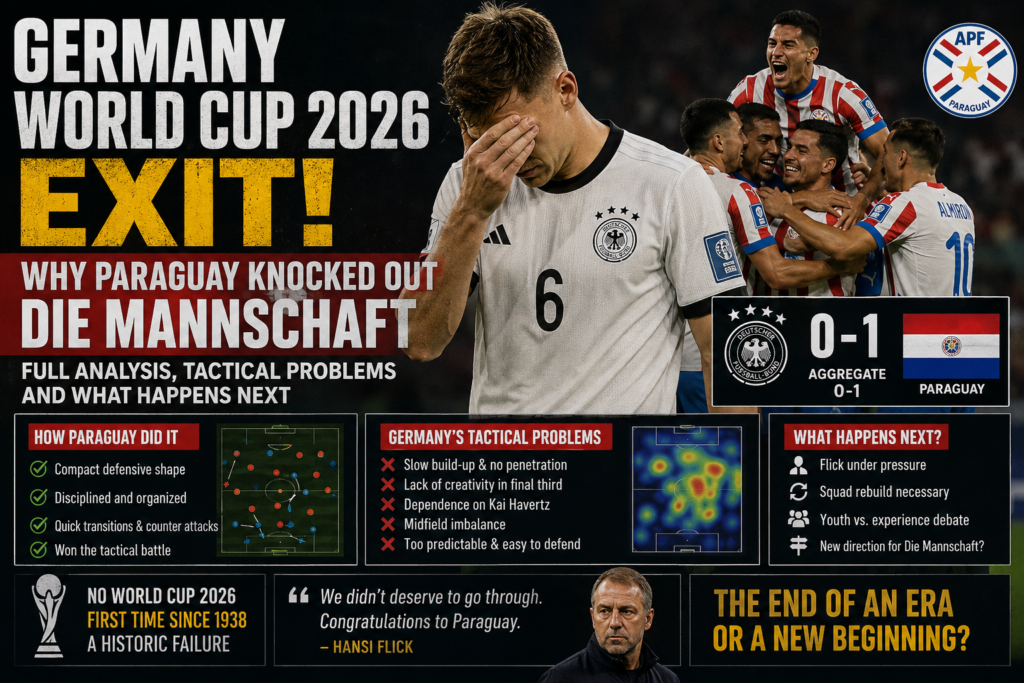
Germany arrived at the 2026 FIFA World Cup with talented players, enormous expectations and a genuine belief that Julian Nagelsmann’s team could bring the country back among football’s biggest powers. Instead, Die Mannschaft are out in the Round of 32 after losing 4–3 on penalties to Paraguay following a 1–1 draw after extra time.
It was not simply a bad night in Boston. It was another warning sign for one of football’s most successful nations.
Germany had the ball. Germany had the star names. Germany had more territory, more pressure and enough time to decide the match. But Paraguay were braver in the decisive moments, more compact without the ball and calmer during the penalty shootout.
For Germany, the 2026 World Cup exit is especially difficult because it continues a worrying pattern. The four-time world champions went out in the group stage at the 2018 World Cup, went out in the group stage again in 2022, and have now been eliminated in their first knockout match in 2026.
This is the full story of Germany’s World Cup 2026 exit: the Paraguay match, the tactical mistakes, the key players, the pressure on Julian Nagelsmann and what German football must do next.
Read Finter.dk in your own language
Finter.dk can be read in several languages. Use the language selector in the bottom-right corner of the page to choose your preferred language.
International front page:
https://finter.dk/front-page/
More football videos and guides:
https://finter.dk/fodboldvideoer/
https://finter.dk/temaer/finter/
https://finter.dk/temaer/driblinger/
Germany vs Paraguay 2026: Match facts
| Match | Germany vs Paraguay |
|---|---|
| Tournament | FIFA World Cup 2026 |
| Round | Round of 32 |
| Date | June 29, 2026 |
| Venue | Boston Stadium, Foxborough |
| Final score | Germany 1–1 Paraguay |
| Penalty shootout | Paraguay won 4–3 |
| Paraguay scorer | Julio Enciso, 42nd minute |
| Germany scorer | Kai Havertz, 54th minute |
| Decisive penalty | José Canale |
| Germany coach | Julian Nagelsmann |
| Germany captain | Joshua Kimmich |
Germany are out – and this defeat will hurt for a long time
The final whistle after the penalty shootout felt like more than the end of a football match.
It felt like the end of another German World Cup dream before it had properly begun.
Germany had started the tournament in spectacular style. A 7–1 win against Curaçao created excitement around the team. The attacking football looked sharp, young players looked fearless and stars such as Florian Wirtz, Jamal Musiala, Kai Havertz and Deniz Undav gave Germany several different ways to hurt opponents.
But World Cups are rarely decided by one brilliant performance.
They are decided by whether a team can solve difficult matches when the space disappears, when the opponent sits deep, when the first goal goes against them and when panic begins to enter the stadium.
Against Paraguay, Germany could not solve the problem.
Paraguay defended with discipline, protected the centre of the pitch and made Germany play in front of them. Germany had long spells of possession, but the ball often moved too slowly. The combinations around the penalty area lacked speed, surprise and conviction.
That is exactly the type of match Germany used to find a way to win.
In the past, Germany became famous for surviving pressure, controlling chaos and producing one decisive moment. In 2026, Paraguay produced that moment instead.
How Germany vs Paraguay unfolded
Germany began with a strong-looking side.
Manuel Neuer started in goal behind a defence featuring Jonathan Tah, Antonio Rüdiger, Joshua Kimmich and Nathaniel Brown. Aleksandar Pavlovic and Felix Nmecha operated in midfield, while Florian Wirtz, Leroy Sané and Deniz Undav supported Kai Havertz.
On paper, Germany had technical quality everywhere.
On the pitch, however, Paraguay quickly made the game uncomfortable.
Germany dominated possession but struggled to turn control into clear chances. Paraguay stayed compact, protected their own penalty area and waited for moments to break forward. Their plan was clear: deny space to Wirtz and Musiala, force Germany wide and survive the crosses.
The breakthrough came in the 42nd minute.
After a corner situation, Julio Enciso found space inside the box and headed Paraguay into a shock lead. Germany had been warned. They had not created enough. They had allowed Paraguay to believe.
The second half began with more urgency from Germany.
Kai Havertz equalised in the 54th minute when Florian Wirtz delivered a precise cross into the penalty area. Havertz guided his header into the far corner and Germany finally had momentum.
For a period, it looked as if Germany would complete the comeback.
They increased the tempo, sent more crosses into the box and introduced Jamal Musiala to create more unpredictability. But Paraguay regained their defensive shape. The spaces disappeared again. Germany had possession, but not enough clear solutions.
The match went into extra time.
Germany thought they had found another decisive goal, but the moment did not stand. The frustration grew. Paraguay continued to defend with courage, goalkeeper Orlando Gill remained calm and the match moved towards penalties.
That was where Germany’s World Cup ended.
Kai Havertz missed Germany’s first penalty. Joshua Kimmich and Jamal Musiala scored, but Germany could not create enough security in the shootout. Manuel Neuer saved one Paraguayan attempt, yet Jonathan Tah sent Germany’s final penalty over the bar.
José Canale then scored the decisive kick.
Paraguay celebrated one of the greatest results in their football history.
Germany went home.
Watch the Germany vs Paraguay drama
Germany vs Paraguay – World Cup 2026 full match highlights:
https://www.youtube.com/watch?v=7Zst7Bjhe1U
Julian Nagelsmann’s post-match reaction after Germany’s elimination:
https://www.youtube.com/watch?v=bnDF6MYOG_s
The biggest tactical problem: Germany moved the ball too slowly
Julian Nagelsmann was honest after the match.
Germany’s build-up was too slow. Their passing took too long. Their attacks became predictable.
That is the central reason why Paraguay were able to stay in the match.
A deep defensive block does not always need to win the ball immediately. Sometimes it only needs to force the opponent to pass sideways, play safe passes and lose rhythm. Paraguay did exactly that.
Germany often had the ball in good areas but did not create enough danger from those positions.
The team needed quicker decisions:
- Faster forward passes through midfield
- More runs behind Paraguay’s defensive line
- More one-touch combinations around the box
- More dribbles to create numerical advantages
- Earlier crosses with more players arriving in the area
- More shots before Paraguay could organise again
Florian Wirtz tried to create moments of quality. Musiala added energy after coming on. Havertz scored an important equaliser. But Germany needed more than individual flashes.
They needed a collective answer.
They never fully found one.
Why Paraguay’s plan worked so well
Paraguay did not try to match Germany pass for pass.
They created a different kind of match.
Their defenders stayed close together, their midfield protected the central spaces and their attacking players worked tirelessly without the ball. When Germany played wide, Paraguay were ready for crosses. When Germany tried to play through the middle, the spaces were crowded.
The key was patience.
Paraguay did not panic after Havertz equalised. They did not suddenly attack with too many players. They accepted that Germany would have possession and trusted their structure.
This is an important lesson for young footballers and coaches.
Possession alone does not win matches.
A team can have the ball for long periods and still be less dangerous than an opponent with better organisation, clearer transitions and more belief in decisive moments.
Paraguay had fewer famous names than Germany. But for 120 minutes, they played with enormous discipline and clarity.
From a 7–1 opening win to a World Cup exit
Germany’s tournament began with a 7–1 win over Curaçao.
It was one of the most impressive opening performances at the World Cup. Germany attacked with pace, scored freely and looked ready to make a serious run towards the final.
But the later matches told a more complicated story.
Germany beat Ivory Coast 2–1, but the match was difficult and physically demanding. Then came a 2–1 defeat to Ecuador in the final group game. Germany still finished first in the group, but the warning signs were there.
Ecuador showed that Germany could be hurt when opponents played with speed, intensity and aggression.
Paraguay showed that Germany could be frustrated when opponents defended deep and denied them space.
Those are two very different tests.
Germany failed both.
That does not mean the squad has no quality. It means the team is not yet complete enough to solve every type of football match.
Great tournament teams must be able to win in different ways.
They must win open games. They must win physical games. They must win ugly games. They must find a goal when the opponent refuses to give them space.
Germany could not do that against Paraguay.
A historic problem for German football
Germany have won the World Cup four times: 1954, 1974, 1990 and 2014.
For decades, Germany were the ultimate tournament team.
They did not always play the most beautiful football, but they were usually among the last teams standing. They reached finals, semi-finals and decisive matches with remarkable consistency.
That reputation has changed.
Since lifting the World Cup in Brazil in 2014, Germany have struggled to build a stable identity. There have been talented squads, exciting young players and occasional excellent performances, but the consistency has disappeared.
The 2026 exit is not just about one missed penalty.
It is about a longer question:
What does Germany want to be as a football nation?
Do they want to dominate possession?
Do they want to press high and play aggressively?
Do they want to build around Wirtz and Musiala?
Do they have enough natural specialists in key positions?
Can they handle pressure when a World Cup match becomes tense?
These questions will now dominate the debate in Germany.
The pressure on Julian Nagelsmann
Julian Nagelsmann is one of the most talented coaches of his generation.
He is known for detailed tactical ideas, flexible systems and a willingness to trust younger players. Germany’s 2026 squad had technical quality, athleticism and depth in several areas.
But international football is different from club football.
At a World Cup, a coach gets very little time to correct mistakes. One bad match can end everything. A tactical plan that looks brilliant against an open opponent can become ineffective against a compact, defensive side.
Nagelsmann admitted that Germany did not move the ball quickly enough and did not make enough of their attacking situations.
That honesty matters.
But German football will now want more than honest words. It will want a clear plan for the future.
The biggest question is not only whether Nagelsmann should stay.
The bigger question is whether Germany can create a stronger football identity around him.
Part 1 conclusion: Germany need a reset, not panic
Germany’s 2026 World Cup exit against Paraguay was painful, but it should not lead to blind panic.
The country still has outstanding players.
Florian Wirtz can become one of the world’s best attacking midfielders. Jamal Musiala can unlock any defence. Joshua Kimmich remains an important leader. Kai Havertz has proven he can score in major matches. Young players such as Nathaniel Brown, Aleksandar Pavlovic and Felix Nmecha represent the next generation.
But talent is not enough.
Germany must learn how to play when the match becomes slow, physical, nervous and complicated. They must create more attacking variety. They must become faster in possession. They must develop stronger solutions against deep defensive blocks.
Paraguay did not eliminate Germany because Germany lacked famous players.
Paraguay eliminated Germany because they had the clearer plan on the night.
Germany World Cup 2026 Exit: The Players, the Penalty Shootout and the Future of German Football
The penalty shootout that ended Germany’s World Cup
Penalty shootouts are cruel because they reduce 120 minutes of football to a few seconds of pressure.
Germany had enough time to win against Paraguay. They had possession, corners, crosses, attacking substitutions and even a disallowed extra-time goal. But when the match reached penalties, the pressure became impossible to escape.
Kai Havertz missed Germany’s first penalty.
Joshua Kimmich responded by scoring. Jamal Musiala also converted. Nadiem Amiri kept Germany alive later in the shootout. But Nick Woltemade and Jonathan Tah both missed, and José Canale then scored the decisive penalty for Paraguay.
That moment completed one of the biggest shocks of the 2026 World Cup.
For Germany, the shootout was not the only reason for elimination. It was simply the final consequence of a match in which the team created too little danger for too long.
A strong tournament team should not need penalties after dominating so much of the ball against a deep defensive opponent.
Germany’s key players: Who performed and who must improve?
Manuel Neuer: Germany’s leader could not save the team again
Manuel Neuer had another major tournament moment for Germany.
At 40 years old, he brought experience, calmness and authority to the team. Against Paraguay, he made an important save in the shootout and gave Germany hope when the situation looked lost.
But Neuer could not solve Germany’s attacking problems.
He was not responsible for the exit. Germany’s own players and coaching staff made that clear after the match. The team did not create enough clear chances, did not move the ball quickly enough and did not turn pressure into goals.
Neuer’s World Cup may also become an important turning point for German football.
Germany must soon decide who will become the long-term number one goalkeeper. Replacing Neuer is not only about finding a good shot-stopper. It is about finding a goalkeeper who can lead the defence, play under pressure and start attacks from deep positions.
YouTube search – Manuel Neuer World Cup 2026 highlights:
https://www.youtube.com/results?search_query=Manuel+Neuer+World+Cup+2026+highlights
Joshua Kimmich: A captain carrying enormous responsibility
Joshua Kimmich was Germany’s captain during the World Cup and one of the players who accepted responsibility immediately after the defeat.
He did not blame the coach, the referee or Paraguay.
Instead, he said that the players had failed to give Germany’s supporters the tournament run they wanted.
That reaction matters.
Kimmich scored his penalty, kept trying to create danger and delivered several dangerous set pieces. But Germany need more than determination from their captain. They need the entire team to play with the same urgency from the first minute.
Germany often became more dangerous only after they were behind.
That is a major problem.
The best international teams do not wait for trouble before increasing their tempo. They play with intensity from the beginning, especially in knockout football.
Kimmich will remain central to Germany’s future because he brings leadership, tactical understanding and mentality. But Germany must build a clearer structure around him.
Florian Wirtz: Germany’s biggest creative hope
Florian Wirtz remains one of the most important players in German football.
Against Paraguay, he created the equaliser with a precise cross for Kai Havertz. He was also involved in several of Germany’s better attacking moments and constantly looked for spaces between Paraguay’s midfield and defence.
But Wirtz could not create everything alone.
That is one of the biggest lessons from the World Cup.
Germany have many technical players, but they sometimes place too much responsibility on one creative midfielder. When opponents close down Wirtz, block the centre and stay compact, Germany need other players to make runs, dribble past opponents and create confusion.
Wirtz is at his best when he has movement around him.
He needs runners behind the defence. He needs players arriving from the wings. He needs a striker who can link play and attack crosses. He needs teammates who make quick decisions.
Germany’s future should be built around Wirtz, but not depend entirely on him.
YouTube search – Florian Wirtz Germany skills and highlights:
https://www.youtube.com/results?search_query=Florian+Wirtz+Germany+skills+highlights
For more football technique, dribbling and skill inspiration, visit:
https://finter.dk/temaer/driblinger/
https://finter.dk/fodboldvideoer/
Jamal Musiala: A superstar who needs freedom
Jamal Musiala entered the Paraguay match in the second half to give Germany more creativity.
His dribbling ability, quick feet and willingness to attack defenders made Germany less predictable. When Musiala receives the ball facing forward, he can change a match in one move.
But Paraguay made it difficult for him.
They defended close together, gave him little space in central areas and forced Germany into wide positions. Musiala often received the ball with too many defenders around him.
Germany must find better ways to use him.
One solution could be to give Musiala more freedom between the lines. Another could be to use him closer to the left side, where he can cut inside and combine with overlapping full-backs. Germany can also use him as a second attacking midfielder alongside Wirtz.
The biggest question is simple:
Can Germany build a system where Wirtz and Musiala both shine at the same time?
That could decide whether Germany return to the world’s elite before EURO 2028 and the 2030 World Cup.
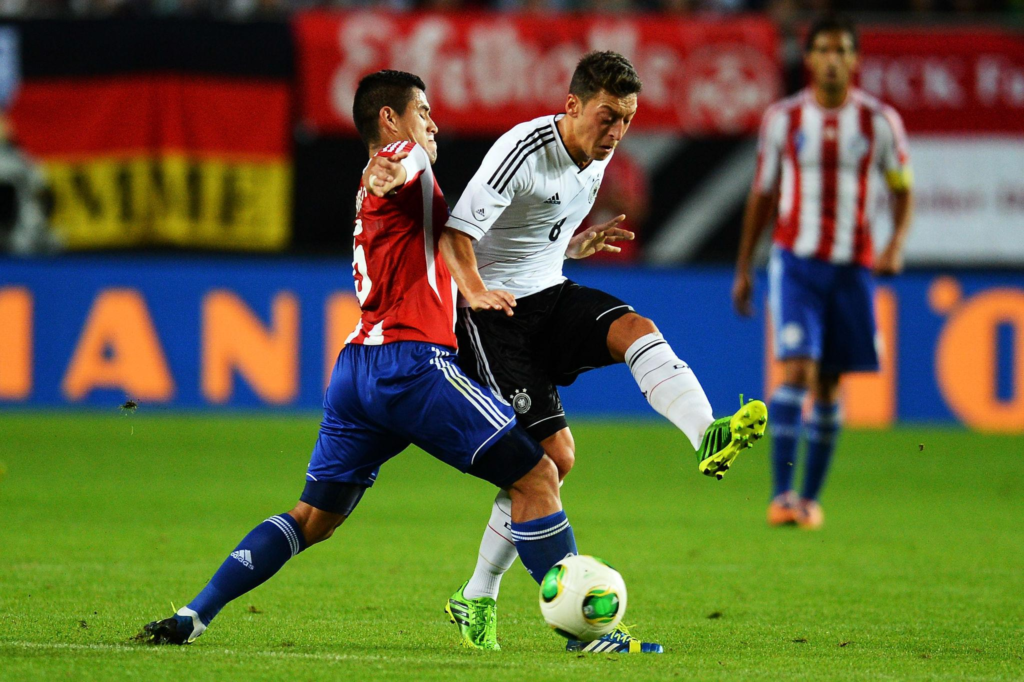
Kai Havertz: Goal scorer, but also a symbol of Germany’s problem
Kai Havertz scored Germany’s equaliser against Paraguay with a well-placed header.
It was an important goal. It gave Germany hope and changed the rhythm of the match.
But Havertz also missed the first penalty in the shootout.
That does not make him the reason Germany went out. Football is never that simple. Still, his night summed up Germany’s tournament: moments of quality, moments of promise, but not enough decisive actions when everything was on the line.
Havertz can play as a striker, a false nine, an attacking midfielder or a wide forward. His versatility is a strength, but Germany must decide where he is most dangerous.
Against deep defences, Germany often need a more direct presence in the box. They need someone who attacks crosses, occupies centre-backs and gives the creative players a clear target.
Havertz can do that job, but he needs more support around him.
Deniz Undav and Nick Woltemade: Different answers in attack
Deniz Undav started against Paraguay after an impressive World Cup group stage.
He brought energy, movement and a willingness to press. He tried to connect Germany’s midfield with the attack, but Paraguay’s defensive block gave him very little room.
Nick Woltemade came on late and made his World Cup debut in a high-pressure moment. He had shots blocked in extra time and then missed his penalty in the shootout.
That will hurt.
But young players learn from difficult moments. Woltemade should not be judged only by one penalty. He has qualities that Germany need: height, technical ability, link-up play and an unusual profile for a modern striker.
Germany need different types of attackers.
They need quick players for transitions. They need technical forwards for combination football. They need physical strikers for matches where opponents defend deep and crosses become important.
The future Germany squad should include variety, not only talented players with similar strengths.
The disallowed goal: A turning point in extra time
Germany believed they had scored the winning goal in extra time.
Jonathan Tah headed the ball into the net after a corner, but the referee ruled that there had been an attacking foul. The decision meant Germany’s celebrations ended immediately.
Julian Nagelsmann strongly disagreed with the decision afterwards and called it a major mistake.
It was a huge moment in the match.
But Germany cannot allow one refereeing decision to become the full explanation for the defeat. They had 120 minutes to score another goal. They had several corners. They had possession. They had the penalty shootout.
The best response to a controversial decision is to keep playing and create another chance.
Germany did not do enough after the goal was ruled out.
A familiar World Cup pattern since 2014
Germany won the World Cup in 2014.
Since then, the story has been much harder.
- 2018: Germany went out in the group stage.
- 2022: Germany went out in the group stage again.
- 2026: Germany reached the knockout stage but lost their first elimination match against Paraguay.
This is not a normal record for a country with four World Cup titles.
Germany remain one of football’s greatest nations, but history does not win modern matches. The national team must earn its status again through performances.
The problem is not a lack of talented players.
Germany have Wirtz. Musiala. Kimmich. Havertz. Pavlovic. Brown. Woltemade. Many other young players are developing in the Bundesliga and abroad.
The problem is turning talent into a complete tournament team.
That means:
- Defending better against fast counter-attacks
- Moving the ball faster against deep blocks
- Creating more goals from open play
- Developing more natural attacking partnerships
- Becoming mentally stronger in decisive moments
- Giving young players tournament experience before the biggest matches arrive
What this means for the Bundesliga
Germany’s World Cup exit will create major debate around the Bundesliga.
The Bundesliga remains one of Europe’s best leagues for young players. It gives chances to teenagers, develops technical footballers and produces exciting attacking talent.
But the national team needs more than individual development.
German football must ask whether young players are being prepared for every type of international match.
Can they handle compact defensive opponents?
Can they handle physical pressure?
Can they manage a match when they are favourites?
Can they defend transitions when their full-backs attack?
Can they stay calm when a knockout match becomes tense?
These are not only questions for Julian Nagelsmann.
They are questions for academies, Bundesliga clubs, youth coaches and the German Football Association.
For young players, the lesson is important:
Skills matter. Speed matters. Technique matters.
But decision-making, mentality and the ability to solve difficult matches matter just as much.
What Germany should do before EURO 2028
Germany should not destroy everything after one defeat.
The team has a base to build on.
Julian Nagelsmann has said that fundamental things must change, but he also made clear that he is ready to continue if the German Football Association wants him to stay.
The next two years should focus on creating a clear identity.
Germany need to decide how they want to play.
Do they want to dominate through possession?
Do they want to press aggressively?
Do they want Wirtz and Musiala as dual creators?
Do they need a more physical striker?
Do they need more pace at centre-back and full-back?
The answer may be a mixture of all those things.
The strongest Germany teams in history were never one-dimensional. They could play beautiful football, but they could also win ugly matches. They could control possession, but they could also counter-attack. They had stars, but they also had specialists.
That is the standard Germany must chase again.
Part 2 conclusion: Germany have the talent, but need the identity
Germany’s defeat to Paraguay was not just a penalty-shootout loss.
It exposed the difference between having good players and becoming a great tournament team.
Florian Wirtz and Jamal Musiala can lead the next generation. Joshua Kimmich can remain a key leader. Manuel Neuer has shown once again why he is one of Germany’s greatest goalkeepers. Kai Havertz, Deniz Undav and Nick Woltemade give Germany different attacking options.
But the next Germany team must be faster, braver and more flexible.
The road to EURO 2028 starts now.
Julian Nagelsmann’s Future: Should Germany Keep Their Coach After World Cup 2026?
Germany’s World Cup exit has immediately created one enormous question:
Should Julian Nagelsmann remain Germany coach?
Nagelsmann has made clear that he wants to continue if the German Football Association still believes in him. That is important. He is not running away from the disappointment, and he understands that the team must improve.
But staying is not enough on its own.
Germany must use this defeat to make honest decisions about tactics, player roles and the identity of the national team before EURO 2028.
Nagelsmann is still one of the most interesting coaches in world football. He understands modern pressing, positional play, flexible formations and player development. Yet the Paraguay match showed that tactical intelligence is only valuable when it creates clear solutions on the pitch.
Germany had the ball, but they did not have enough answers.
Against a deep and organised opponent, the team became too predictable. Paraguay knew where Germany wanted to play. They blocked the central spaces, forced Germany wide and waited for crosses.
Germany needed more speed, more movement and more risk.
The Joshua Kimmich question: Right-back or midfield leader?
Joshua Kimmich remains one of Germany’s most intelligent and important players.
He can control matches, deliver set pieces, switch play with long passes and lead younger teammates. But Germany must decide where he helps the team most.
At right-back, Kimmich gives Germany experience and quality on the ball. He can move inside during attacks and help build play from deeper positions.
In midfield, however, he can dictate the rhythm of the entire game.
Against Paraguay, Germany often lacked someone who could receive the ball under pressure and immediately play forward. Too many passes went sideways. Too many attacks started slowly.
A future midfield built around Kimmich, Aleksandar Pavlovic and Florian Wirtz could give Germany more control and creativity. But that would require Germany to find reliable, athletic full-backs who can defend large spaces.
This is one of the biggest decisions before EURO 2028.
Germany need more direct attacking football
Germany are at their best when they combine technical football with direct running.
The equaliser against Paraguay was the perfect example. Florian Wirtz moved into a wide area, created space for himself and delivered an early cross. Kai Havertz attacked the ball brilliantly and scored with a precise header.
That goal showed what Germany can do.
The problem was that they did not create enough similar moments.
Modern football is not only about keeping possession. It is also about attacking before the opponent is ready.
Germany should use more:
- Early crosses into the box
- Fast passes behind the defensive line
- Overlapping full-backs
- Third-man runs from midfield
- Long shots when the penalty area is crowded
- One-versus-one dribbling from Musiala and Wirtz
- Quick transitions after winning the ball
The best teams can play patiently when necessary, but they can also hurt opponents within three or four passes.
Germany need to become dangerous in both ways.
Wirtz and Musiala: Germany’s future must be built around both
Florian Wirtz and Jamal Musiala are the two biggest creative talents in German football.
They should not be competing for the same role.
They should be used together.
Wirtz is excellent at reading space, combining with teammates and making the final pass. Musiala is one of the world’s best young dribblers, capable of beating defenders in tight areas and creating chaos close to goal.
The challenge is balance.
When both players move inside, Germany can become too narrow. Opponents can crowd the centre and force them backwards. That means Germany need width from their full-backs and wingers, plus a striker who can occupy centre-backs.
A possible attacking structure could look like this:
| Position | Key role |
|---|---|
| Florian Wirtz | Creative midfielder, final pass, late runs into the box |
| Jamal Musiala | Free attacking role, dribbling, combinations and individual breakthroughs |
| Kai Havertz or Nick Woltemade | Central forward, link-up play and attacking crosses |
| Wide attackers | Stretch the pitch and attack behind the defence |
| Full-backs | Create width when Wirtz and Musiala move inside |
Germany do not need to choose between Wirtz and Musiala.
They need to create a team where both can be decisive.
YouTube search – Florian Wirtz and Jamal Musiala Germany highlights:
https://www.youtube.com/results?search_query=Florian+Wirtz+Jamal+Musiala+Germany+highlights
Why Germany need a more natural number nine
Germany have talented forwards, but they still need to decide what type of striker they want.
Kai Havertz is technically gifted and can score important goals. Deniz Undav brings energy, clever movement and finishing. Nick Woltemade offers height, hold-up play and a different physical profile.
That variety is valuable.
But in matches against deep defences, Germany often need a forward who stays close to the penalty area, attacks crosses and gives defenders a constant problem.
A natural number nine can create space for Wirtz and Musiala simply by occupying two centre-backs.
That does not mean Germany must play old-fashioned football. It means they need more options.
The strongest national teams have different solutions depending on the opponent.
Sometimes they need a technical false nine.
Sometimes they need a quick striker for counter-attacks.
Sometimes they need a powerful target in the box.
Germany should develop all three possibilities.
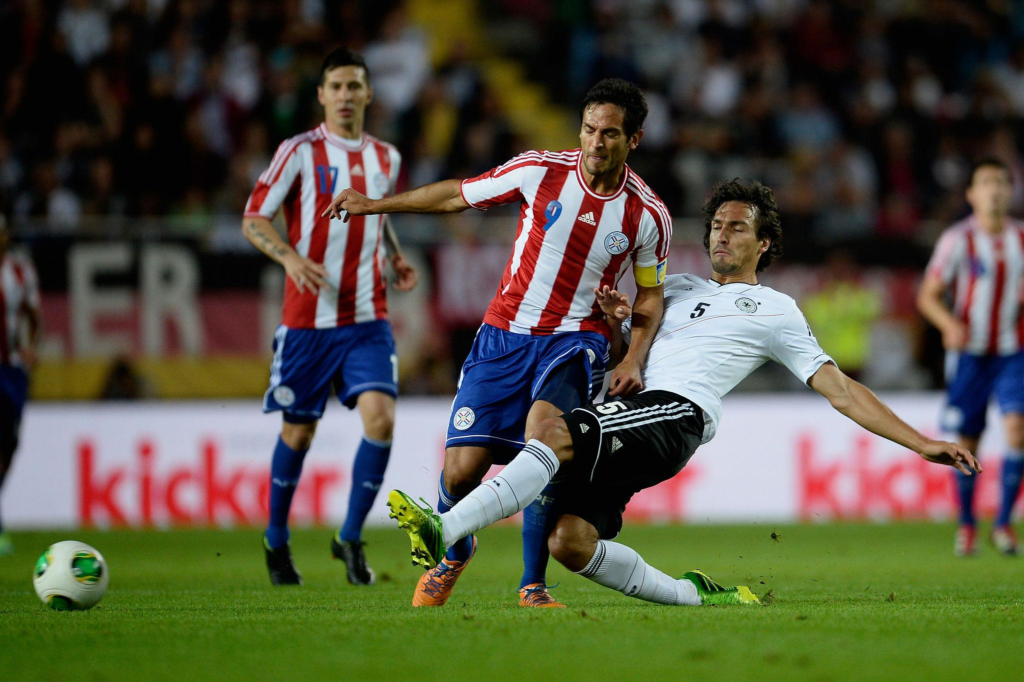
The next generation: Five players Germany can build around
Florian Wirtz
Wirtz is Germany’s most important creative player. He already has the vision, calmness and technique to decide major matches.
Jamal Musiala
Musiala can become Germany’s main match-winner. His dribbling can break down defensive blocks when passing alone is not enough.
Aleksandar Pavlovic
Pavlovic has the profile Germany need in midfield: composure, passing ability and intelligence under pressure.
Nathaniel Brown
Brown represents the modern full-back profile: energy, pace and willingness to attack. Germany need more players who can create width from defensive positions.
Nick Woltemade
Woltemade’s missed penalty will be painful, but he should not be defined by one moment. His size, technique and link-up play could make him a unique option for Germany.
The biggest lesson from Paraguay: Possession must have purpose
Germany had huge spells with the ball against Paraguay.
But possession without danger can become a trap.
Paraguay were happy to let Germany pass sideways. Their defensive structure stayed compact, their players protected the middle and their goalkeeper was rarely forced into impossible saves.
Germany must learn to ask one simple question every time they have the ball:
Does this pass move us closer to a real chance?
A pass can be safe but still unhelpful.
Young players can learn from this too. Do not pass only to avoid losing the ball. Pass to move an opponent, create a new angle or open space for a teammate.
That is why first touch, body position and scanning are so important.
For more football training ideas, skills and dribbling inspiration, see:
https://finter.dk/temaer/driblinger/
https://finter.dk/fodboldvideoer/
https://finter.dk/temaer/finter/
What German youth football can learn from this World Cup exit
Germany do not need to copy another country.
They need to develop their own strengths again.
German football has historically been famous for organisation, mentality, team spirit and tournament intelligence. In recent years, it has also produced more technical and creative players than ever before.
The future should combine both traditions.
Young German players should learn:
- To receive the ball under pressure
- To play quickly with both feet
- To dribble when a pass is not available
- To defend one-versus-one
- To make fast decisions near goal
- To play with courage in difficult matches
- To stay calm during penalties and decisive moments
Technique matters. Physical strength matters. Tactical understanding matters.
But mentality still matters most when a World Cup match reaches the final minutes.
Germany’s road to EURO 2028
The next major target is EURO 2028.
Germany have two years to build a more complete team. That is enough time, but only if the lessons from the Paraguay defeat are taken seriously.
Germany should not start from zero.
They should keep the best parts of the current project:
- The technical quality in midfield
- The creativity of Wirtz and Musiala
- The leadership of Kimmich
- The promise of young players such as Pavlovic, Brown and Woltemade
- The tactical knowledge of Julian Nagelsmann
But they must add more speed, more directness, more defensive security and more attacking variety.
A great Germany team does not need to dominate every match.
It needs to know how to win every type of match.
Part 3 conclusion: The rebuild starts with clear decisions
Germany’s World Cup 2026 exit was painful, but it can still become useful.
The defeat against Paraguay exposed weaknesses that can be fixed. Germany need a clearer midfield structure, more direct attacking football, stronger solutions against deep defensive blocks and a better balance around Florian Wirtz and Jamal Musiala.
Julian Nagelsmann may still be the right coach to lead that process.
But the next Germany team cannot simply be a younger version of the old one.
It must be faster, more flexible and more ruthless.
Germany’s 2014 World Cup Blueprint: What the Current Team Must Learn From Lahm, Schweinsteiger, Kroos, Müller, Klose and Neuer
Germany’s 2026 World Cup exit against Paraguay should not only be seen as a failure.
It should also be used as a lesson.
The best way forward is to look back at the Germany team that last won the World Cup in 2014. That squad was not successful only because it had famous names. It succeeded because every player understood the team’s identity.
Germany had technical quality. Germany had leaders. Germany had tactical flexibility. Germany had players who could control a match, survive difficult moments and decide a game when the pressure was highest.
That is the standard the current generation must chase again.
Germany have won the World Cup four times: in 1954, 1974, 1990 and 2014. The 2014 team remains the clearest modern example of how Germany can combine intelligent possession football with toughness, discipline and tournament mentality.
Why Germany 2014 were so difficult to beat
The Germany team at the 2014 World Cup could play in several different ways.
They could dominate the ball. They could press high. They could defend deep. They could keep calm in extra time. They could win with technique, set pieces, counter-attacks or pure mentality.
That flexibility was one of their greatest strengths.
In 2026, Germany often looked good when a match opened up. But against Paraguay, the team struggled when the opponent defended deep and made the game slow.
The 2014 team also faced difficult matches.
They needed extra time against Algeria in the Round of 16. They had to survive a physical semi-final atmosphere against Brazil. They had to remain patient against Argentina in the final before Mario Götze scored the winning goal in extra time.
The difference was that the 2014 side always had another solution.
They never depended on only one player or one type of attack.
Philipp Lahm: The importance of intelligent leadership
Philipp Lahm was not the loudest player on the pitch.
But he was one of the smartest.
He understood positioning, tempo and risk. He could play at right-back, left-back or in midfield. He knew when to stay deep, when to support an attack and when to slow a match down.
Germany’s current team need that type of intelligence.
Joshua Kimmich has many of the same qualities. He can lead, pass, organise and play in more than one position. But the team must make sure he is surrounded by players who understand their roles just as clearly.
A captain cannot solve every problem alone.
Germany need leaders in every part of the pitch:
- A goalkeeper who communicates constantly
- Centre-backs who organise the defensive line
- Midfielders who control the rhythm
- Attackers who demand responsibility in decisive moments
The 2014 squad had leaders everywhere. That made Germany calm when matches became chaotic.
Bastian Schweinsteiger: The mentality to survive difficult matches
Bastian Schweinsteiger became one of the symbols of Germany’s 2014 World Cup win.
In the final against Argentina, he was repeatedly fouled, knocked down and tested physically. But he continued. He kept running, tackling and fighting for every ball.
That performance showed something important about tournament football.
Talent gets a team to the knockout stage.
Mentality gets a team through the knockout stage.
Germany’s 2026 squad have talented footballers. Florian Wirtz can create magic. Jamal Musiala can beat players in tiny spaces. Kai Havertz can score important goals. But the next step is becoming a team that embraces difficult matches rather than becoming frustrated by them.
Against Paraguay, Germany needed more patience, more aggression in the final third and more calmness after setbacks.
Schweinsteiger’s lesson is simple:
When a game becomes ugly, do not disappear. Become more important.
Toni Kroos: Control is more than possession
Toni Kroos was one of the greatest controllers of a football match.
His passing was not just accurate. It had purpose.
He knew when to speed up an attack, when to change the angle, when to switch play and when to force the opponent to move. That is why Germany’s possession in 2014 usually created danger.
Against Paraguay in 2026, Germany had long spells with the ball but too many passes did not change the situation.
This is the difference between having possession and controlling a match.
A team can have 65 per cent possession and still make life easy for the opponent. If the ball moves slowly, defenders can stay organised. If passes are predictable, the opponent can protect the dangerous spaces.
Germany must learn to use possession with a clearer purpose:
- Move the opponent before attacking
- Play forward quickly when a gap appears
- Switch the ball before the defence is ready
- Create one-versus-one situations for creative players
- Make runs behind the defence to stretch the pitch
- Shoot when the opponent gives space outside the box
Aleksandar Pavlovic, Kimmich and the next generation of German midfielders can study this part of Kroos’ game closely.
Miroslav Klose: Why Germany need penalty-box specialists
Miroslav Klose was Germany’s all-time World Cup goal scorer and a master of movement inside the penalty area.
He was not only a goal scorer. He understood timing.
He knew when to move away from a defender. He knew when to attack the near post. He knew when to wait at the far post. He knew how to make space for teammates.
That type of striker is extremely valuable against deep defences.
Against Paraguay, Germany needed more players attacking the dangerous areas in the box. Too many crosses arrived without enough runners. Too many attacks ended with a blocked pass or a harmless delivery.
Kai Havertz, Nick Woltemade and other German forwards can offer different strengths. But Germany must develop clear striker roles.
A forward must know:
- When to drop deep and link play
- When to stay high and occupy centre-backs
- When to attack the near post
- When to create space for Wirtz and Musiala
- When to be ruthless with one chance
Germany do not need to copy Klose exactly.
But they do need a forward who makes defenders uncomfortable for 90 minutes.
Thomas Müller: The value of movement without the ball
Thomas Müller became famous for finding spaces that other players did not see.
His greatest strength was often not a dribble, a pass or a spectacular shot.
It was movement.
Müller constantly changed the position of defenders. He made late runs into the box. He drifted into areas where no one expected him. He created space for teammates simply by moving at the right time.
Germany’s current attackers need more of that movement.
Florian Wirtz and Jamal Musiala are most dangerous when there are runners around them. They need teammates who stretch the defence, pull centre-backs out of position and create passing lanes.
Against low defensive blocks, movement without the ball can be more important than another safe pass.
Young players can learn a lot from Müller’s style:
Do not watch the player with the ball. Watch the empty space.
That is often where the next chance begins.
Manuel Neuer: A goalkeeper who changed how Germany played
Manuel Neuer helped redefine the modern goalkeeper role.
He was not just a shot-stopper. He acted as an extra defender, swept up danger behind the defensive line and gave Germany confidence to play higher up the pitch.
That allowed the 2014 team to press more aggressively.
When a team knows its goalkeeper can read danger early, defenders can stand higher. Midfielders can press with greater confidence. Attacks can begin closer to the opponent’s goal.
Germany must think carefully about the future after Neuer.
The next number one must be more than a goalkeeper with good reflexes. Germany need someone who can:
- Play confidently with both feet
- Communicate with defenders
- Deal with crosses under pressure
- Make big saves in knockout matches
- Cover space behind a high defensive line
- Start attacks with calm distribution
Neuer’s role was one reason the 2014 side looked so complete.
The 7–1 against Brazil: A lesson in ruthless football
Germany’s 7–1 semi-final win against Brazil in 2014 remains one of the most unforgettable matches in World Cup history.
The scoreline was extraordinary, but the biggest lesson was Germany’s ruthlessness.
When Brazil lost control, Germany did not slow down. They recognised the moment, attacked quickly and punished every mistake.
That is what elite teams do.
They do not always need ten chances. They take advantage when the match turns in their favour.
Germany’s 2026 team must become more ruthless near goal.
That means:
- Shooting earlier instead of always looking for one more pass
- Attacking rebounds aggressively
- Taking set pieces seriously
- Making the first run into the box
- Being ready when an opponent makes one mistake
- Staying switched on after scoring
The best tournament teams are not always the teams that play the prettiest football.
They are the teams that recognise decisive moments and take them.
The 2014 final: Winning when the margins are tiny
The final against Argentina was not easy.
Germany had to stay calm. They had to defend dangerous attacks. They had to recover after missed opportunities. They had to keep believing until the final stages of extra time.
Then Mario Götze delivered one unforgettable moment.
That is another lesson for the 2026 generation.
World Cup football is often decided by tiny details:
- A first touch
- A defensive header
- A set piece
- A substitution
- A penalty
- One brave run into the box
- One calm finish
Germany’s 2026 exit proves that the margins are still tiny. A penalty shootout can end everything. But the teams who handle pressure best usually give themselves more chances to survive those moments.
Germany must become better at playing the final 15 minutes of major matches.
That includes game management, concentration, leadership and courage.
Germany 2014 vs Germany 2026: The biggest differences
| Germany 2014 | Germany 2026 |
|---|---|
| Clear roles across the entire squad | Several key roles are still being defined |
| Strong leaders in every position | Heavy responsibility on Kimmich and a few senior players |
| Possession with speed and purpose | Too much slow possession against Paraguay |
| Multiple ways of creating goals | More reliance on individual creativity |
| Strong penalty-box movement | Need for more consistent runs and presence in the area |
| Experience of major knockout matches | Several players are still learning tournament pressure |
| Tactical flexibility during matches | Need for clearer solutions against deep defensive blocks |
The 2026 team should not try to become a copy of 2014.
Football has changed.
But the principles remain useful: clarity, balance, movement, leadership, bravery and the ability to win difficult matches.
A practical blueprint for Germany before EURO 2028
Germany should use the next two years to build a team with clear roles.
1. Build the attack around Wirtz and Musiala
Both players must have freedom, but the structure around them must create width and runs behind the defence.
2. Choose a clear midfield balance
Germany need one player who can control tempo, one player who can protect transitions and one player who can attack the final third.
3. Develop more penalty-box threat
The squad needs attackers who make aggressive runs and turn crosses, rebounds and set pieces into goals.
4. Improve game management
Germany must learn how to control the final moments of tense knockout matches.
5. Create leaders across the squad
The next team cannot depend on one captain. Leaders must emerge in defence, midfield and attack.
6. Keep tactical flexibility
A major tournament demands different solutions. Germany must be able to press, counter-attack, dominate possession and defend a narrow lead.
Training inspiration: How young players can learn from Germany’s 2014 team
Young footballers do not need to be professional players to learn from Lahm, Schweinsteiger, Kroos, Müller, Klose and Neuer.
Here are six simple lessons:
- Scan before receiving the ball like Kroos.
- Keep fighting after mistakes like Schweinsteiger.
- Move into empty spaces like Müller.
- Attack the box with purpose like Klose.
- Communicate with teammates like Lahm.
- Be brave outside your comfort zone like Neuer.
For more football exercises, skills and training ideas, explore:
Football videos on Finter.dk
Dribbling guides on Finter.dk
Football skills and inspiration on Finter.dk
Warm-up ideas for players and coaches
Part 4 conclusion: Germany must recover its tournament identity
Germany’s greatest teams were never perfect.
They had difficult matches. They had injuries. They had setbacks. They had moments when the pressure was enormous.
But they had an identity.
The 2014 team knew how to control matches, survive challenges and deliver when the tournament was on the line. The current generation has the talent to build something special, but talent must become a clear team identity.
Florian Wirtz and Jamal Musiala can be the creative centre of the next Germany era.
But to succeed, they need the structure, movement, leadership and ruthlessness that made Germany champions in 2014.
Germany’s Next Generation: The Players, Tactics and Bundesliga Talent Pipeline for EURO 2028
Germany’s World Cup 2026 exit must not become the end of a project.
It must become the beginning of a bwed that Germany still have talent, technical quality and several players who can decide major matches. But it also showed that the team need a clearer identity, more attacking variety and stronger solutions when opponents defend deep.
The positive news is that Germany do not need to rebuild from nothing.
Florian Wirtz, Jamal Musiala, Aleksandar Pavlovic, Nathaniel Brown, Felix Nmecha, Nick Woltemade and other younger players can form the core of the next generation. Combined with experienced leaders such as Joshua Kimmich, Kai Havertz, Jonathan Tah and Antonio Rüdiger, Germany have the ingredients for a strong EURO 2028 team.
The challenge is turning those ingredients into a complete tournament side.
The Germany rebuild must start with Wirtz and Musiala
Florian Wirtz and Jamal Musiala are not simply talented players.
They are Germany’s two biggest match-winners.
Wirtz brings vision, calmness, final passes and intelligent movement between the lines. Musiala brings dribbling, acceleration, unpredictability and the ability to beat defenders when there appears to be no space.
Germany’s next team should be designed to make both players dangerous.
That means they should not be forced to stand in the same small central area. The team needs width, overlapping runs and a striker who can occupy defenders.
A successful structure could allow:
- Wirtz to receive the ball between midfield and defence
- Musiala to attack defenders from the left or from central areas
- A wide player to stretch the pitch on the opposite side
- Full-backs to create overlaps
- A striker to stay close to the penalty area
- Midfielders to protect the team when attacks break down
The important point is simple:
Germany must give Wirtz and Musiala freedom, but not chaos.
Freedom without structure can make a team easy to defend against. Structure without freedom can make creative players disappear.
Germany need both.
Aleksandar Pavlovic: A key player for Germany’s midfield future
Aleksandar Pavlovic has the type of profile Germany need in midfield.
He is comfortable receiving the ball under pressure, can keep possession in tight spaces and has the calmness to help control the rhythm of a match. In the future, he could become one of the players who makes Germany less predictable in possession.
Germany’s problem against Paraguay was not a lack of passes.
It was a lack of passes that changed the game.
Pavlovic can help solve that problem if he develops into a midfielder who can:
- Receive the ball while facing his own goal
- Turn away from pressure
- Play forward quickly
- Change the side of the attack
- Protect the defence after losing possession
- Control the tempo in difficult periods
Every great Germany team has had midfielders who make the match feel calmer.
Toni Kroos did it through his passing. Bastian Schweinsteiger did it through control, energy and leadership. Germany’s next midfield needs its own version of that balance.
Nathaniel Brown and the importance of modern full-backs
Modern international football demands far more from full-backs than simply defending wide areas.
A top full-back must defend one-versus-one, attack with pace, support the winger, recover quickly after losing the ball and make intelligent decisions in the final third.
Nathaniel Brown represents an exciting profile for Germany because he brings athleticism and attacking energy from defence.
Germany need more players like that.
When Wirtz and Musiala move inside, the full-backs must create width. Without that width, opponents can defend narrowly and close down the creative players.
The best full-backs do not attack at every moment.
They choose the right moments.
That is one of the biggest tactical lessons Germany must develop before EURO 2028.
Germany’s striker debate: Havertz, Undav or Woltemade?
Germany’s future attack should not depend on one striker type.
Kai Havertz, Deniz Undav and Nick Woltemade offer different solutions, and that can become a major strength.
Kai Havertz
Havertz offers technical quality, intelligent movement and the ability to score in major matches. He can play as a striker, a false nine or a second forward.
Deniz Undav
Undav brings urgency, clever movement and a natural instinct around goal. His World Cup group-stage form showed that he can make an impact when given responsibility.
Nick Woltemade
Woltemade gives Germany a different physical profile. He can hold up the ball, compete in the air and create space for creative teammates.
Germany should use the right forward for the right match.
Against a team defending very deep, a striker with size and penalty-box presence may be valuable.
Against a team that leaves space behind its defence, a quicker and more mobile forward may be the better option.
Against a team that presses high, Havertz’s technical ability and movement could help Germany play through the pressure.
The best national teams do not rely on one plan.
They have several.
A possible Germany tactical system for EURO 2028
Germany should not become obsessed with one formation.
The system must be flexible enough to change during matches.
A 4-2-3-1 shape could give Germany balance:
| Position | Role |
|---|---|
| Goalkeeper | Calm build-up play, communication and protection behind a high line |
| Right-back | Defensive balance or inverted midfield role |
| Centre-backs | Strong in duels, quick enough to defend transitions |
| Left-back | Width, overlaps and recovery speed |
| Double pivot | One controller and one midfielder protecting counter-attacks |
| Florian Wirtz | Creative attacking midfielder and final-pass specialist |
| Jamal Musiala | Free attacking role, dribbling and movement between the lines |
| Wide forward | Pace, direct runs and width |
| Striker | Penalty-box presence, link-up play and finishing |
This system could become even more dangerous when Germany attack.
Kimmich could move into midfield from right-back. Brown could overlap on the left. Wirtz and Musiala could play closer together behind a striker.
That would create a flexible attacking shape without leaving the team completely open defensively.
One possible Germany 2028 line-up blueprint
This is not a prediction. It is a tactical example of how Germany could combine experience, creativity and athleticism.
| Position | Possible profile |
|---|---|
| Goalkeeper | Germany’s new long-term number one |
| Right-back | Joshua Kimmich or an athletic defensive specialist |
| Centre-back | Jonathan Tah or another experienced organiser |
| Centre-back | A quicker defender able to protect large spaces |
| Left-back | Nathaniel Brown or another attacking full-back |
| Midfield | Aleksandar Pavlovic as the controlling passer |
| Midfield | Felix Nmecha or a strong transition midfielder |
| Right attacking role | Florian Wirtz cutting inside |
| Central attacking role | Jamal Musiala with freedom to dribble |
| Left attacking role | A fast wide forward |
| Striker | Kai Havertz, Deniz Undav or Nick Woltemade depending on the match |
The most important thing is not the names on paper.
It is whether every player understands the role.
Germany’s 2014 World Cup team had stars, but it also had clear responsibilities. The full-backs knew when to attack. The midfield knew when to control the game. The forwards knew when to make runs and when to create space.
Germany must recover that clarity.
What the Bundesliga must provide
The Bundesliga remains one of the best leagues in Europe for giving young players opportunities.
Young talents often get first-team minutes earlier in Germany than in many other major leagues. That is a huge advantage.
But the next generation must be developed for international tournament football, not only for exciting league matches.
Young players need to learn how to:
- Break down deep defensive blocks
- Defend fast counter-attacks
- Stay calm when the stadium becomes tense
- Play with fewer touches
- Make decisions under pressure
- Win physical duels
- Protect a narrow lead
- Take responsibility in decisive moments
Germany have never lacked football culture.
The next step is creating more players who can solve difficult matches at the highest level.
Why Germany must improve transition defending
One of the biggest risks for Germany is what happens after losing the ball.
When full-backs attack and creative midfielders move forward, there can be large spaces behind them. If the opponent wins the ball and attacks quickly, Germany can suddenly face dangerous counter-attacks.
That means the midfield must be organised.
One player should always be ready to protect the centre-backs. The defenders must communicate. The team must know when to press immediately and when to drop back into shape.
This is called transition defending.
It may not be as exciting as dribbles, goals and assists, but it decides major tournaments.
A team that attacks brilliantly but cannot defend transitions will always be vulnerable.
The mental rebuild: Germany must enjoy pressure again
Germany’s greatest teams were respected because they looked comfortable when matches became difficult.
The current generation must learn to enjoy those moments again.
A World Cup knockout match is not supposed to feel easy.
There will be mistakes. There will be pressure. There will be missed chances. There will be moments when the opponent scores first or the referee makes a controversial decision.
The response matters more than the setback.
Germany must become a team that reacts with calmness and aggression:
- Do not panic after conceding
- Do not slow down after one missed chance
- Do not blame teammates after mistakes
- Do not depend on one player to save the game
- Do not stop attacking when the match becomes tense
The best players are not players who never feel pressure.
They are players who can still make good decisions while feeling it.
Training lessons for young footballers inspired by Germany’s rebuild
Germany’s future is not only decided in the national team camp.
It begins in local clubs, school football, academies and training grounds.
Young players can improve by working on the same skills Germany need most:
First touch and scanning
Look over your shoulder before receiving the ball. Know where the opponent is before the ball arrives.
One-versus-one dribbling
Learn to beat one defender like Musiala. A single successful dribble can open an entire defence.
Passing with purpose
Do not pass just to keep possession. Pass to move the opponent, find a teammate between the lines or create a shooting opportunity.
Movement without the ball
Study how players such as Wirtz and Havertz find space. Great movement creates chances before the ball even arrives.
Finishing under pressure
Practise finishing quickly with both feet. In tournament football, you may only get one clear chance.
For more football skills, training ideas and video inspiration, see:
Football videos on Finter.dk
Dribbling and football skills
Football inspiration, tricks and challenges
Warm-up exercises for football players
Football activities for school, SFO and clubs
Part 5 conclusion: Germany have a route back to the top
Germany’s World Cup 2026 exit was painful, but the future is not hopeless.
The country has two elite creative players in Florian Wirtz and Jamal Musiala. It has promising midfielders, modern full-backs, different striker options and one of Europe’s strongest development systems.
The next step is building a team that can win in every way.
Germany must be able to dominate possession, counter-attack at speed, defend transitions, break down deep blocks and stay calm under pressure.
That is how Germany can turn the disappointment against Paraguay into the foundation for a stronger EURO 2028 campaign.
Germany World Cup 2026 Statistics, FAQs, Videos, SEO Keywords and Final Verdict
Germany’s World Cup 2026 campaign ended far earlier than expected.
The team had started the tournament with a spectacular 7–1 victory over Curaçao and qualified from the group. But the knockout defeat against Paraguay showed that a strong opening match does not guarantee a strong tournament.
Germany had quality, possession and famous players.
Paraguay had discipline, defensive organisation, belief and greater calmness in the decisive moments.
That combination was enough to create one of the biggest shocks of the 2026 FIFA World Cup.
Germany vs Paraguay: The key numbers
| Statistic | Germany | Paraguay |
|---|---|---|
| Final score after extra time | 1 | 1 |
| Penalty shootout | 4 | 5 |
| Germany goal scorer | Kai Havertz | — |
| Paraguay goal scorer | — | Julio Enciso |
| Germany possession | Dominated possession | Defended deep and counter-attacked |
| Germany passes in the first half | 244 | 31 |
| Disallowed Germany goal | Jonathan Tah in extra time | — |
| Decisive penalty scorer | — | José Canale |
| Germany World Cup finish | Round of 32 | Advanced to Round of 16 |
Germany completed more than 250 passes more than Paraguay in the first half but still went into the break behind. That statistic explains the match perfectly: Germany controlled the ball, but Paraguay controlled the danger.
Why Germany lost to Paraguay
Germany did not lose because they lacked talent.
They lost because they could not turn their talent into enough clear chances.
Paraguay defended with a compact block, protected the middle of the pitch and allowed Germany to have the ball in areas that were not dangerous. Germany often moved the ball sideways instead of forward.
The biggest reasons for the defeat were:
- Too slow ball circulation
- Too few runs behind Paraguay’s defence
- Not enough dangerous shots from outside the box
- Too little presence in the penalty area
- Too much responsibility on Wirtz and Musiala
- A lack of rhythm after going behind
- Missed penalties in the shootout
- Paraguay’s outstanding defensive discipline
Germany had enough time to win the match.
But the best teams do not only dominate possession. They dominate the penalty area.
Germany World Cup 2026: The biggest positives
The tournament was painful, but Germany can still take positive lessons from it.
Florian Wirtz showed his class
Wirtz created Germany’s equaliser with a dangerous cross for Kai Havertz. He remained Germany’s most important creative player and showed that he can perform in major international matches.
Jamal Musiala remains a match-winner
Musiala added dribbling, speed and unpredictability when he entered the Paraguay match. He can become the player who breaks down defensive blocks when passing is not enough.
Deniz Undav took his opportunity
Undav entered the World Cup with less attention than several other Germany attackers, but his performances in the group stage gave Nagelsmann another serious attacking option.
Young players gained tournament experience
Aleksandar Pavlovic, Nathaniel Brown, Nick Woltemade and other younger players experienced the pressure of a World Cup. That experience can help Germany before EURO 2028.
Germany World Cup 2026: The biggest problems
Germany must now improve several areas.
1. Breaking down deep defences
Germany need quicker passing, more dribbling, more early crosses and more players attacking the box.
2. Defensive transitions
When Germany lose the ball, they must be better organised immediately. Full-backs, midfielders and centre-backs need clearer protection against counter-attacks.
3. Penalty-box presence
Germany need more players who attack crosses, rebounds and loose balls with aggression.
4. Leadership in difficult moments
Joshua Kimmich cannot carry the responsibility alone. Germany need leaders in defence, midfield and attack.
5. Tactical flexibility
Germany must be able to play possession football, counter-attacking football, pressing football and direct football depending on the opponent.
Germany’s most important players before EURO 2028
| Player | Why he matters |
|---|---|
| Florian Wirtz | Germany’s key creator and final-pass specialist |
| Jamal Musiala | Dribbling, unpredictability and individual brilliance |
| Joshua Kimmich | Leadership, set pieces and tactical intelligence |
| Aleksandar Pavlovic | Midfield control and composure under pressure |
| Kai Havertz | Experience, movement and important goals |
| Deniz Undav | Finishing, energy and clever attacking movement |
| Nick Woltemade | Physical presence, link-up play and future potential |
| Nathaniel Brown | Pace, width and modern full-back qualities |
| Jonathan Tah | Defensive experience and leadership |
| Felix Nmecha | Midfield energy and transition protection |
Germany should not panic and throw away this generation.
The squad has enough quality to become strong again. But the players need a clearer structure and a stronger tournament mentality.
What Julian Nagelsmann must decide next
Julian Nagelsmann faces important decisions after the World Cup.
He must decide where Joshua Kimmich should play. He must create the best tactical balance for Florian Wirtz and Jamal Musiala. He must identify the right striker options. He must also make Germany more dangerous against teams that defend deep.
The main question is not whether Germany should play attacking football.
Germany should.
The question is whether the attack has enough speed, width, movement and balance.
A Germany team with Wirtz, Musiala, Havertz, Pavlovic, Brown and several talented younger players should be exciting.
But it must also become difficult to play against.
Germany’s path towards EURO 2028
EURO 2028 is Germany’s next major target.
The team should use the coming matches to test tactical solutions, develop partnerships and give younger players more responsibility.
The priorities should be clear:
- Build the team around Wirtz and Musiala.
- Create a stable midfield structure.
- Develop better attacking patterns against deep blocks.
- Improve transition defending.
- Find the best striker combination.
- Give young players major-match experience.
- Recover Germany’s traditional tournament mentality.
Germany do not need a complete revolution.
They need a smarter evolution.
Frequently asked questions about Germany’s World Cup 2026 exit
Why did Germany go out of the 2026 World Cup?
Germany lost to Paraguay after a 1–1 draw and a penalty shootout. Paraguay won 5–4 on penalties.
Who scored in Germany vs Paraguay?
Julio Enciso scored for Paraguay. Kai Havertz equalised for Germany.
Who scored the winning penalty for Paraguay?
José Canale scored the decisive penalty.
Did Germany have a goal disallowed?
Yes. Jonathan Tah scored in extra time, but the goal was ruled out after a VAR review for a foul.
Was this Germany’s third straight disappointing World Cup?
Yes. Germany went out in the group stage in 2018 and 2022, then lost their first knockout match in 2026.
Will Julian Nagelsmann stay Germany coach?
Nagelsmann said after the match that he wanted to continue, but Germany’s football leaders will now review the World Cup campaign.
Who are Germany’s biggest stars for the future?
Florian Wirtz, Jamal Musiala, Aleksandar Pavlovic, Nathaniel Brown, Nick Woltemade and other younger players can lead the next generation.
YouTube videos: Germany World Cup 2026 and German football
Germany vs Paraguay World Cup 2026 highlights
https://www.youtube.com/results?search_query=Germany+vs+Paraguay+World+Cup+2026+highlights
Germany World Cup 2026 squad highlights
https://www.youtube.com/results?search_query=Germany+World+Cup+2026+highlights
Florian Wirtz Germany highlights
https://www.youtube.com/results?search_query=Florian+Wirtz+Germany+highlights
Jamal Musiala Germany skills and goals
https://www.youtube.com/results?search_query=Jamal+Musiala+Germany+skills+goals
Joshua Kimmich leadership and passing highlights
https://www.youtube.com/results?search_query=Joshua+Kimmich+Germany+passing+highlights
Germany 2014 World Cup documentary
https://www.youtube.com/results?search_query=Germany+2014+World+Cup+documentary
Germany 7–1 Brazil 2014 highlights
https://www.youtube.com/results?search_query=Germany+7-1+Brazil+2014+highlights
Read Finter.dk in your own language
Finter.dk can be read in several languages. Use the language selector in the bottom-right corner of the page to choose your preferred language.
International front page:
https://finter.dk/front-page/
More football on Finter.dk
Football activities for school, SFO and clubs
Fun football games and activities
Football confidence and mentality
SEO keywords for this article
Germany World Cup 2026, Germany Paraguay, Germany World Cup exit, Germany eliminated World Cup 2026, Julian Nagelsmann Germany, Florian Wirtz Germany, Jamal Musiala Germany, Joshua Kimmich Germany, Kai Havertz Germany, Germany penalty shootout, Paraguay Germany penalties, Germany football crisis, Germany EURO 2028, Germany national team future, German football rebuild, Germany tactics, Germany World Cup analysis, Germany vs Paraguay highlights, Germany World Cup statistics, Germany World Cup squad.
Final verdict: Germany must turn disappointment into progress
Germany’s exit against Paraguay was one of the most painful nights in the modern history of the national team.
But it can still become an important turning point.
Germany have creative superstars in Florian Wirtz and Jamal Musiala. They have experienced leaders. They have talented younger players. They have one of Europe’s strongest football cultures.
Now they need to become a real tournament team again.
That means playing faster, defending smarter, attacking with more variety and handling pressure better when a major match is on the line.
The 2026 World Cup is over for Germany.
But the road towards EURO 2028 has already begun.