
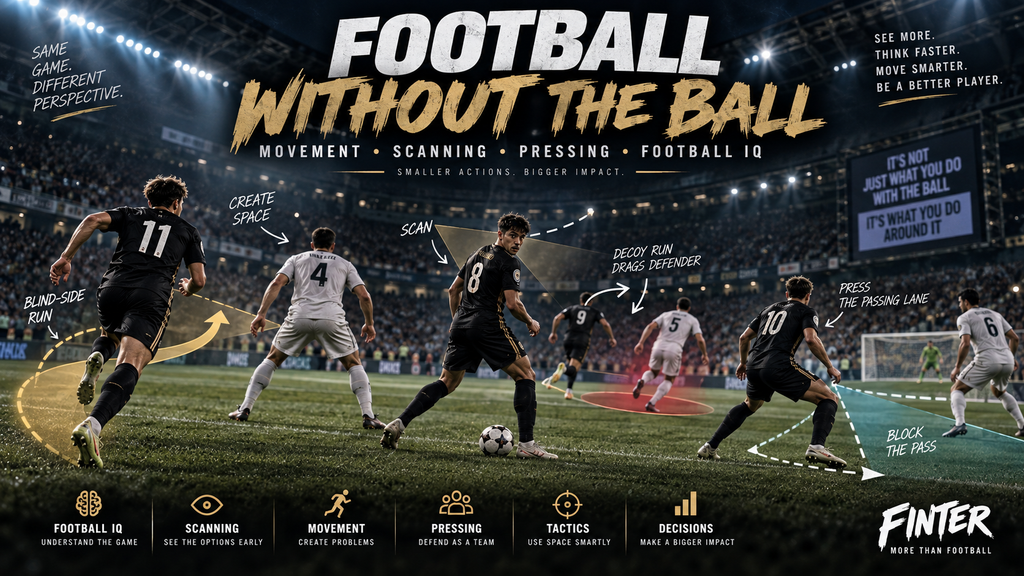
⚽🧠 Football Without the Ball
How the World’s Smartest Players Create Space, Press, Move & Control Matches Without Touching It
Watch a football match and your eyes naturally follow the ball.
But some of the most important actions happen somewhere else.
A run pulls a defender away. A midfielder scans before receiving. A striker blocks a passing lane. A winger stays wide and creates space inside. A teammate sprints knowing the ball may never arrive.
Welcome to the football that happens without the ball.
🌍 FINTER in English
FINTER has a dedicated English Front Page with football training, tactics, stories, player development, Football IQ, interactive tools and football history.
🤯 The Ball Is Only One Part of Football
Twenty-two players can be on the pitch. Only one player can possess the ball at any given moment.
That means almost everything else in football happens away from possession.
Players without the ball can still:
Move defenders away from useful areas.
Scan before becoming involved.
Force opponents to make decisions.
Create new routes through a defensive block.
Control where the opponent can play.
Cover spaces and support pressure.
Do not judge movement only by asking: “Did the player receive the ball?”
Ask: “What changed because the player moved?”
👀 Great Movement Starts Before the Run
Movement without information is often just running.
Before moving, elite players constantly collect information:
- Where is the nearest defender?
- Which teammate has the ball?
- Where is the free space?
- Which passing lane may open?
- Can the passer actually see me?
- Should I come short or run behind?
Continue on FINTER
Scanning is one of the foundations of intelligent off-ball movement.
→ Football Scanning Explained – Vision, Awareness & Decision Making
🔥 12 Ways to Dominate Football Without Touching the Ball
1. Scan Before the Ball Arrives
A player who looks around before receiving has already started solving the next situation.
Scanning can reveal:
- nearest pressure
- free teammates
- space behind the defender
- first-touch direction
- forward passing lanes
The feet execute the decision. The information often arrives first.
2. The Blind-Side Run
Defenders naturally watch the ball.
Smart attackers move into positions where the defender cannot comfortably see both the runner and the ball.
That area is often called the defender’s blind side.
The run becomes especially dangerous when the attacker waits, then accelerates at exactly the moment the passer can play forward.
3. The Decoy Run
Sometimes the best run is one that never receives the pass.
Imagine a striker sprinting toward the near post. A centre-back follows.
The ball is then cut back into the space the defender just left.
The first runner never touches the ball — but may have created the goal.
Who created more value: the player who made the final pass, or the runner who created the space?
Sometimes the correct answer is: both.
4. Moving After Passing
Passing should not end your involvement.
A player who passes and stops can become easy to mark.
A player who passes and immediately moves can:
- create a return pass
- drag a defender away
- create an overload
- open space for a teammate
Pass → move → scan → become useful again.
5. Staying Wide
Young players often move toward the ball because they want involvement.
Sometimes moving closer actually makes the attack worse.
A winger staying wide forces the defence into a choice:
- follow wide and open central space
- stay narrow and leave the winger free
Sometimes distance creates value.
6. Dropping Between the Lines
Attackers do not always need to run toward goal.
A striker or attacking midfielder can drop away from the defensive line into space between midfield and defence.
A defender now faces a difficult decision:
Follow and leave space behind?
or
Stay and allow the attacker to receive?
7. Third-Player Movement
Some of football’s smartest combinations involve a player who is not initially part of the obvious pass.
Player A passes to Player B.
While the defence reacts to A and B, Player C moves into the newly created space.
B then connects with C.
This is why the third player can often attack space before the defence reorganises.
8. Occupying a Defender
You do not always need to move a defender.
Sometimes keeping a defender exactly where they are creates value somewhere else.
A striker positioned between two centre-backs may prevent either centre-back from stepping into midfield.
The striker might barely touch the ball, yet their position influences the entire defensive line.
9. The Pressing Angle
Pressing is not just sprinting toward the opponent.
The angle of the run matters.
A forward can press in a curved path that:
- pressures the ball
- blocks a passing option
- forces play toward one side
One intelligent run can defend two options.
10. The Cover Shadow
A pressing player can use their body position to block a passing lane to an opponent behind them.
That invisible blocked area is often called the cover shadow.
The player pressures one opponent while making another difficult to reach.
11. Recovery Runs
Losing the ball does not end your involvement.
A recovery run can:
- stop numerical superiority
- protect the centre
- cover a teammate
- force the attack wide
- delay the counterattack
Some match-saving actions never contain a tackle.
12. Creating Space for Someone Else
The most intelligent movement sometimes makes another player look brilliant.
A midfielder moves away. A defender follows. A teammate receives in the space.
The runner gets no assist. No shot. No goal.
But the attack may not exist without that movement.
📊 Compare Different Types of Off-Ball Movement
| Movement | Main purpose | Problem for defender | Best moment |
|---|---|---|---|
| Run behind | Attack depth | Defender must turn toward own goal | When passer has time to play forward |
| Drop short | Receive between lines | Follow or hold position? | When centre-back is reluctant to step out |
| Stay wide | Stretch defence | Protect centre or width? | Against narrow blocks |
| Diagonal run | Cross defensive zones | Who tracks the runner? | When defenders must hand players over |
| Decoy run | Create space for teammate | Follow runner or protect zone? | Around the box |
| Third-player run | Attack new space | Runner arrives outside immediate focus | After combination play |
| Overlap | Create outside width | Track runner or ball carrier? | Wide attacking situations |
| Underlap | Attack inside channel | Runner appears between defenders | When winger stays wide |
| Recovery run | Restore defensive balance | Reduce transition space | Immediately after losing possession |
| Curved press | Pressure + block lane | Passing options disappear | When opponent receives facing own goal |
🛡 Football Without the Ball in Defence
Defensive intelligence is much more than tackling.
⚡ Press
Approach the ball with purpose instead of simply running.
🚪 Close the Lane
Position the body so the easiest forward pass disappears.
🛡 Cover
Support the teammate applying pressure.
⚖ Balance
Protect the opposite side if the attack switches direction.
🏃 Recover
Sprint toward the most valuable defensive space, not automatically toward the ball.
👀 Scan
Know where the runner is before the through ball or cross arrives.
⭐ Player Examples: What to Watch
The purpose here is not to rank players. Instead, use different elite players to study different off-ball behaviours.
Thomas Müller – Finding Space
Müller became famous for interpreting spaces that defenders struggled to control.
When watching him, do not focus only on the final touch. Watch:
- where he stands before the pass
- how late he arrives
- how defenders lose visual contact
- how he occupies spaces between positions
Erling Haaland – Depth & Blind-Side Runs
Study the timing rather than only the speed.
- When does the run begin?
- Which shoulder of “`